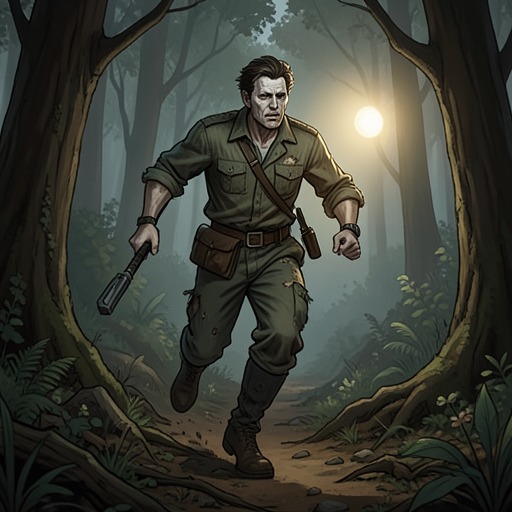
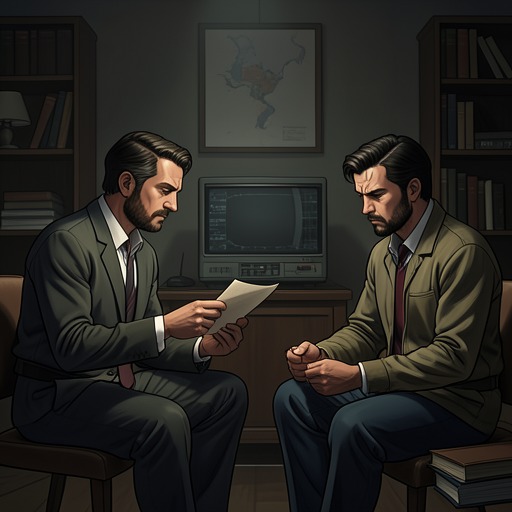
Wilmarth and Akeley’s Vermont investigation
The Colour Out of SpaceWilmarth and Akeley’s Vermont investigation transforms a folkloric debate into an inquiry supported by converging reports, physical traces, photographs, recordings, and personal testimony. What begins with Wilmarth’s effort to explain away the flood rumors becomes a correspondence with Henry Wentworth Akeley, a cautious scholar who insists that the old stories describe real presences in the hills. Their exchange unsettles Wilmarth’s skepticism and draws him toward the possibility that the legends and the recent sightings have a common, nonhuman source.
From flood reports to folklore
The investigation’s public beginning was the historic Vermont flood of November 3, 1927. Wilmarth, an instructor of literature at Miskatonic University and an amateur student of New England folklore, received newspaper accounts and reports circulating among acquaintances. After examining them, he judged that they referred chiefly to three sightings: one near the Winooski River by Montpelier, one on the West River in Windham County beyond Newfane, and one on the Passumpsic River above Lyndonville. Witnesses described pinkish, roughly five-foot forms with crustacean bodies, large dorsal fins or membranous wings, articulated limbs, and a mass of short feelers in place of a conventional head. Wilmarth initially reasoned that floodwaters had carried human or animal remains which local legend had made fantastic.
The older accounts gave the reports a wider context. Drawing on Eli Davenport’s rare monograph and tales he had heard in New Hampshire, Wilmarth knew traditions of a hidden race in remote forests, high slopes, and deep gorges. The stories associated the beings with claw-like tracks, stone circles, caves partly blocked by boulders, and rare twilight sightings. Some accounts described large, light-red crablike creatures with batlike wings, moving on many legs or using their forelimbs to carry objects. One reported a disciplined group wading three abreast through a woodland stream; another described a creature launching from a hill and disappearing into the night sky.
Local memory and public dispute
The traditions did not describe a single, unchanging relationship between the beings and human communities. In the older layer, they generally harmed people who intruded on their territory. Later stories spoke of disappearances beyond the most feared areas, prints near farmhouse windows, buzzing voices imitating human speech, and isolated people suspected of having become allies or agents. Such accounts helped explain why certain hills and valleys were avoided, even after the original reasons for keeping away had largely faded from memory. Settlements and customary routes followed safer, more familiar ground; in time, practical habit persisted where active fear had receded.
Accounts of the beings also varied across communities. Settlers sometimes understood them as devils’ familiars, while people with Celtic traditions connected them to malign fairies or hidden little people. Pennacook stories described winged visitors from the Great Bear who mined stone in earthly hills, carried it back to the stars, and generally left people alone unless watched or approached. Wilmarth knew these traditions as folklore and argued that similar hidden-race stories appeared across cultures, without proving the beings existed. His opponents countered that the consistency of the Vermont reports and the unexplored nature of the hills left room for an underlying fact.
The debate reached the press through letters to the Arkham Advertiser. The Rutland Herald printed extracts from both sides, and the Brattleboro Reformer reproduced one of Wilmarth’s historical and mythological essays. By spring 1928, he had become a familiar name to some Vermont readers despite never having visited the state. The exchange changed direction when Akeley wrote to challenge his conclusions. Wilmarth’s discussion of the legends had, in effect, created a public forum that brought him into contact with a witness who claimed to know the phenomena firsthand.
Akeley’s evidence and Wilmarth’s reassessment
Akeley was not simply another advocate of the legends. The last local representative of a distinguished family, he had studied mathematics, astronomy, biology, anthropology, and folklore at the University of Vermont. Wilmarth regarded him as educated, intelligent, and notably willing to keep his conclusions tentative. Though he initially believed Akeley mistaken, he did not accept the suggestion that fear of the hills made him insane. Akeley’s proximity to the reported events, and his readiness to distinguish observation from inference, made his claims more difficult to dismiss.
In his first account, Akeley reported tracks near his home on Dark Mountain and voices heard in the woods. He had taken a phonograph equipped with a dictaphone attachment to a location where the voices were often reported and obtained a recording. Older local listeners recognized one sound as resembling the buzzing voice in inherited stories. Akeley treated the recording as evidence to be assessed rather than demanding that Wilmarth accept his explanation. He also described the beings as visitors from another planet who mined metals beneath the hills, and warned that curiosity could be dangerous. Publicly, Akeley continued to support Wilmarth’s skeptical position; privately, he said that the subject should not be publicized in a way that encouraged people to visit the places he had explored.
Akeley’s photographs further altered Wilmarth’s view. The clearest image showed a claw-like print in an upland mud patch, with pebbles and grass providing a scale that, in Wilmarth’s judgment, made a simple double exposure unlikely. He described its central pad and opposing pairs of saw-toothed projections, while acknowledging uncertainty about whether it was strictly a walking organ. Other pictures showed swamp and hill country, a blurred mark near Akeley’s house, and the farmhouse itself, with large dogs on the lawn. These images did not establish Akeley’s explanation, but they persuaded Wilmarth that something beyond ordinary knowledge had left traces in the Vermont hills.
A much longer letter supplied the background to Akeley’s claims: transcripts of voices, accounts of pinkish forms seen at twilight, and a cosmic history he had developed through scholarship and information from a man who had claimed to be a spy for the beings. Wilmarth was struck by both the extraordinary scale of the account and Akeley’s controlled manner. The letter ended Wilmarth’s public participation in the debate. In private, he began to take seriously the possibility that the legends and flood reports contained a factual core, and he shared Akeley’s concern that people should stay away from the remote hills.
Correspondence, recording, and the limits of proof
During late May and June, Wilmarth and Akeley exchanged letters to compare mythological material and look for connections between the Vermont reports and traditions from elsewhere. Some letters went missing, forcing them to repeat earlier work. They came to associate the Vermont beings with the Mi-Go described in Himalayan lore. Akeley also directed their attention to the hieroglyphs on a black stone, which they hoped to decipher. The inquiry therefore moved between different kinds of evidence: inherited accounts, contemporary reports, physical marks, images, and an object whose inscriptions might, they suspected, disclose more than folklore alone could explain.
Akeley’s recording provided a particularly concrete, but imperfect, link between story and investigation. He said he had made it at about one in the morning on May 1, 1915, near a blocked cave mouth on the western slope of Dark Mountain above Lee’s Swamp. He had chosen May-Eve because European underground traditions made that night seem especially promising. The apparatus captured only fragments: one voice seemed human and cultivated, while another spoke grammatical English in a buzzing sound Akeley considered unmistakably inhuman. Its remote, muffled recording conditions left room for doubt, but the medium also gave Wilmarth something that could be replayed and examined rather than merely remembered.
That evidence did not make the investigation straightforward. Akeley’s account of a dead creature found near his kennel described a body that disappeared within hours; his attempt to photograph it yielded only the woodshed on the developed film. He also connected the creature’s disappearance to the flood reports, whose strange forms had likewise been seen on the first morning after the waters rose. The failures of physical preservation and photography reinforced the central difficulty of their inquiry: witnesses could report what they saw and touched, yet the evidence did not remain available for ordinary inspection.
The investigation reaches Wilmarth in person
The correspondence eventually led Wilmarth to Akeley’s isolated farmhouse. There, the subject of travel by the Outside Beings became more than a speculative claim. Akeley explained that they could transport human brains in metal cylinders, preserving the bodies elsewhere and connecting the brains to instruments that reproduced sight, hearing, and speech. In this account, a brain could travel through interstellar space and continue to communicate through mechanical sensory equipment.
Wilmarth then heard one such device speak. Its voice was metallic, lifeless, and deliberate; it identified itself as a human being whose body was being maintained at Round Hill while its brain communicated from a cylinder. The speaker claimed to be allied with the Outside Beings and to have travelled to many celestial bodies. The encounter did not simply confirm every part of Akeley’s explanation, but it brought the investigation beyond folklore, testimony, and photographs into a direct confrontation with the technology Akeley had described.
The inquiry’s significance lies in this accumulating change of scale. Flood rumors first appeared to Wilmarth as familiar folklore attached to a natural disaster; the inherited stories then offered a map of places people had avoided, and Akeley’s evidence made that map newly unsettling. Their investigation does not resolve every uncertainty by conventional proof. Instead, it shows how each medium and witness alters what can be considered: community memory gives the reports a history, photographs make a trace materially persuasive, recordings preserve a voice while limiting its context, and the mechanical speaker turns an account of distant travel into an immediate presence.