Wilmarth escapes Akeley’s farmhouse
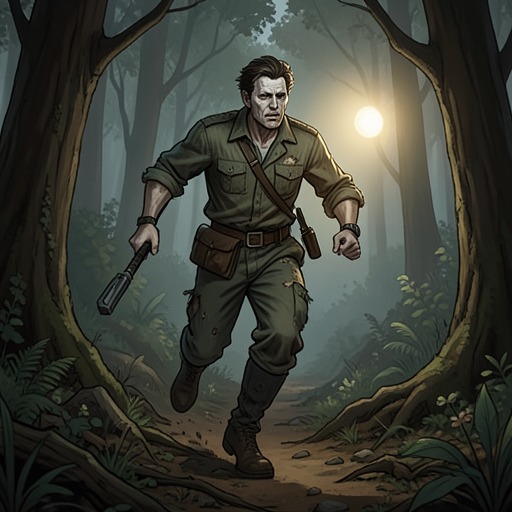
The Colour Out of SpaceAlbert N. Wilmarth’s escape from Akeley farmhouse turns a bewildering absence into a desperate flight. The empty chair, the clothes and bandages left behind, and three unsettling constructions give Wilmarth grounds to fear that the person he believed was Henry Wentworth Akeley has vanished—or may not have been what he seemed. He leaves with his flashlight, valise, and revolver, reaching Townshend in an old Ford and carrying the terror of the encounter with him.
The Empty Chair
After searching the dark study with his flashlight, Wilmarth finds the great easy-chair empty. The familiar dressing-gown trails from the seat to the floor; nearby lie the yellow scarf and the huge foot-bandages that had seemed strange to him. Their presence makes the absence harder to explain: the sick-room garments remain, but their supposed wearer is nowhere in sight.
The room’s sensory disturbances have also stopped. The queer odour and vibration that had been strongest near Akeley are no longer present. Wilmarth recognizes that they had been confined to Akeley’s vicinity, or to the space just outside the room. Their disappearance alongside the occupant sharpens the mystery without resolving it.
When his flashlight returns to the chair, Wilmarth notices three objects partly concealed by the folds of the discarded gown. They are not visually horrifying in themselves; their force lies in what they suggest. Wilmarth sees them as clever constructions fitted with metallic clamps, apparently intended to attach to organic structures. He hopes they are waxworks made by a gifted artist, but cannot dismiss the more disturbing possibility that they are connected to Akeley’s disappearance. The investigators who later visit the farmhouse do not find them.
Flight from the Farmhouse
The sight of the empty chair and its concealed objects breaks Wilmarth’s hesitation. He lets out a muffled shriek, a sound that must disturb Noyes, the sleeping sentinel across the hall, though it does not quite wake him. Noyes’s still-unbroken snore is the last sound Wilmarth hears inside the farmhouse.
In a wild scramble, Wilmarth manages to keep hold of his flashlight, valise, and revolver. He gets out of the room and the house without making another noise, reaches the old Ford in the shed, and drives into the black, moonless night. He has no settled destination, only the need to reach safety. The journey feels delirious, but he eventually arrives in Townshend.
Aftermath and Uncertainty
Wilmarth presents the escape as the end of his time in the farmhouse, but not as the end of his fear. He doubts whether his sanity has remained intact and worries about what the years may bring, especially after the discovery of Pluto. Even in retrospect, he has moments of near-scepticism, when he is tempted to attribute the experience to dreams, nerves, and delusion.
That uncertainty is bound to the objects he leaves behind in the chair. Their appearance offers no decisive proof, yet their clamps, the absent wearer, and the vanished odour and vibration converge into an inference Wilmarth cannot comfortably accept or wholly escape. The flight therefore provides physical safety without settling what happened to Akeley: Wilmarth gets out of the farmhouse, but the meaning of the empty chair follows him.