Yith
The Colour Out of SpaceYith is described as an obscure world far beyond the Milky Way and the ancestral home of the minds that became the Great Race of Yith. It is not the Great Race’s later home on Earth: its history begins with minds departing a dying world, and its significance rests on that separation between a civilization’s mental inheritance and the bodies it successively inhabits.
Cosmic location and condition
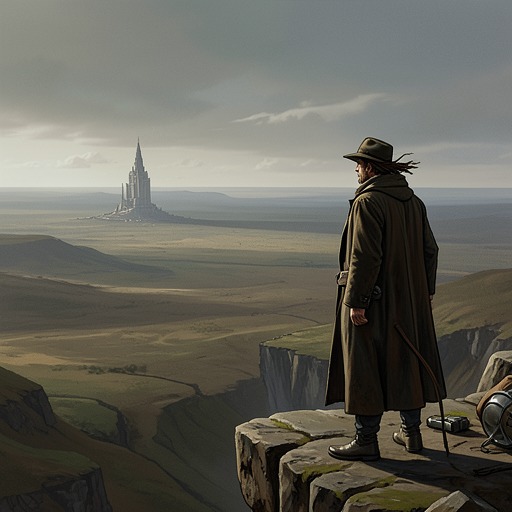
The account places Yith in far space, calling it a black, aeon-dead orb whose civilization had already reached the end of its world. The name itself comes through the disturbing and debatable Eltdown Shards, so the narrative offers no direct view of Yith’s landscapes, cities, or inhabitants. What can be reconstructed is chiefly its condition at the moment of departure: an elder world facing death, whose beings possessed knowledge they hoped to preserve beyond their own bodily lifespan.
The Great Race of Yith’s mental heritage is said to be older than its earthly form. Its origin is therefore not a simple account of a people travelling bodily from one planet to another. The beings of Yith sent their minds forward in time, seeking a future species capable of sustaining them; Yith remains the source of those minds even after the bodies that house them have changed.
Migration and temporal history
The migration from Yith was collective. Its inhabitants sent their minds en masse into the cone-shaped beings that lived on Earth about a billion years ago. The transfer saved the minds while leaving the bodies of the Yithian beings behind to die in unfamiliar forms. On Earth, the incoming minds became the Great Race of Yith, a civilization whose identity depended less on a single body or world than on its capacity to move through time and adopt new physical hosts.
That migration was not the final one. The Great Race would eventually face death again and send its best minds onward into the bodies of a future beetle species, chosen because they offered a longer physical span. Yith is thus the beginning of a chain of survival rather than the permanent seat of an immortal civilization: each migration preserves a mind by surrendering the body and world it once knew.
Legends and earthly traces
Other traditions in the narrative also describe beings that did not originate on Earth, but they should not be treated as direct accounts of Yith. Pennacook myths, for example, tell of the Winged Ones coming from the Great Bear, mining earthly hills for a rare stone, and returning to their stars. These stories share a broad idea of nonterrestrial visitors with the account of Yith, yet give those visitors their own origin and activities; the text does not identify them as the minds that formed the Great Race of Yith.
The Australian material offers a different kind of connection to the ancient history associated with the Great Race: evidence of a lost world on Earth, not a description of Yith itself. A correspondent reports weathered, carved stones in the Great Sandy Desert, while local traditions recalled enormous underground stone dwellings and a place feared for what lay beneath it. When the expedition reaches the site, the narrator’s dreams and the sight of ancient masonry converge, lending physical weight to a past previously approached through legends and conjecture. These earthly remains do not reveal Yith’s appearance; they make the vast interval between its migration and the later history of Earth more tangible.
Narrative significance and limits
Yith is a place established through fragments: a disputed ancient text, an account of a dying civilization, and a history inferred from minds that survived by changing bodies. The absence of a direct description keeps the world itself distant, while the migration story gives that distance consequence. Yith is not merely an extraterrestrial point of origin; it is the first stage in a history that unsettles ordinary boundaries between a person and a body, a civilization and its planet, and survival and continuity.