Yuggoth
The Colour Out of SpaceYuggoth is described as a nearly lightless world beyond Neptune, associated with the Outer Beings and with their long history on Earth. First presented to the narrator through Henry Wentworth Akeley’s account of an immense cosmic history, it is more than a distant destination: it is a threshold between Earth and a domain that exceeds human ideas of space, time, and life.
Position and Cosmic Role
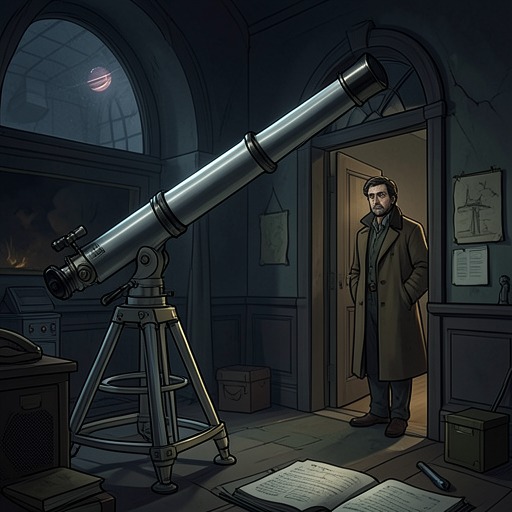
Akeley identifies Yuggoth as the ninth planet from the Sun and the Outer Beings’ principal immediate abode. Though thought to be undiscovered, it is expected to become perceptible to astronomers when the beings direct thought-currents toward Earth. The account thus makes its discovery seem less like an independent scientific achievement than a disclosure the beings can permit or arrange, perhaps with help from a human ally.
Yuggoth is also only a stepping-stone. Akeley describes the beings’ wider habitat as abysses beyond the reach of human imagination, where the space-time universe humanity takes for the whole of existence is merely an atom within a greater infinity. His account places Yuggoth within a cosmic history of immense age: the beings were on Earth before the epoch associated with Great Cthulhu had ended, and remembered R’lyeh when it stood above water. The narrator’s first encounter with this history comes through Akeley’s letter, whose scholarship and accumulated testimony move him from skepticism toward belief in the scale of the claims.
Cities and Environment
The world Akeley expects to visit contains vast cities formed from tiers of terraced towers built of black stone. Akeley says the specimen he had tried to send the narrator came from Yuggoth. The cities and temples have no windows: the beings need no light, and ordinary light is said to hamper and confuse them. Their world is therefore presented not simply as dark to human eyes, but as a place whose conditions and architecture reflect senses and needs unlike humanity’s.
Akeley also describes fungoid gardens and black rivers of pitch running beneath enormous bridges. He attributes the bridges to an elder race that had become extinct and forgotten before the Outer Beings came to Yuggoth from the ultimate voids. These features make the planet a layered place: its built environment preserves traces of an earlier inhabitants’ history, while the beings who now occupy it are themselves understood as arrivals from beyond the familiar cosmos. Akeley anticipates travelling there, though his account stresses that the world’s strangeness would be difficult for a human visitor to endure and report.
Connections to Earth and the Narrative
Yuggoth’s relationship to Earth extends beneath the planet’s surface. Akeley says the Outer Beings have explored the Earth and that hidden openings lead to extensive underground worlds, including passages in the Vermont hills. He names blue-lit K’n-yan, red-lit Yoth, and black N’kai among these regions. In his account, Earth is neither isolated from the beings nor fully known to its own inhabitants; the Vermont landscape becomes one point of access to a much wider, concealed geography.
The narrator later connects Yuggoth to Pluto after reports that a ninth planet beyond Neptune has been glimpsed and given that name. He regards the coincidence as confirmation of Akeley’s account, while remaining troubled by the possibility that the beings have a reason for allowing the planet to become known at that particular time. The identification does not explain their purpose; it sharpens the narrator’s uncertainty about what their growing contact with Earth may mean. Yuggoth consequently occupies a double role in the narrative: it is a concrete astronomical location in the narrator’s account and a threshold onto an incomprehensible order of existence.