A princess never has a choice
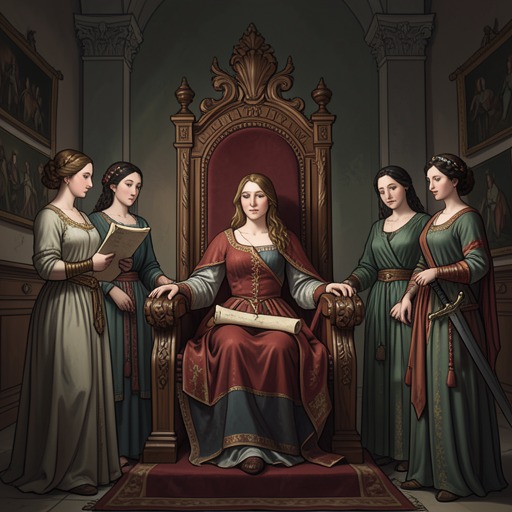
The Constant Princess“A princess never has a choice” is a recurring principle of dynastic life in Catalina’s story, but not a simple claim that royal women have no agency. It describes how survival, recognition, marriage, and inheritance are organized around the will of rulers and the needs of a dynasty. Catalina accepts that constraint as part of her destiny, then uses the authority she gains to govern. The expression therefore holds two realities together: a princess may have little freedom to choose her position, yet still shape what she does from within it.
The expression and the marriage dilemma
The idea is stated most directly in a conversation about a York princess whose circumstances left few alternatives. Harry Tudor explains that her father was dead and her mother was an enemy of the king, confined in sanctuary. To remain alive and be acknowledged as a princess, she needed the king’s favor; to become Queen of England, she would have to marry him. Catalina suggests that she might have raised an army, but Harry answers that this was not a practical route to becoming queen. The argument treats marriage not as a private preference but as the available political means of securing recognition and a future.
Catalina draws the comparison toward herself. She gives thanks that her own destiny brought her to marry Harry, and he responds that they would have married and she would have become queen whether or not she had liked him. Her assent culminates in the expression’s plainest form: “There is never a choice for a princess.” The exchange is intimate, but its subject is structural. Even a marriage both of them welcome is described as something that royal status would have required regardless of personal feeling.
Dowry, widowhood, and restricted alternatives
The constraints are not only ceremonial or emotional; they are also financial. During the dispute over Catalina’s dowry, she identifies the disagreement as a source of Henry VII’s displeasure. The Spanish king had agreed to a substantial payment but sent only half in money, suggesting that the remainder could be represented by the plate and treasure Catalina brought with her. Henry VII demanded the balance. At Ludlow Castle, her household used that plate, and the wear from ordinary meals threatened to reduce its value. Catalina was caught between two rulers negotiating over the terms of her marriage and the goods attached to it.
After Arthur’s death, her choices are again framed by money and the possibility of pregnancy. In a letter, Isabella of Castile instructs Catalina to remain where she is until she knows whether she is carrying a child. If she is not, she is to seek her jointure as Dowager Princess of Wales and leave for Spain only after receiving the full amount. If she is pregnant, she is to secure her allowance, arrange for the dowry to be paid in cash, and rest in the hope of a son. The letter is presented as a queen’s business with a princess, not as maternal comfort. It defines Catalina’s immediate paths through her reproductive status, her allowance, and the settlement owed to her.
Dr. de Puebla explains that the jointure amounts to a third of the revenues of Wales, Cornwall, and Chester, while Catalina’s parents are also asking for the return of her dowry. She doubts that Henry VII will pay: he had not reliably paid her allowance even while Arthur was alive, and she sees little reason he would now return the dowry and grant the jointure. The contract gives her a claim, but not assurance that it will be honored. Her widowhood thus makes the expression materially concrete: legal terms may specify what is owed, while her security and movement remain subject to negotiation between rulers.
From constrained princess to ruling queen
Catalina’s later authority does not erase those earlier limits; it shows what she can make of the position they produced. When Margaret Beaufort dies, the court lacks a clear plan for the funeral. Catalina summons the Duke of Buckingham and Margaret Pole, consults the Royal Book, and finds handwritten instructions Margaret Beaufort had prepared for her own burial. Catalina reduces the scale of the proposed arrangements and gives the orders herself. The quiet ceremony makes her command visible before her coronation, and the court recognizes that the princess who had waited for years has learned how to rule.
At her coronation, Catalina is carried from the Tower to Westminster in a cloth-of-gold litter drawn by four white palfreys. After Henry VIII is crowned, she receives the anointing, takes the scepter and ivory wand, and sits on a throne slightly lower than his. The ceremony fulfills the queenly destiny she has long anticipated, but it also makes her body and office part of the public authority of the monarchy. The expression’s lack of choice is answered not by escape from dynastic forms but by Catalina’s ability to inhabit them and claim their power.
That authority becomes practical in government. Catalina consults advisers and works with the Privy Council toward a more unified kingdom, considering the reach of law, coastal defenses, ships, and army musters. She understands this work as learned from her parents and as a return to the political education of her childhood. When Henry VIII gives her the Great Seal of State at Dover and appoints her regent, governor of the realm, and captain general for home defense, the formal delegation turns her queenly standing into executive command. She chooses to make the defeat of the Scots her first priority.
Meaning and limits
The expression is therefore neither a rejection of Catalina’s later achievements nor proof that royal women simply submit. It identifies the narrowness of the choices made available to a princess: marriage secures status, widowhood activates contractual claims, and the prospect of an heir shapes the instructions governing her future. Catalina’s ascent depends on those same dynastic structures. Her marriage makes queenship possible; coronation confirms it; appointment as regent gives her power to act in the king’s absence.
The contrast between prescribed role and practiced rule is the expression’s central tension. Catalina does not choose the political conditions into which she is born, nor can she assume that promises of money will be kept. Yet as queen she organizes a royal funeral, advises on administration, and takes charge of national defense. “A princess never has a choice” captures the constraint; Catalina’s story also shows how authority may be won and exercised inside it.