Alhambra
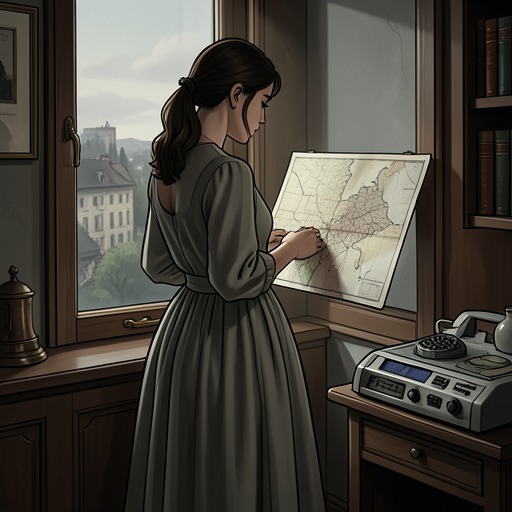
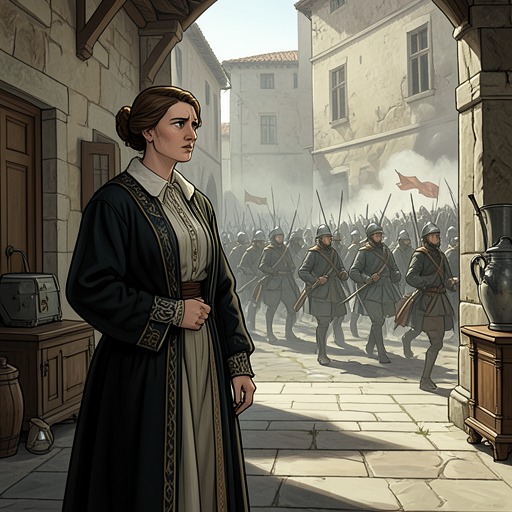
The Constant PrincessThe Alhambra is Catalina of Aragon’s lost home: a palace and fortress in Granada whose remembered gardens, architecture, and surrounding landscape shape how she experiences England. In her recollections it is more than a contrast to the places where she lives; it holds her childhood, her parents, and the possibility of being at home. As her political future becomes uncertain, the Alhambra increasingly survives in memory and dreams, while Catalina’s sense of identity changes around the impossibility of returning to it.
The Palace in Catalina’s Memory
Catalina introduces the Alhambra to Arthur, Prince of Wales, through details that resist the English expectation that grandeur must announce itself at the entrance. The first doorway, she explains, opens onto a space no larger than a small merchant’s hall. Its modest scale conceals the palace beyond: a building whose beauty does not depend on an imposing first impression. The contrast lets her describe the Alhambra as a place to be understood by entering and looking, rather than judged from outside.
Her account of its garden is especially precise. The hedge is not ragged but cut straight, like a wall or a block of green marble. At the far end, a gateway, its arch, and the building around it appear reflected in water. Light screens of stucco pierce the walls, and the birds belong to the scene as another feature of the garden. These remembered arrangements make the place legible through shape, reflection, and relation: walls frame views, water returns an image, and delicate screens distinguish the palace from the heavy stonework of a fortress.
The Alhambra also belongs to a larger landscape. In one dream, Catalina flies as a swift over New Castile and south toward Granada, crossing hills and reaching the rosy walls of the Alcázar, the fort enclosing the palace. She skims the square watchtower where the flag of the sickle moon once flew and circles the Court of Myrtles, with its stucco and tile buildings and water. From above, the remembered palace is at once enclosed and open to its setting: a protected place approached through a broad imaginative journey across Spain.
England Measured Against Home
Catalina’s arrival at Ludlow sharpens the difference between her former home and her new surroundings. She had imagined a city contained within defended walls, with gardens, terraces, a hill, and a busy centre; the circuit of the Alhambra’s battlements would take guards more than an hour, while a sentry at Ludlow could complete a circuit in minutes. She does not tell Arthur that she had been thinking of the Alhambra, choosing instead to mention Richmond. Her restraint preserves his reassurance that Ludlow is a welcoming town, even as she silently sets its scale against a palace built with beauty in mind.
The contrast returns in her account of London. Looking through the gate at Durham House, Catalina sees a prosperous city filled with commerce and the bells of churches. Yet the street contains none of the features she associates with home: no veiled women, flower sellers, spice sellers, herbalists, physicians, or astronomers pursuing their trades in the open, and no movement to prayer at the mosque. The comparison is not simply between a small town and a great city. London may be wealthy and confident, but its public life does not resemble the world Catalina has left.
The difference becomes physical in her memories of weather and season. During a cold, rainy English winter, she misses the warmth and growth she associates with Spain. In her imagination, water in the Alhambra’s canals begins to flow again as the frost releases, gardeners plant flowers and young trees, and farmers turn the red soil. The seasonal picture gives her longing a calendar: while England’s winter seems to linger, the gardens at home are already moving toward spring. The Alhambra is therefore not only a fixed childhood scene but a place she imagines continuing to live and change without her.
Exile, Memory, and a New Home
In the spring of 1502, Catalina longs for her parents to see her happiness with Arthur and wonders whether she might visit Spain. She cannot bear to be away from him, but fears that without such a journey she may never again touch her mother’s hand or see her smile. Her position as Princess of Wales and future Queen of England, which she has accepted as an honour, now reveals its cost: England is to be her home, perhaps permanently. The Alhambra represents not a simple destination she can choose to revisit, but a family life and former home increasingly separated from her by royal duty.
That separation appears in her dreams as well as her waking recollections. In one dream, she flies back to the Alhambra and sees her mother, Isabella of Castile, walking in the evening and thinking of her daughter far away in England. Later, a flight that seems to lead toward Ludlow Castle resolves instead into Windsor Castle and the River Thames. Catalina recognizes that she is far from Spain but also decides that England will become home. The swift becomes an image for this changed identity: a bird associated with flight and distance, now imagined as belonging among English towers. She will no longer be Catalina, the Infanta of Spain, but Katherine of Aragon, Queen of England, as Arthur named her.
The Alhambra does not disappear when Catalina accepts that transformation. Before her betrothal to Prince Harry, she dreams of walking there with Arthur, showing him the enclosing sandstone wall, Granada below, and the snow-capped mountains on the horizon. In the dream she understands her future as the completion of what she, her mother, and Arthur desired. The palace becomes the setting in which she can still address Arthur and imagine his approval, even though her life is being decided elsewhere.
A Place of Loss and Moral Comparison
After years of waiting in England, Catalina continues to imagine the Alhambra’s gardens, water, and returning spring. She describes her love for Arthur and her longing for Spain as the two feelings that remain most alive to her. The garden of al-Yanna, the paradise garden, joins remembered home to a spiritual hope and to the prospect of reunion with Arthur. In this later vision, the Alhambra is both a particular place she misses and an image of a refuge beyond the losses of her present life.
The palace also informs Catalina’s judgment of events far from Granada. When Edward Howard’s body is returned after the French have treated it as spoil, she recalls Hernando Pérez del Pulgar’s daring raid on the Alhambra. She does not claim that the Moors actually captured him or describe an event that did not occur. Instead, she imagines that they would have recognized him as a formidable enemy, returned his body with honour, and commemorated him in song or in a fountain. Her comparison reverses the expected distinction between Christian and Moorish conduct: the Christians’ treatment of Howard makes her ashamed to call the Moors barbarians.
Across these memories, the Alhambra retains a double meaning. It is a real home with an entrance, fortress walls, courtyards, gardens, and a place within Granada; it is also the measure by which Catalina recognizes what exile has cost her. Its details return in conversation and dreams, but that recurrence cannot restore the life she left. The palace endures instead as a remembered world that accompanies her as she becomes Katherine of Aragon and makes England her home.