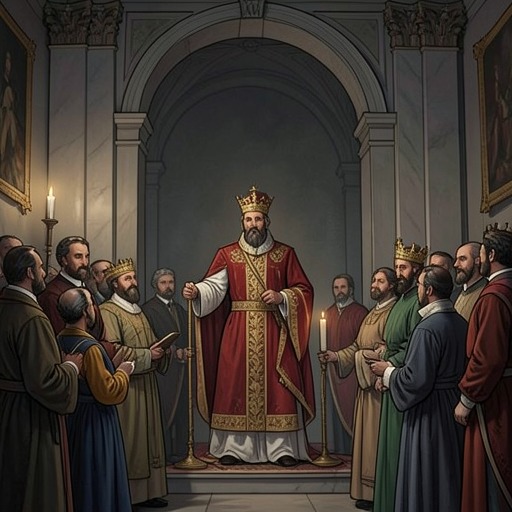
Betrothal of Henry, Prince of Wales, and Catherine of Aragon
The Constant PrincessThe Betrothal of Henry, Prince of Wales, and Catherine of Aragon joined Catalina of Aragon to the boy who would become Henry VIII, after the death of his elder brother Arthur had transformed her marriage prospects. Celebrated at Whitehall on 25 June 1503, it was both a royal family arrangement and a diplomatic bargain. Its vows promised a future union; they did not secure its timing, its financing, or the consent required to make it possible.
A dynastic arrangement after Arthur
After Arthur’s death, Catalina’s future was bound up with the question of whether she could marry his younger brother. The claim that her marriage to Arthur had not been consummated became crucial to that possibility: affinity could otherwise stand as an impediment, and Catalina’s proposed remedy was to seek a papal dispensation. The legal question was not merely private. A marriage between the widow of one prince and his brother could continue the alliance the families had negotiated, but it required church approval and the cooperation of the royal parents.
A separate proposal by Henry VII to marry Catalina had also brought the affinity issue into sharp focus. Rodrigo Gonsalvi de Puebla warned that, even if the marriage with Arthur had not been consummated, a dispensation would still be needed; without the parents’ agreement to seek one, the proposed marriage could not proceed. The eventual betrothal of Catalina to Harry therefore depended on more than the prince’s assent. It rested on a contested account of the previous marriage and on decisions made by adults and rulers beyond the young couple.
The Whitehall ceremony
On 25 June 1503, Catalina and Harry appeared before the Bishop of Salisbury with a small court in attendance: Henry VII, Margaret Beaufort, Mary Tudor, and a few other witnesses. Catalina was twenty-one; Harry was eleven. The ceremony placed her hand in the child prince’s and made their future marriage a public commitment before the royal household.
Harry had been coached by his grandmother and knew how to perform his part, but he was not prepared for the meaning of the arrangement. He asked whether the betrothal meant they would marry when he was fifteen. Henry VII corrected the age to sixteen, noting that Arthur had been fifteen. Harry repeated his oaths, while the narration presents him as scarcely understanding the life those oaths would shape.
For Harry, the ceremony also recast the family’s loss as his own elevation. Arthur was gone; Harry was now Prince of Wales, his father’s favorite, and pledged to Arthur’s bride. The betrothal made Catalina a princess again, but it did not erase the difference between the adult widow she was and the boy to whom she was promised.
Law, dowry, and dependency
The promise was entangled with a financial dispute that had already strained relations between the two royal houses. Catalina told Margaret Pole that Henry VII was displeased over the dowry. The agreed sum had not arrived in full: her father had sent only half, proposing that her household plate and treasure make up the remainder, while Henry demanded the balance in cash. At Ludlow Castle, Catalina’s household used her gold plates, diminishing their value and strengthening Henry’s position in the dispute.
The negotiations also concerned Catalina’s support if she remained a widow. Her mother’s instructions made her next steps conditional: if she was not pregnant, she was to demand her jointure and return to Spain only after receiving the money; if she was pregnant, the dowry was to be paid in cash and at once, and she was to claim her allowance and hope for a boy. Rodrigo Gonsalvi de Puebla later explained that the jointure amounted to a third of the revenues of Wales, Cornwall, and Chester, while Catalina’s parents were also seeking the return of her dowry. She doubted Henry would pay what the contract required, or grant the revenues, and recognized how little practical leverage she had over the king.
The six-year wait and eventual fulfillment
The betrothal was not promptly followed by marriage. Catalina said that the unpaid dowry and Henry VII’s hostility left her unable to compel the English to honor the agreement; Harry was still a child, and she rarely saw him. As he passed from fourteen to fifteen and then sixteen and seventeen, she waited, increasingly isolated and poor. She turned the panels of her gowns, sold jewels, and pawned her plate to feed herself and her household, knowing that each piece sold set the promised wedding further away.
The commitment was finally fulfilled after Henry VII’s death. On 24 June 1509, Catalina was carried from the Tower to Westminster in a gold-cloth litter borne by four white palfreys. Harry, now Henry VIII, was crowned first; Catalina was then anointed and crowned Queen of England. The long-delayed marriage had become a royal union, and the princess who had remained constant through years of uncertainty took her place beside the king. The betrothal’s enduring significance lies in that distance between promise and fulfillment: a ceremony performed by a child began a political and personal future that Catalina had to wait, negotiate, and endure years to reach.