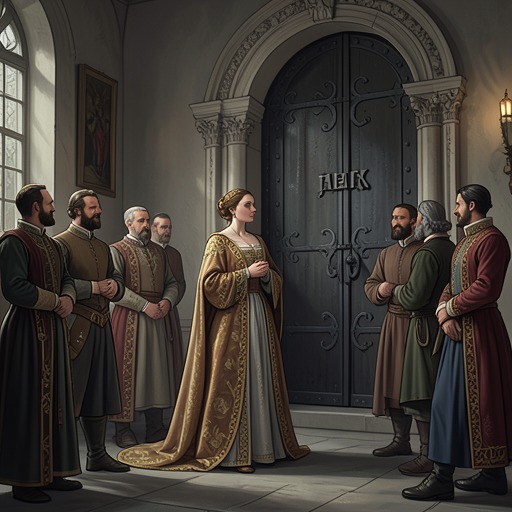
Born to be Queen of England
The Constant PrincessBorn to be Queen of England is the conviction that gives Catalina’s years of uncertainty a direction. Raised for a royal destiny, she treats the title not as a prize that others may grant or withdraw, but as the purpose for which she has been prepared. The phrase changes with her circumstances: it first resists her removal from the English court, then helps her negotiate a marriage, and finally becomes a claim tested by the institutions and people who can determine whether she may keep her place.
Origin of the Claim
After Arthur, Prince of Wales, dies, Catalina faces the prospect that her future will be decided by others. At the gate of Durham House, she compares the unfamiliar city outside with the world she has left behind, but refuses to treat homesickness as consent to return. She says, “This is my home now,” and declares, “My parents should not think that they can change my destiny.” Her claim to be born for England’s crown is also a demand not to be cast off after her first marriage has ended.
The expression is rooted in her upbringing, not in a sudden response to widowhood. When Doña Elvira suggests that being a widow need not prevent a good match, Catalina insists that she does not want simply “someone.” She recalls that Arthur’s greatest wish was for her to become Queen of England, and tells Doña Elvira to report that she remains a virgin. The insistence on her future title thus appears alongside the contested account of her marriage: both are bound to the possibility of marrying again within the English dynasty, rather than being sent away to another household.
Catalina’s mother, Isabella of Castile, gives the aspiration a religious and familial frame. In a letter that takes weeks to arrive and has been opened, Isabella agrees that Catalina’s destiny is to be Queen of England and calls it God’s will as well as her own wish. Yet the instruction is to be patient and avoid offending the king or his mother. Catalina answers by appealing to the identity in which she was raised: “I am Princess of Wales,” and says that she was born to be Princess of Wales and Queen of England. The gap between the certainty of the declared destiny and the uncertainty of its realization becomes a source of spiritual loneliness; on Arthur’s death anniversary she asks God why, if the outcome is His will, it does not happen at once.
Destiny Meets Political Bargaining
The claim carries practical force because Catalina’s future is subject to negotiations between royal families. Henry VII recognizes that she believes herself born to be Queen of England and sees a second English marriage as a way to preserve the alliance. His mother, Margaret Beaufort, dismisses Catalina as a fool, but Henry replies that she was raised to be a queen from childhood. In this exchange, the expression is both a personal conviction and a political fact that others can use when considering her marriage.
When Henry VII proposes marriage to Catalina himself, she says that she was brought up for the role and wants nothing more. She calls queenship “nothing more than my due” and accepts his promise to make her Queen of England, with marriage dependent on a dispensation from the Pope. The negotiations turn on whether her marriage to Arthur was consummated. Dr. de Puebla confirms the claim that it was not, while raising the possibility of an objection on grounds of affinity; Henry VII says he will apply for a dispensation. The expression therefore does not operate alone: its fulfillment depends on church authority, diplomatic consent, and a disputed account of Catalina’s first marriage.
When the prospect of marrying Prince Harry is delayed because he is considered too young, Catalina sees marriage to Henry VII as the available route to her purpose. She speaks of becoming Queen of England and mother of its next king, and links that future to promises made to her mother and to Arthur: defending the country against the Moors and the Scots, and making it a place of justice and fairness. Her ambitions are not confined to possession of a title. She imagines queenship as a charge to govern and protect, even while accepting a match she says she must force herself to take.
Fulfillment and Its Bodily Stakes
The long wait ends at the coronation on 24 June 1509. Catalina is carried from the Tower to Westminster in a cloth-of-gold litter, wearing white satin and a pearl coronet. Henry is crowned first; then Catalina receives the holy oil, takes the sceptre and ivory wand, and becomes an anointed queen. The public ceremony confirms what she has repeatedly claimed: she has taken her place at last. Her seat is slightly lower than Henry’s, but the crowd cheers for her as well as for the new king. The expression has moved from private insistence to visible, sacred office.
The coronation does not make the destiny simple or secure. In January 1510, Catalina wakes in pain and finds that she is losing a child. She knows the child is lost before the attendants arrive; after a long day, a daughter is born dead. Her grief includes the thought that she has failed the country, Henry, her homeland, and Arthur. The episode places the royal body at the center of the promise: the queen’s title carries expectations of succession, while pregnancy and loss expose the vulnerability of the person expected to fulfill them.
Reassertion and the Final Test
When Henry VIII sails for France, he appoints Catalina regent, governor of the realm, and captain general of the forces for home defense. The great seal is used in the ceremony at Dover. Catalina understands the appointment as more than a temporary honor: she has become more than Princess of Wales and Queen of England, entrusted with the country’s government and defense. The regency gives her claim a governing dimension, though its authority is exercised in Henry’s absence and by his appointment.
Years later, the words’ confidence is tested in the court proceeding over her marriage. Catalina knows that the court expects her not to answer when her name is called, and that she has prepared no defense because she does not recognize its authority. She enters anyway. Her case depends on Henry’s unwillingness to challenge the account she has maintained: that she came to him a virgin, rather than as Arthur’s wife and lover. She acknowledges that this was a lie and stakes her position on Henry’s reluctance to contradict it publicly. The earlier declaration of destiny now stands beside a deliberate strategy for retaining the title it promised. Born to be Queen of England is therefore neither merely a prophecy nor a simple assertion of entitlement: it is a conviction Catalina repeatedly turns into action, even as its fulfillment requires political bargaining, dynastic service, and a story she knows is false.