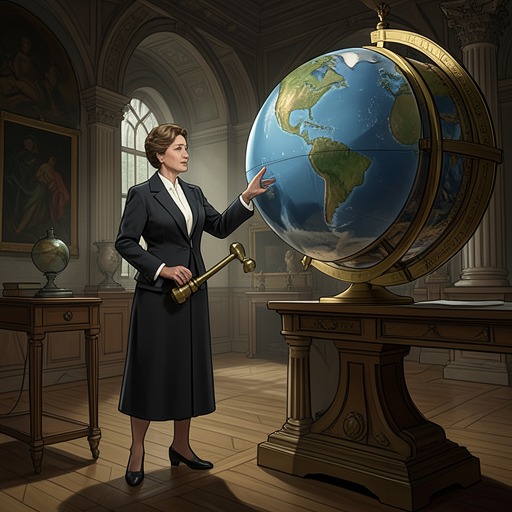
Camelot as an ideal of just rule
The Constant PrincessCamelot as an ideal of just rule begins as a shared political vision between Arthur, Prince of Wales, and Catalina of Aragon. Drawing on the legend as a model rather than a literal blueprint, they imagine a kingdom whose authority is exercised with justice and in the interests of its people. Their conversations connect that ideal to practical institutions, and the later course of Catalina’s life brings the distance between imagining a just realm and wielding power into view.
The Arthurian model
Arthur first hesitates to share his plan, fearing it will sound childish and bookish. What he proposes is not a court gathered from his father’s personal companions, but a council representing the whole kingdom: one knight from each county, chosen by the county itself. These representatives would meet, report on conditions at home, and alert the rulers to impending hardship. If a crop failure threatened hunger, the government could learn of it in time to send food. The design makes local knowledge part of royal responsibility: the council is to help the rulers see the country and act before a crisis deepens.
The proposed council would also carry responsibility for defense, particularly in the north and along the coasts. Arthur’s vision thus joins care for material needs to the protection of the realm. Catalina immediately recognizes the importance of representation and information, understanding the members as the rulers’ eyes and ears. Her response makes the scheme collaborative: she does not merely admire Arthur’s imagined institution but identifies how it could support their shared work as rulers.
Their discussions extend from government to education. Catalina proposes that parish churches teach reading and writing, drawing a comparison with the schools attached to mosques, and that further learning be supported by new colleges at the universities. The proposal links education in local communities to the development of advanced institutions. Like Arthur’s county council, it imagines a kingdom strengthened by knowledge distributed beyond the royal household.
From story to political program
The name Camelot gathers these proposals into a larger ideal. Arthur says it simply, and Catalina repeats it. She had encountered the story in her mother’s library and found Arthur’s well-used copy in his father’s library. She recognizes that Camelot is fictional, akin to the idealized worlds of romance and legend. Yet she distinguishes the story from the political principle it can express: ruling with justice and with the people’s consent is not, to her, merely a fairy tale.
Catalina believes the couple will inherit the power, treasure, and goodwill needed to make such a kingdom possible. She also sees the English fear of renewed civil war as a reason that peace and public support matter. Her confidence in the project is therefore tied both to a moral aspiration and to a judgment about the political circumstances they expect to inherit. They could decide what kind of country to make, she believes, and bring that choice into reality.
The scope of her hopes also reveals a tension within the ideal. Catalina imagines a powerful alliance between England and Spain, extending the promise of their rule into the balance of power across Europe. In the same vision, that alliance is directed against the Moors and toward further expansion eastward. The aspiration to just government thus exists alongside a dynastic and military ambition that reaches far beyond the kingdom whose people Arthur’s council was meant to represent.
Planning a kingdom
The vision acquires a practical setting when the young Prince and Princess of Wales establish an office in Catalina’s rooms. They move a large table to the window for the afternoon light and pin maps of the principality to the walls. The scene gives their political imagination a material form: maps, reports, education, food provision, and defenses belong to a program of governing, not only to an abstract discussion of legendary kingship.
The scale remains both intimate and national. Their shared office is inside Catalina’s rooms, while the maps open their attention to the principality beyond them. The imagined council would bring reports from each county to the rulers; the maps make the territory itself visible as something they hope to understand and shape. The proposed educational network similarly reaches from parish churches to universities. Across these plans, Camelot means responsible rule made possible by knowledge of the country and investment in its people.
Coronation and the demands of power
Catalina’s coronation as Queen Katherine in 1509 gives royal rule a sacred and bodily significance different from the couple’s earlier plans. Carried from the Tower to Westminster in a cloth-of-gold litter, she is crowned after Henry VIII. The ceremony includes the holy oil, the scepter, and the ivory wand; she understands her anointing as a divine appointment to govern. Her public place is a throne just below the king’s, and the crowd welcomes her as well as him. After years of waiting, she sees the coronation as the fulfillment of the destiny she had promised herself she would reach.
The difference between the ceremony and Camelot is instructive. Their earlier ideal had stressed representation, local knowledge, education, and consent. The coronation instead makes Catalina’s authority visible through hereditary status and religious ritual. The two are not presented as identical forms of legitimacy, but they meet in her conviction that rule is a responsibility rather than a private possession. At the same time, her private recollection of the ceremony is bound to longing for Arthur, keeping personal loss within the story of political fulfillment.
In January 1510, Catalina’s pregnancy ends in the loss of her child. She cannot tell Henry or the court herself, and she fears that she has failed England, Henry, Spain, and, most painfully, Arthur. The episode reveals the pressure placed on her personal life by the expectations of dynasty and succession. It also sharpens the contrast between the imagined kingdom, where institutions could anticipate hunger and provide for the country, and the vulnerability of a royal household whose future is made to depend so heavily on an heir.
The ideal in office
At Dover, as Henry prepares to sail for France, he gives Catalina the Great Seal of State and appoints her regent, governor of the realm, and captain general of the forces responsible for home defense. Her authority is no longer a future discussed over maps: it is formally entrusted to her. She receives the appointment gravely, but privately welcomes the power it gives her. She identifies defeating the Scots as her first task.
The regency makes Catalina’s political agency concrete, but it does not show her putting Arthur’s full program into practice. The evidence presents no reforms to the council, parish education, or local reporting system. Instead, her first declared objective is military. Camelot therefore remains an ideal against which the exercise of power can be measured, not a description of every decision its would-be rulers make. Its lasting force lies in the questions embedded in Arthur and Catalina’s plans: whether authority can listen to the country it governs, prepare for its needs, and make justice more than a beautiful name.