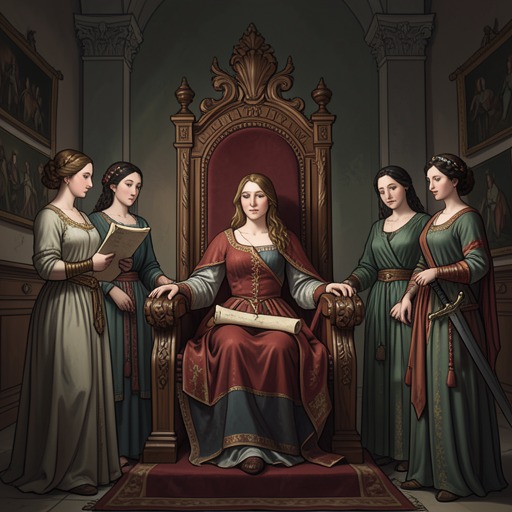
Catalina and Margaret Pole’s friendship
The Constant PrincessCatalina and Margaret Pole’s friendship grows from the encounter Catalina fears most: meeting the sister of a man whose execution she believes was demanded for her sake. Margaret answers that guilt with compassion grounded in her own losses and understanding of dynastic power. At Ludlow Castle, their connection gives Catalina a friend who can share the burdens of royal life without pretending that either woman controls the policies governing it.
The meeting Catalina dreaded
Catalina first hears that Margaret Pole has returned to Ludlow Castle and is waiting to meet her. Her immediate response is to fear the meeting. She had assumed Margaret’s earlier absence was deliberate, a sign that she meant to avoid Catalina out of hatred. Now Catalina understands why: Margaret is the sister of Edward Plantagenet, Duke of Warwick, executed to make the succession safe for Catalina and her line. Catalina believes that her parents insisted on his death before they would send her to England, and she cannot imagine that his sister could greet her without resentment.
The fear is sharpened by the circumstances of Catalina’s own position. She reminds Arthur, Prince of Wales, that her household is small, that his father has forbidden her to add companions, and that she has no allowance with which to pay another woman. She initially mistakes Margaret’s visit for a request for a place at court, and has to explain that she cannot expand her household even for a friend of her husband. When Arthur clarifies that Margaret is not seeking a position but has returned home, Catalina’s practical anxiety gives way to the deeper dread of facing a bereaved sister.
Arthur tries to prepare her by explaining that Margaret has been away caring for her children and that they must all live together at the castle. He also insists that Margaret does not hate Catalina, Arthur, or even Henry VII, who ordered the execution. In his view, Margaret understands that policy, rather than personal choice, governs royal lives. Catalina cannot accept that explanation as sufficient: she compares Margaret’s loss with the death of her own brother and the lasting grief her mother has endured. To Catalina, a woman who lost her brother and heir to her family should not be expected to welcome the person for whose future he died.
Guilt answered by recognition
When the two women meet in the warden’s apartments, Margaret rises to greet Catalina with a respectful curtsey. Her gray dress and hood, her measured courtesy, and her friendly interest make the encounter formal, but not hostile. Catalina offers a small curtsey in return. The restrained gestures begin a meeting shaped by the very uncertainty that has tormented her: whether Margaret sees an individual responsible for her brother’s death, or a young princess caught within decisions made by others.
Margaret directly addresses that uncertainty. She tells Catalina that women often have little power over what men do, and that she believes Catalina would have wished no harm to her brother. Margaret describes her own family’s history as one in which a father’s choices brought consequences upon an innocent son; events, she suggests, might have turned out differently. Her image of fortune as a coin that can fall either way does not diminish the loss. It offers Catalina a way to understand that loss without treating it as a personal accusation.
Catalina admits that she arrived in England feeling that Edward Plantagenet’s death was on her conscience. Margaret rejects that burden: one person should not blame herself for another person’s actions, and taking responsibility for others’ sins can itself become a form of pride. She says she does not blame Catalina, her parents, or Henry VII. Were she in their positions, she might have acted as they did and left the explanation to God. As someone outside those decisions, her task is to consider how she behaves and how she will answer for that conduct herself.
This distinction gives their friendship its moral foundation. Margaret does not claim that the execution was harmless or that grief should disappear; she separates bereavement from inherited guilt. Catalina, who had feared that Margaret would meet her with hatred, is instead invited to recognize the limits of her own responsibility. The reassurance is not simply political advice. It allows the women to meet as people who have suffered within dynastic arrangements, rather than as representatives of opposing families.
Shared limits, distinct identities
Margaret explains why she understands Catalina’s predicament: she was once a princess royal, the last Plantagenet princess, and was raised by Richard III in the nursery with his son. She knows that a princess lives among forces she cannot command—the will of a husband, parents, king, and God. In her view, royal status does not give a woman the power to challenge what a king has done. Obedience becomes the condition imposed upon women, though Margaret does not confuse it with an absence of thought.
Their conversation makes room for wit as well as solemnity. Margaret acknowledges that a woman must think for herself, and distinguishes chosen obedience from mere agreement. Catalina laughs aloud with an Englishwoman for the first time and makes clear that she never wanted to be a foolish attendant. Margaret responds in kind. Though her former rank has given way to the position of a wife living in the Tudor border country, she holds fast to an inward sense of who she is, whatever title the world assigns her. Their shared humor does not erase the hierarchy around them; it briefly lets them speak within it as equals.
The friendship also helps Catalina interpret the difference between the world she has left and the one she has entered. She has grown up among women—her mother, sisters, attendants, and servants—in the Alhambra, whose rooms and gardens offered women privacy. England seems to her to be organized more openly around men: male courtiers may approach her rooms, and she has not found a household arranged with the same exclusive spaces for women. Margaret becomes a companion in this unfamiliar setting, helping Ludlow feel like a home and offering comfort for Catalina’s separation from her mother and sisters. The friendship thus answers not only guilt but also isolation and displacement.
Care shaped by duty
Margaret’s concern for Catalina is not expressed as unconditional agreement. During Arthur’s illness, when Catalina announces that she will visit him, Margaret warns that the sickness may be the Sweat and refuses to let her approach closer than the foot of his bed. Catalina protests that Margaret’s duty is to her. Margaret replies that her duty is to England and, if Catalina is carrying a Tudor heir, to the child as well. The exchange shows the firmness that underlies her care: friendship cannot require her to disregard the risks she believes she must guard against.
That protection places their relationship within the political order both women understand. Margaret speaks not only as a trusted companion but as a former princess who has learned that private wishes can be constrained by a kingdom’s interests. Her decision frustrates Catalina in the moment, yet it treats Catalina as someone whose safety matters beyond her own feelings. Their bond therefore contains both comfort and limits; Margaret’s loyalty may take the form of refusing a request when she believes England’s interests demand it.
After Arthur’s death, Margaret approaches Catalina while she sits motionless in mourning. Catalina is dressed in black and looks out at the summer landscape without seeing it; Arthur is buried in Worcester Cathedral, and the future they had imagined together is gone. Margaret begins tentatively, addressing her as princess and asking to speak. The scene establishes her again as the person willing to approach Catalina’s grief, though the moment of opening is all that is shown here. It recalls the earlier meeting: Margaret does not demand that grief be solved, but she does not leave Catalina entirely alone with it.
Friendship beside a changing royal identity
Catalina’s later coronation as Queen Katherine of England marks a decisive change in rank. She is anointed after Henry VIII, takes a throne below his, and understands the ceremony as the fulfillment of the destiny for which she has waited. Later, as Henry prepares to sail for France, she is formally invested as regent, governor of the realm, and captain general of the forces for home defense. These public transformations contrast with the private basis of her friendship with Margaret: the trust between them began not in ceremony or office but in a painful conversation about a dead prince, culpability, and what women can control.
Margaret’s place in Catalina’s story is therefore significant even when the later milestones concern Catalina’s changing authority rather than Margaret’s direct participation. Margaret recognizes that a woman may be constrained by dynastic policy while retaining judgment, humor, and an inward identity. Catalina, initially convinced that Margaret must hate her, discovers instead a companion who can acknowledge the violence of political necessity without assigning its guilt to her. Their friendship makes a home within an unfamiliar court and offers a humane alternative to the logic of succession: not denial of loss, but compassion between the people who must live with its consequences.