Catalina’s status as Queen of England
The Constant PrincessCatalina’s status as Queen of England is the outcome of a long struggle to turn a precarious dynastic position into recognized authority. After years as the impoverished widow of Arthur, Prince of Wales, and the neglected fiancée of the future Henry VIII, she becomes queen through marriage, establishes herself at court before her coronation, and later receives power to govern in her husband’s absence. Her queenship joins ceremonial legitimacy to practical command: it is at once a promised destiny, a political settlement, and a responsibility she demonstrates she can carry.
From Dowager Princess to Queen
As Arthur’s widow, Catalina’s immediate security depended on the financial terms of her marriage and on decisions made by two crowns. The dowry dispute had already strained relations: Henry VII demanded the full payment, while Ferdinand II of Aragon proposed that the value of Catalina’s household goods make up the shortfall. Her plate was not merely a symbol of rank. As the household used it, it could lose value, and the dispute left Catalina caught between the demands of her father and her father-in-law.
Her mother’s instructions made the choices stark. Catalina was to remain where she was until she knew whether she was pregnant. If she was not, she was to have Dr. de Puebla press for her jointure as Dowager Princess of Wales and return to Spain only after receiving the money. If she was carrying a child, her parents would seek payment of the dowry in cash and the allowance owed to her, while she stayed and hoped for a son. The instructions treated her future as a matter of dynastic business, but also made clear how much her residence, income, and marriage prospects depended on the outcome of her pregnancy.
The ambassador explained that her jointure amounted to a third of the revenues of Wales, Cornwall, and Chester, and that her parents were also asking Henry VII to return the dowry. Catalina doubted that he would pay either the sums or the revenues, pointing out that he had not paid her allowance even while Arthur was alive. The contract gave her a claim, but not the power to make the king honor it. With no Spanish dowry payment to force the English court to respect her betrothal, and little access to the young Henry, she remained unable to make the marriage happen on her own terms.
The waiting years made that dependence tangible. Catalina turned the panels of her gowns, sold jewels, and pawned her gold plate piece by piece to feed herself and her household. She understood that selling the plate might delay the marriage further, but her attendants also needed food and could not be expected to serve without wages. Her poverty was therefore both a personal hardship and a political trap: the resources she needed to survive were entangled with the wealth and marriage settlement that might secure her future.
Marriage and the Claim to Queenship
After seven years, the emissary brought news that Henry VIII wanted to marry her. The message did not make Catalina abandon her composure. When he knelt and celebrated the prospect that she would become Queen of England, she answered that she had always been going to be queen. Her certainty contrasts with the ragged hem of her gown, carefully mended and worn through again. The title had not yet been formally secured, but her response presents it as the destination toward which her endurance had been directed.
The marriage took place at Greenwich Palace on 11 June 1509. Catalina had dreaded repeating vows once spoken to Arthur, but she understood the marriage as fulfilling Arthur’s wish and deliberately kept thoughts of him at a distance during the service. Unlike her earlier wedding at St Paul’s Cathedral, this was a small ceremony in the church of the Friars Observant, attended by only three witnesses and a handful of others. There was no elaborate feast, dancing, or public bedding. The quietness spared Catalina the public ritual she had feared, while the private ceremony marked the decisive change in her legal and political position: she was now Henry VIII’s wife and Queen of England.
Her changed place at court was visible that evening. In a hastily tailored new gown, with a gold collar and pearls, she entered the hall and was conducted to a table at the front. She curtseyed to Henry VIII, her husband-to-be, then faced his grandmother, Margaret Beaufort, whose cold attention made the new status something to be tested as well as celebrated. By the wedding, Margaret had moved out of her rooms for Catalina; there was no suggestion that the new queen would live under her supervision. Catalina’s courtesy did not mean submission to Margaret’s authority. The balance between the women had shifted with the marriage.
Coronation and Court Authority
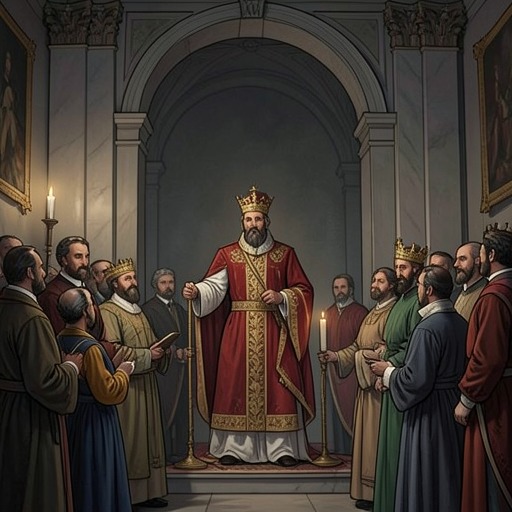
The coronation on 24 June 1509 made Catalina’s queenship public and sacred. She traveled from the Tower of London to Westminster in a cloth-of-gold litter carried by four white palfreys, dressed in white satin and wearing a pearl coronet. Henry VIII was crowned first; Catalina then received the holy oil and the regalia associated with queenship. The ceremony gave visible form to a status she had long claimed inwardly: she understood anointed queenship as a divine appointment and saw herself as fulfilling the destiny for which she had been raised.
The death of Margaret Beaufort, less than an hour after Catalina had spoken with her, gave the new queen an early opportunity to exercise authority beyond ceremony. The court lacked an agreed plan for the funeral, and Henry VIII had never organized a royal funeral before. Catalina summoned the Duke of Buckingham, asked for Margaret Pole, and had the Royal Book brought to her. Inside it she found three handwritten pages setting out Margaret’s desired arrangements, including the numbers of bishops, pallbearers, mourners, and mutes, as well as street decoration and the duration of mourning. Catalina cut almost everything by half and issued her own orders.
The resulting funeral was quiet and dignified. Its scale and manner showed that Catalina could read the court and the expectations of the English people, and could use ceremony to establish a place in public life. Those who had overlooked her during her years of poverty recognized her capacity to rule. By arranging Margaret’s funeral, she became the leading woman of the new court and an arbiter of its decisions, even before her own coronation. She accepted the court’s new respect with the same calm politeness with which she had endured its earlier neglect.
Queenship as Government
Catalina’s authority was not confined to appearances or household precedence. She consulted trusted members of the court and worked with the Privy Council on the hopes she and Arthur had shared for the kingdom. Their efforts included extending the reach of law across the country, examining coastal defenses, surveying ships that might serve as a fighting navy, and preparing army muster rolls. Catalina’s experience of government had begun in the courts of her parents, Isabella of Castile and Ferdinand II of Aragon; the novel presents statecraft as something she learned in her family and now applied in England.
Henry VIII later promised that she would act as regent when he went to war, rule the country in his absence, and command the forces at home. Catalina answered that she knew she could do it and would keep the country safe. She described her mother’s own military role as including the planning of campaigns, raising money and troops, and at times riding with the army in armor. The exchange connects Catalina’s queenship to a model of women’s political and military participation grounded in her upbringing, rather than presenting her authority as an improvisation.
When Henry VIII prepared to sail for France, that promise became a formal appointment. At Dover, before the embarkation, he gave Catalina the Great Seal of State and invested her as regent, governor of the realm, and captain general of the forces responsible for home defense. The appointment rested on royal authority, but its practical significance was unmistakable: the king entrusted her with government and the defense of the country while he was away. Her queenship had moved from marriage and anointing to direct responsibility for the realm.
Meaning and Limits of the Status
The novel emphasizes the distance between possessing a contractual claim and being able to exercise authority. As a widow, Catalina could point to the jointure and dowry terms, yet she could not compel payment; her status did not protect her household from hunger or her marriage from delay. As queen, she could shape court ceremony, advise on the kingdom’s administration, and, through Henry VIII’s commission, govern and command at home. Her power is therefore neither effortless nor wholly independent: it is built through her dynastic position, recognized by the king, and made effective through her own political skill.
Catalina’s rise also carries the memory of what it cost. Her coronation and regency follow years in which she had little influence over the decisions determining her future, and the gold plate she had sold survives as an emblem of that reversal. The queen who later takes responsibility for the kingdom is the same woman who had to calculate how to feed her household while waiting for a marriage controlled by others. In this arc, queenship is not simply the reward at the end of patient endurance. It is the position from which Catalina can at last turn long-held expectations of rule into public action.