Catalina’s widowhood and succession dilemma
The Constant PrincessCatalina’s widowhood and succession dilemma is a prolonged contest over what her status will be after the death of Arthur, Prince of Wales. Her future depends on an unanswered question of pregnancy: a son would make her the mother of the next king, while the absence of a child would leave her a dowager princess with little influence and a possible return to Spain. The uncertainty is not merely personal. It governs negotiations over her dowry and maintenance, confines her choices, and makes her body a political concern. Her eventual rise to queenship and regency reverses the powerlessness of those years, but does not erase the costs of having lived under dynastic uncertainty.
A Title in the Balance
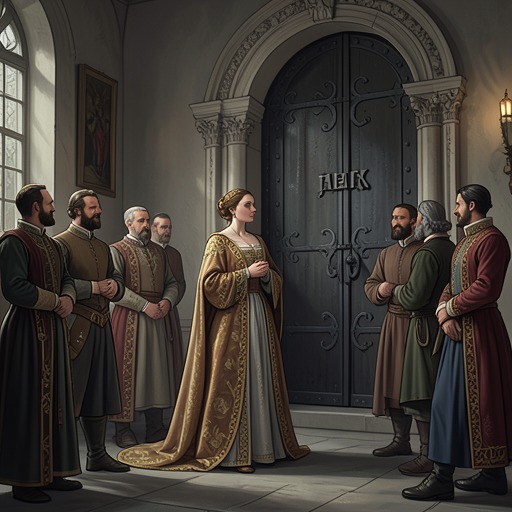
When Margaret Pole identifies Catalina as a princess of Spain, Catalina insists on the identity she has held throughout her life: Princess of Wales. Margaret’s reply, that she is now the dowager princess, makes widowhood a change of political standing as well as a loss. Catalina covers her mouth to contain her pain. Even the title offered as a mark of respect carries the fact that her position has diminished.
Margaret explains the succession in stark alternatives. If Catalina is pregnant and bears a boy, the child will be Prince of Wales and then King of England, and Catalina will become the king’s mother. If she is not pregnant, Prince Harry will be Prince of Wales; when the king dies, Harry will become king. Catalina asks what will become of her in that case. Margaret’s silent shrug conveys how little the English court expects her to matter, though she adds that Catalina will remain an Infanta of Spain. The next Queen of England, she explains, will be Harry’s wife.
The court’s questions about Catalina’s health therefore carry political weight. The queen writes to ask not only whether Catalina is well enough to travel, but whether she may be with child. Pregnancy could transform her from a widowed foreign princess into the mother of an heir; its absence could make her departure from England the expected course. The same uncertain possibility shapes the terms on which both kingdoms consider her future.
Dowry, Jointure, and the Cost of Waiting
The financial dispute compounds the uncertainty of Catalina’s status. Henry VII is displeased over the dowry. The Spanish payment has arrived only in part, while the rest is argued over in relation to the plate and treasure Catalina brought for her household. Her English life thus begins with a disagreement about whether her possessions count toward the money owed. As a widow, she faces a further claim: under the contract, Henry is to pay her a jointure worth a third of the revenues of Wales, Cornwall, and Chester. Her parents also seek the return of her entire dowry.
Catalina doubts that Henry will meet these obligations. She points out that he did not pay her allowance even while Arthur was alive, and she sees little reason for him to return the dowry or provide the promised revenues when he would gain nothing by doing so. The ambassador’s answer is that the contract requires it; Catalina recognizes the difference between an entitlement on paper and money she can actually compel the king to pay. Her maintenance is formally owed, yet her survival depends on the decisions of others.
A letter from Isabella of Castile makes those choices explicit. Until Catalina has had her next course and knows whether she is pregnant, she is to remain in whatever house is provided. If she is not with child, she must instruct Dr. de Puebla to demand her jointure as dowager princess and sail for Spain only after receiving the full amount. If she is pregnant, Isabella directs her to secure the dowry payment in cash at once, obtain her allowance, rest, and hope for a boy. Catalina is also to report her judgment about pregnancy immediately, write again once she is certain, confide in Dr. de Puebla, and remain under Doña Elvira’s chaperonage.
Catalina experiences this instruction as business rather than maternal comfort. She folds the letter carefully, while privately wishing that her mother understood her grief and loneliness and would tell her to come home without delay. The contrast is consequential: Isabella’s letter treats the widow’s future as a sequence of financial and dynastic contingencies, while Catalina’s private sorrow remains outside its terms. At the same time, Catalina does not tell the English court what she knows: she is not pregnant. She delays disclosure while she tries to decide how to fulfill the promise she made to Arthur, believing that neither her parents nor Henry will help her do so.
Poverty and the Long Betrothal
The contract cannot protect Catalina from the practical consequences of delay. When she learns that an emissary is expected to escort her home once her jointure is paid, the required sum is set against the prospect of her departure and a new marriage arranged by her parents. The planned return is not simply a homecoming: it is another dynastic transfer, with Catalina’s future again being negotiated by others. She doubts that Henry will pay what is owed, and the English king’s refusal or inability to meet his obligations leaves her in an increasingly precarious position.
Her betrothal to Harry remains unfulfilled as the years pass. Catalina recalls her sense that she has failed to bring the English alliance her mother expected, while Henry’s hostility and Harry’s youth leave her with little leverage. She waits through Harry’s fourteenth, fifteenth, sixteenth, and seventeenth birthdays without the marriage taking place. Her account reduces those years to repeated waiting, but the repetition marks a political condition: she remains bound to a proposed future without the authority to make it arrive.
Poverty becomes visible in the things she must give up. Catalina turns the panels of her gowns, sells jewels for food, and parts with her gold plate one piece at a time. She understands that selling plate may postpone her marriage further, but her household also needs to eat, and she cannot pay her attendants’ wages. The objects caught between dowry, royal property, and daily subsistence make the cost of her unresolved status concrete. Her persistence is not a comfortable exercise of patience; it is endurance under material constraint.
From Widowhood to Rule
Catalina’s later position sharply contrasts with the helplessness of her widowhood. As queen, she consults her allies and works with the Privy Council on extending the law across the country, strengthening coastal defenses, surveying ships for a fighting navy, and preparing army muster rolls. She describes taking the reins of government and finding that she knows how to govern. The political education she received from her parents becomes practical capacity, rather than merely an argument for the status she hopes to retain.
The death of Margaret Beaufort gives Catalina an early public opportunity to exercise authority. With no one at court able to organize a royal funeral, Catalina summons the Duke of Buckingham and Margaret Pole and consults the Royal Book. Its handwritten instructions specify an elaborate procession, large numbers of bishops and pallbearers, mourners, street decorations, and a prolonged period of mourning. Catalina reduces the proposed scale and orders a ceremony of quiet dignity. The episode demonstrates that she can interpret courtly expectations and make decisions that others will recognize as rule: those who had overlooked her during her impoverished years come to respect her command.
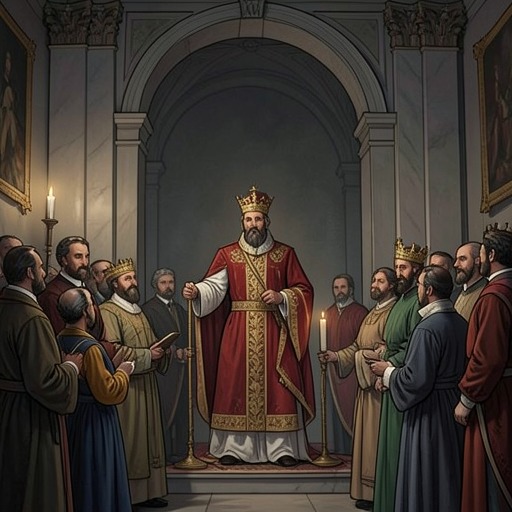
At her coronation, the transformation becomes formal. Carried from the Tower to Westminster in a cloth-of-gold litter borne by four white palfreys, Catalina is crowned after Harry. She receives the anointing, scepter, and ivory wand, and understands herself as a queen appointed to rule. The ceremony answers the years in which her title and future seemed contingent, though her memory of it remains entangled with longing for Arthur.
The change reaches its clearest political expression when Henry VIII leaves to campaign in France. At Dover, he entrusts Catalina with the Great Seal of State and appoints her regent, governor of the realm, and captain general of the forces for home defense. She then rides before five hundred troops, removes her helmet so the soldiers can see her face, and addresses them as their English queen. The widow once required to wait on the uncertain promise of a child now holds authority over the kingdom’s defense. Her trajectory does not make the earlier constraints disappear; it reveals how decisively her political power changes when title, royal appointment, and demonstrated governing ability converge.