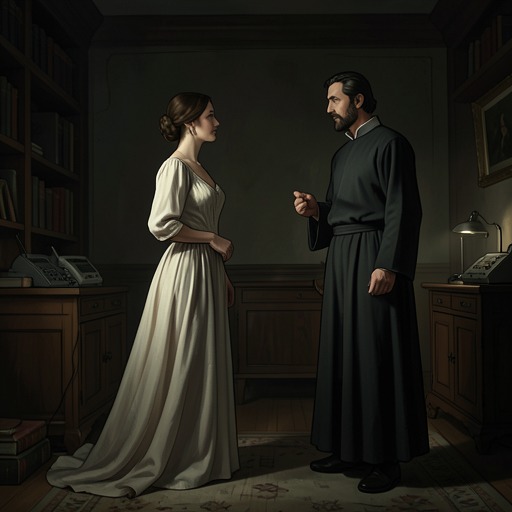
Catherine’s False Pregnancy and Confinement at Greenwich
The Constant PrincessKatherine of Aragon’s false pregnancy turned the expectation of a Tudor heir into a prolonged test of medical authority, royal ceremony, and the queen’s ability to speak about her own body. After losing a daughter, she was told that she had been carrying twins and remained pregnant with the surviving child. The diagnosis led her into nearly three months of confinement at Greenwich Palace, where courtly confidence persisted even as her own doubts gathered evidence against it. The event ended without a birth, a christening, or the customary return-to-court churching: Katherine emerged from confinement and disclosed that there had been no surviving pregnancy.
Background and Diagnosis
The mistaken pregnancy followed a real loss. In January 1510, Katherine woke in pain and discovered that she was bleeding. María de Salinas, who shared her room, summoned her ladies and the midwives. By the time they arrived, Katherine understood that the child could not be saved. The baby was born dead, a girl. Her grief was sharpened by the knowledge that King Henry VIII of England had hoped for a daughter called Mary, and by Katherine’s own sense that she had failed the dynastic hopes attached to her marriage.
The court soon received a different account of what had happened. A physician told the king that Katherine had lost one child but remained pregnant with another, claiming that she had been carrying twins. Henry initially struggled to take in the news, then accepted that his wife still carried a child. The diagnosis transformed loss into renewed expectation. It also gave the court an explanation for the continued fullness of Katherine’s belly, although the claim had not been established through a direct examination.
That uncertainty reflected the queen’s exceptional status as well as the limits of the medical knowledge represented at court. When King Henry VIII of England sent his physician to question her, he could not examine her: the queen’s body was treated as sacred and could be touched only by the king. The physician, embarrassed and deferential, kept his eyes lowered and asked brief questions. Katherine described her loss of appetite for cooked meat and her longing for the fruit and vegetables she had eaten in Spain. He dismissed the value of fruit and vegetables and advised against raw food during pregnancy. When she offered the date of her last menstrual course as a possible guide to the birth, he treated it as unhelpful and rejected the Moorish use of an abacus for calculating a due date as an alien practice.
A Private Search for Knowledge
Katherine had another reason to question the diagnosis, but kept it from the court. At Richmond Palace she arranged, through a hidden stairway from the cellars and a servants’ passage, for a Moorish physician to enter her private rooms. She was still dressing for dinner and wore only her shift beneath a cape. The visit breached the seclusion expected of a queen’s private chamber, yet she believed she needed medical knowledge the English physicians lacked. The doctor could not examine her either; he told her he could offer only an estimate based on looking at her.
The encounter unsettled Katherine’s religious and cultural assumptions. She regarded the visitor as an unbeliever, yet recognized that Moorish physicians had studied Greek medical texts, investigated the body, and tested ideas without the same taboos she associated with Christian medicine. His presence made the hierarchy of knowledge less secure: the queen could consider his learning necessary even while her inherited beliefs urged her to reject it. He gave her an unwelcome opinion, and she later kept both the visit and that judgment secret, even from Margaret Pole.
The consultation also addressed what might follow the loss. The physician observed that the earlier pregnancy, though it had not come to term, showed that both Katherine and her husband could conceive. He recommended that she strengthen her body through riding before conception, walking and swimming, then take a litter during pregnancy. He also advised moderation in food and drink and rest around the time he considered most likely for conception. Katherine’s concern was not simply whether the reported twin survived; she wanted to know how she might bear a child for England. Yet after hearing the doctor’s warning, she chose to continue as though the court’s diagnosis were true.
Confinement at Greenwich
Katherine’s decision was reinforced by the official atmosphere around her. The English physician remained confident, the midwives did not openly contradict him, and the court expected a birth in March or April. In February, Katherine attended the Shrove Tuesday feast and appeared before the court with her belly visibly rounded. She laughed and took part in the celebration; the people around her treated the pregnancy as settled fact. King Henry VIII of England anticipated the child’s arrival and planned a tournament at Greenwich Palace. He spoke hopefully of the coming birth, though he was cautioned against predicting the child’s sex.
The preparations followed the ceremonial rules recorded in the Royal Book. Katherine entered rooms hung with tapestries and furnished with rugs and fresh herbs, while her women gathered around her. María de Salinas stood by the bed, and Margaret Pole arranged the cradle. Katherine welcomed the privacy of confinement as a respite from performing the confident, fertile queen. At the same time, she understood the birth as the work for which she had been raised and the moment that would secure her place in England. The room’s ritual order gave public form to a pregnancy that, in private, she increasingly doubted.
March passed without labor. Katherine asked for a tapestry to be pinned back so she could hear the river and sense the spring air, but no birth followed. The midwives asked whether the child had moved; Katherine did not understand what they meant, while they insisted that a quiet baby was a good sign. Her unease had begun earlier, and she had not felt the expected movement, but she pushed that concern aside. As April came, her gowns became looser. When she showed her belly to María de Salinas, her companion’s expression made clear what Katherine already suspected: it was shrinking rather than preparing for delivery.
The contradiction became impossible to evade when Katherine’s menstrual bleeding returned. The midwives could not explain it. They distanced themselves from the diagnosis, saying that it had been the physician, not they, who had declared that Katherine was carrying a surviving twin. For Katherine, the monthly bleeding made the central fact plain: the court’s assurances had not made the pregnancy real. Her own body supplied evidence that the confident medical account could not absorb.
Disclosure and Significance
In May 1510, at Greenwich Palace, Katherine sent for King Henry VIII of England and told him the news herself. He came unwillingly, and she noticed his lack of warmth, but she did not challenge him before explaining that she was no longer pregnant. She concluded that there had been only one child and that the physician had been mistaken. The confinement, therefore, had served no purpose as a preparation for childbirth. She said she would return to court the next day.
Katherine’s return was deliberately unceremonious. There could be no christening because there was no child, and no churching ceremony because no birth had taken place. After almost three months, she left the shadowed rooms without announcement, while the court behaved as though she had been absent for hours. Her ladies hurried to resume their ordinary duties; their whispered conversations suggested that another matter had developed during her seclusion, but that disturbance belonged to the court beyond the false pregnancy itself.
The episode turns on a contrast between public certainty and private evidence. Ceremony, medical rank, and the desire for an heir combined to sustain a diagnosis that the queen herself increasingly distrusted. The royal body was guarded as sacred and made central to succession, yet Katherine had little recognized authority to establish what was happening within it. Her confinement made that tension visible: she performed the expected confidence before the court, concealed the Moorish physician’s contrary opinion, and finally had to announce the truth herself. The false pregnancy was not only a mistaken medical claim; it was a period in which dynastic expectation prolonged the fiction of a child until Katherine’s body and her own judgment could no longer be set aside.