Conquest of Granada
The Constant PrincessThe Conquest of Granada is both a military victory and the formative political moment in Catalina of Aragon’s life. On 6 January 1492, after Granada’s resistance had been weakened by encirclement, hunger, the death of its champion, and the failure of promised aid, Boabdil surrendered the city and the Alhambra to Isabella of Castile and Ferdinand II of Aragon. Catalina entered the conquered palace with her parents and understood herself, for the first time, as a princess. The triumph that gave her this identity also introduced the contradiction that would shape her memories of Granada: the conquerors inherited a place of extraordinary beauty, pledged protection to its Muslim people, and then repudiated that pledge.
The Siege and Surrender
The account dates the surrender to 6 January 1492. The decisive conditions had accumulated over time: the Moors’ spirits ebbed, their champion was dead, Granada was encircled, and its people faced hunger in a land their fathers had made fertile. Expected support from Africa did not arrive. The Turks had sworn friendship, but their janissaries never came; Boabdil had lost his nerve, and his son was held hostage by the Christians. Opposing the city stood the Spanish rulers with the power of Christendom behind them, a declared holy war, and a crusade gathering momentum.
Within days of the champions’ meeting, Boabdil agreed to terms. The surrender itself is presented not as a chaotic seizure but as a formal transfer: he came on foot to the city’s iron gates carrying the keys to the Alhambra on a silken pillow, and handed them to Isabella and Ferdinand. Granada, the red fort above the city, and the palace within its walls passed to the Spanish monarchs. The ceremony’s carefully arranged grace does not lessen the force of what it records. A kingdom’s stronghold and its seat of beauty changed hands, while the defeated king departed from the place he had ruled.
Catalina’s Entry into the Alhambra
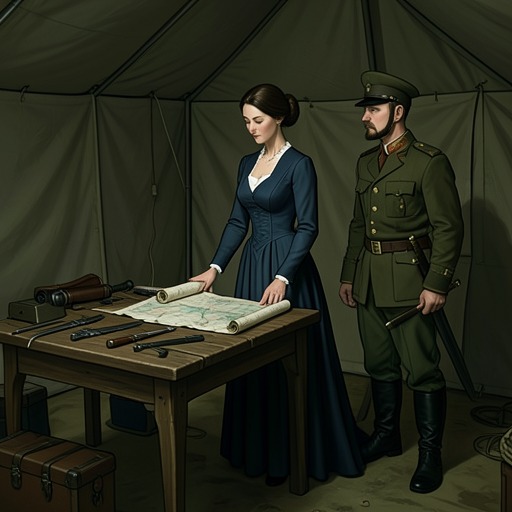
That afternoon, Catalina walked with her parents up the steep, winding path to the palace. She had been a child of the military camp, following the army through sieges and battles and living among the burdens of war. The narrative places that earlier childhood beside the transformation represented by Granada: she had seen the hardship of campaigning and the consequences of violence, but now she entered a palace and imagined a different royal life. The Alhambra was not merely territory taken by her parents. It became the place where she first experienced herself as a princess.
Catalina’s new identity was bound to the setting. She thought of herself as a Moorish princess raised amid luxury and beauty, as well as a Princess of England. The fort’s security and the palace’s splendour supported her confidence in divine favour and in her own destiny. This was a turning point in how she understood her life: before Granada, she had been a child accompanying a victorious army; within the conquered palace, she imagined herself protected, chosen, and destined for a royal future. The conquest therefore enters her story not only as a change of rule, but as the beginning of the self-image she would carry into later trials.
The Promise and Its Reversal
The palace’s beauty made the consequences of conquest more complicated in Catalina’s recollections. She describes the victors learning from the people they had defeated: they relied on Moorish scholarship and physicians, studied the stars and mathematics, enjoyed Moorish poetry and gardens, and lived among architecture and waterworks that taught them new standards of beauty and rule. The Alcazaba, now in Christian hands, was again a secure stronghold. In Catalina’s reflection, possession did not mean understanding. The conquerors could occupy the palaces and benefit from their knowledge while failing to value the culture that had created them.
Political submission was followed by religious restrictions. The palace’s servants were required to profess the Church’s beliefs; the mosque’s call to prayer was silenced in Isabella’s hearing. The Spanish crown had promised Boabdil that Muslims would be as safe under Christian rule as Christians had been under his, a commitment associated with convivencia, or living together. The people of Granada trusted that promise and hoped that Muslims, Christians, and Jews might live with security and self-respect as People of the Book. The narrative stresses the reversal: within three months, Jews were expelled and Muslims threatened with the choice of conversion or departure, with the Inquisition used to test suspected converts. Isabella established a chapel in the council chamber, replacing an Arabic inscription that had invited people to seek justice; the account says that people no longer came there for justice. The promise of shared life gave way to religious uniformity as a project of rule.
Songs of a Lost Kingdom
The surrender survives in Catalina’s later conversations as a story and as song. She asks to hear again the tale of Boabdil giving up the palace keys and leaving in tears. To Arthur, she sings a Moorish account of the Spanish advance, in which Ferdinand leads the army and Isabella is remembered as a queen whose presence strengthened the troops and frightened their opponents. Catalina explains that her mother was never defeated in the battles she attended and recalls her refusal to retreat when the king and his advisers thought withdrawal necessary. In these recollections, conquest is not only a royal achievement but a contested memory: the invaders’ reputation for victory is heard alongside the defeated people’s own songs.
Another song remembers the loss of Alhama and presents the fall as the consequence of earlier divisions and failures. Catalina then recounts Boabdil’s departure from the Alhambra and the story that he looked back at his kingdom and wept. She regards the moment as tragic, even when Arthur responds with laughter to the harsh saying attributed to Boabdil’s mother. The contrast matters: for Catalina, Granada’s fall is not a simple triumphal anecdote. Its songs preserve grief and judgment alongside the Spanish account of victory.
She also sings a song describing Granada at sunset, with Christian worship replacing Muslim prayer and one king entering in triumph as another leaves in grief. Arthur draws from it a pattern of succession: the rise of one ruler entails the fall of another. The conquest thus becomes a way of thinking about power’s costs and continuities. What happens to Boabdil anticipates the reversals that attend royal inheritance, a subject that will matter deeply to Catalina’s own life.
Legacy and Retrospective Change
Granada also gives Catalina a political map through which to understand her parents’ ambitions. She tells Arthur that her family is building a kingdom from the lands of al-Andalus: Castile and Aragon have been joined by Granada, while her father’s attention turns toward Navarre, Naples, and regions of France. The conquest appears as a decisive expansion, but not an endpoint. Its transfer of territory belongs to a larger program of royal power and alliance, one that shapes the political expectations placed upon Catalina.
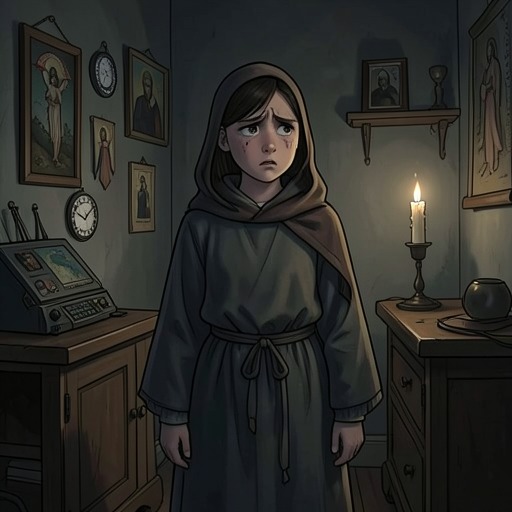
The meaning of the victory changes further as Catalina grows older. After receiving kindness from a Moorish physician when she was vulnerable, she rejects the assumption that the Moors could simply be dismissed as barbarians or spiritually empty. She recognizes in him compassion and sincere religious conviction, and extends that recognition to Moorish people as men and women who are fallible, hopeful, and faithful to their own creed. Her faith in God remains, but her unquestioning trust in her parents’ judgment does not. That later change does not undo the conquest or its policies; it alters the way Catalina can interpret them. Granada remains the place where she first felt destined to rule, but also where the gap between Christian claims of victory and the treatment of the conquered becomes impossible to ignore.