Death and funeral of Lady Margaret Beaufort
The Constant PrincessMargaret Beaufort, the King's Grandmother, died shortly before Catalina of Aragon’s coronation, and her funeral became more than a matter of royal mourning: it was Catalina’s first major public test as a leader. Faced with an uncertain court and a newly elevated king, Catalina turned Margaret’s own ceremonial book into a practical guide, shaping a restrained funeral that announced her command before she was crowned.
The Last Counsel
Margaret’s final hours joined religious devotion to political counsel. She lay in an ornate bed while a lady-in-waiting held a monstrance for her to see; a crucifix stood nearby, and prayers continued around her. Catalina knelt at the foot of the bed with a coral rosary, praying silently. The scene placed the two women together at a threshold: Margaret was nearing death, while Catalina was about to assume a more prominent place in the English court.
Margaret’s last clear advice concerned the kingdom’s safety. She insisted that Henry VIII must not take England into war, urging a policy of keeping clear of Europe’s recurring conflicts and preserving peace behind the seas. Catalina asked her to repeat herself, and Margaret restated the warning. The counsel mattered because it was not simply a private reflection from a dying woman: it expressed a view of England’s political interests that Henry VIII still needed to hear. The narrative makes that need explicit even as it shows him waiting outside, eager for the independence he believed her death would bring.
Margaret died less than an hour after an exchange in which she and Catalina affirmed that some things would remain unchanged. Her death, however, immediately altered the court. Henry VIII had never arranged a royal funeral, and the people around him had no settled answer about the honor due to his grandmother, the number of mourners, the length of mourning, or the place and form of burial. The absence of an experienced authority turned the funeral into an urgent test of who could give orders.
Catalina Organizes the Funeral
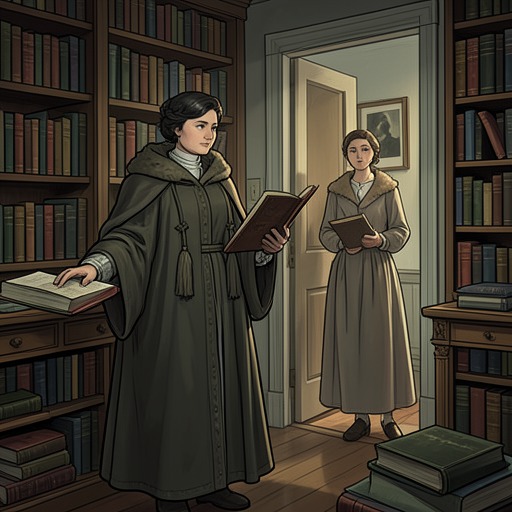
Catalina took charge rather than waiting for the new king to resolve the uncertainty. She summoned Edward Stafford, Duke of Buckingham, who had welcomed her to England years earlier and now held the office of lord high steward, and asked for Margaret Pole to join them. Her ladies brought the Royal Book, the ceremonial volume Margaret herself had written. Tucked inside its cover, Catalina found three pages of Margaret’s handwritten instructions for her funeral.
The notes specified a procession and its scale: the bishops who should serve, the pallbearers, the mutes and mourners, the decorations along the streets, and the duration of mourning. Catalina and Margaret Pole reacted to the extent of the arrangements; the Duke of Buckingham, once Margaret’s ward, offered no objection aloud, but silently smiled and shook his head. Catalina then took a quill and black ink, cut almost every provision by half, and began issuing orders. The evidence does not supply a final list of participants or describe the route and burial, but it does show the essential decision: she used Margaret’s plan as a framework and reduced its demands to a scale she judged appropriate.
The resulting ceremony was quiet and dignified. Its restraint distinguished Catalina’s approach from the elaborate scale Margaret had requested, while the use of Margaret’s own book preserved a direct connection to the woman being honored. The funeral thus presented Catalina not as a newcomer improvising without guidance, but as a ruler able to read the court, adapt its rituals, and make a decision that others would follow.
A Public Demonstration of Authority
The court recognized that the ceremony had been commanded by the Spanish bride. Those who had overlooked Catalina during the years of her poverty and waiting now saw her capacity to judge English expectations: what the people considered stylish, what they might regard as mean, and how a public occasion could be made to suit its audience. The funeral made her knowledge visible in action. She accepted the respect that followed as calmly as she had borne neglect, and the narrative presents the event as establishing her as the foremost woman of the new court and an arbiter of its decisions.
That authority was effective before her coronation. Catalina’s account describes Margaret’s death as leaving her in command without a rival, and the funeral gave that claim a public form. The ceremony did not merely fill the gap created by Henry VIII’s inexperience; it showed that Catalina could organize the court when a major royal obligation required judgment. In one carefully managed event, she transformed a moment of uncertainty into evidence of her readiness to rule.
The Coronation Follows
Margaret’s funeral preceded the coronation, but Catalina and the king decided not to cancel the celebration. The arrangements were already in place, and people had travelled from across England to see Henry VIII receive his father’s crown and Catalina be crowned. Some had come from Plymouth, where they had seen her arrive years earlier as a frightened, seasick girl. The decision to proceed honored the expectations of the city and the visitors rather than allowing the death to extinguish a public occasion already prepared.
At Westminster Palace on 24 June 1509, Catalina was carried from the Tower in a cloth-of-gold litter borne by four white palfreys. She wore white satin and a pearl coronet. Henry VIII was crowned first; Catalina then received the holy oil, the sceptre, and the ivory wand. The coronation formalized the status that the funeral had already helped her establish in practice. Together, the two ceremonies mark a sharp transition: Margaret’s death ended the presence of an older, critical authority, while Catalina’s handling of the funeral demonstrated that she could direct the court and claim its respect before the crown was placed on her head.