Death in Infancy of Prince Henry Tudor
The Constant PrincessThe death in infancy of Prince Henry Tudor on 22 February 1511 turned Queen Katherine’s joy in motherhood into a crisis of grief and faith. The account makes the loss more than a private sorrow: the dead child was the prince whose survival mattered to the future of the Tudor dynasty, while his mother understood her queenship as a God-given charge to secure England’s succession. His death breaks that confidence at its most personal point, before Margaret Pole’s patient companionship offers Katherine a way to endure.
Background: A Queen’s Hopes
Katherine’s understanding of her royal role had been shaped by a long struggle to reach it. At her coronation, she received the holy oil and the symbols of kingship, and recognized herself at last as queen, following the example of her mother. She understood the anointing as divine appointment and her rule as a destiny she had promised herself she would fulfill. The ceremony joined her own identity to the public office of queen; motherhood and the prospect of an heir would give that office an immediate dynastic meaning.
The death followed an earlier reproductive loss. In January 1510, Katherine suffered a miscarriage and delivered a stillborn daughter. She grieved not only the child but the expectations attached to her: she believed she had failed England, Henry, Spain, and, in a private sorrow she could not share, Arthur. The later loss therefore did not arrive in an untroubled life. It reopened mourning and intensified the pressure that royal motherhood placed on her.
The News and Its Immediate Effect
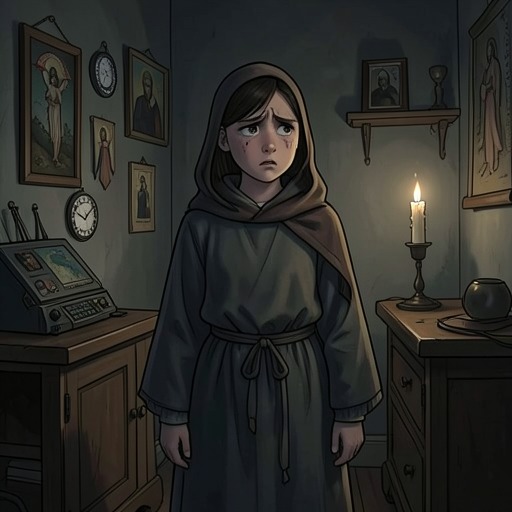
The account dates the news of the prince’s death to 22 February 1511. Katherine receives it at the height of her happiness, then withdraws to her room, ordering the shutters closed and the doors bolted. The gestures mark an attempt to shut out both the news and the ordinary world continuing beyond her grief. A page’s laughter in the garden seems incomprehensible to her: the child’s death has made joy itself appear impossible.
The narrative presents Katherine’s response through her disorientation and inability to take in what is happening around her. She thinks that Henry and María de Salinas are present, and sees Margaret Pole, Thomas Howard, and William Compton, but cannot be sure of the faces before her. She recalls the child as a real, particular person, not merely an heir or an emblem of the future. Yet the account gives no cause of death; its emphasis is on the news, the mother’s bereavement, and the collapse of the meaning she had relied upon.
Grief, Faith, and Shared Loss
Katherine had believed that courage and faith would carry her through whatever sorrow came. The prince’s death makes that belief seem to her like an illusion. She connects her pain to losses among the women of her family, including the darkness her mother experienced after losing a son and the grief associated with Juana. Arthur’s death had already broken her heart, but she now feels that losing her child has taken away her desire to live. She cannot understand why an innocent child should die, and the event becomes a crisis of faith as well as a bereavement.
Margaret Pole, who had been responsible for the child’s nursery, enters Katherine’s room without waiting for an invitation and kneels before her. She asks Katherine’s pardon while acknowledging that she has done nothing wrong. The gesture does not explain the death or remove blame; instead, it creates a point of contact between two people affected by the same loss. For the first time in weeks, Katherine looks directly at another person and recognizes that the grief is not hers alone. She turns toward Margaret, who catches and holds her.
That recognition changes the scene without diminishing the loss. Katherine tells Margaret that losing Arthur felt like torture, while losing the baby feels like death itself. Margaret answers not with a claim that grief can be avoided, but with the assurance that Katherine can learn to bear it. She recalls that Katherine endured sorrow at Ludlow and insists that grief will not destroy her: she will live, return to the world, love, and have another child. Katherine cannot yet see that future, but Margaret’s confidence gives her a voice and a companion within the silence.
Consequences and Significance
The event overturns Katherine’s certainty that God will protect her and drains away, for a time, her ambition to rule England and keep the country safe. That reversal is especially sharp because she had understood her authority and her duty to secure the succession as parts of a divinely appointed purpose. Her individual body, previously celebrated in the anointing ceremony and bound to hopes for a royal future, now bears the limits of that purpose: neither rank nor faith can prevent the child’s death.
The scene does not resolve Katherine’s grief or restore her faith. It ends instead with Margaret’s promise that recovery and renewed happiness remain possible, even though Katherine cannot imagine them. The prince’s death therefore stands at once as a dynastic loss and a turning point in Katherine’s inner life. Its immediate consequence is not political action but a profound break in her former confidence; its first counterweight is the friendship that allows her to begin bearing what she cannot undo.