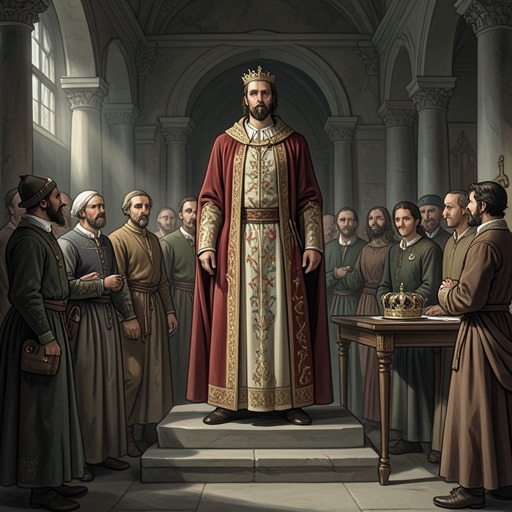
Death of Henry VII
The Constant PrincessThe death of Henry VII on 21 April 1509 transformed Catalina of Aragon’s long, precarious wait into a new contest over her future. It did not settle her claims to money or guarantee her marriage to Harry Tudor, but it removed the king who had opposed her and left the decision to his successor. Catalina’s first response was guarded hope: the change she had awaited had come, but its promise was not yet secure.
News of the King’s Death
The news reached Catalina in a brief letter from Gutierre Gómez de Fuensalida, the Spanish ambassador. He reported that Henry VII was dead and warned that, on his deathbed, the king had told his son that he was free to marry whom he chose. Fuensalida offered to arrange a ship to take Catalina to Spain, even offering his own funds, and cautioned that remaining in England might bring her only insult, disgrace, or danger. His message joined a report of death to an immediate question of policy: whether Catalina should leave or wait to see what the new king would decide.
The report contradicted the impression Henry had made on Catalina during his illness. She had heard that he was sick, but had thought he never weakened and might reign forever. The news therefore marked not only the end of his rule but the sudden disappearance of a powerful and familiar obstacle. When one of her ladies asked what had happened, Catalina answered that the king was dead; she then went out alone rather than accept María de Salinas’s offer of company.
The Unsettled Claims
Henry’s death came against the background of a bitter dispute over Catalina’s dowry and widow’s provision. Earlier, when Catalina told Margaret Pole that Henry had been displeased, she identified the dowry as the cause. The Spanish king had agreed to a substantial payment but sent only half in cash, proposing that the rest be made up through the plate and treasure supplied for Catalina’s household. Henry demanded the full amount. At Ludlow Castle, where Catalina and Arthur had lived, meals were served on Catalina’s gold plates, so their use could diminish the value of the goods intended to satisfy the unpaid balance.
The financial dispute remained pressing after Arthur’s death. Catalina’s mother had instructed her to stay where she was until she could establish whether she was pregnant; if she was not, she was to demand her jointure as Dowager Princess of Wales and sail for Spain only after receiving the full payment. If she was pregnant, she was to seek payment of the dowry in cash, secure her allowance, and hope for a son. The claims were substantial: Henry was required by contract to provide a third of the revenues of Wales, Cornwall, and Chester, while Catalina’s parents also demanded the return of her dowry. Catalina doubted that Henry would pay, noting that he had not even provided her allowance while Arthur was alive. His death altered who held power, but did not itself resolve these obligations.
Catalina’s Choice to Wait
Rather than treat Fuensalida’s offer of passage as a settled plan, Catalina focused on the change in succession. In her account, she ran beside the river, trying not to let hope overwhelm the caution formed by years of disappointment. Henry had wanted to marry her after Arthur’s death, and Catalina had refused him; now, she believed, Harry would decide what came next. She had watched Harry closely and judged his character, and that knowledge gave her a faint reason to hope that the new king might be more favorable to her future.
The possibility of marriage was still constrained by dynastic and ecclesiastical authority. When Henry had proposed marriage, Catalina’s obedience to her mother was invoked: without her parents’ consent, they would not seek the necessary papal dispensation. The question of whether her marriage to Arthur had been consummated was also treated as relevant to the proposed union. Henry’s death did not erase these barriers; it made Harry’s choice, and the willingness of Catalina’s family to support the match, newly decisive.
From Bereavement to Coronation
The consequences became visible within the new reign. On 24 June 1509, Catalina was carried from the Tower to Westminster in a cloth-of-gold litter, wearing white satin and a pearl coronet. Harry was crowned first; Catalina then received the holy oil, the sceptre, and the ivory wand, and took her place on a throne slightly lower than his. Her coronation fulfilled the queenly destiny she had long insisted upon, turning the uncertain status of a widowed princess into public, anointed queenship.
Henry VII’s death thus changed the conditions under which Catalina could pursue her future, rather than instantly granting her security. The reported freedom he gave Harry to choose a wife made succession a matter of personal decision as well as family negotiation; Catalina’s coronation showed how quickly that change could elevate her position. Years later, when Harry sailed for France, he appointed her regent, governor of the realm, and captain general for home defense. That later authority was not a direct consequence of the death alone, but it belonged to the political future made possible by the succession it had begun.