Edward Howard
The Constant PrincessEdward Howard’s brief career turns from celebrated naval success to a disastrous attack on the French fleet, making him both a favorite of the English court and a casualty of its appetite for martial glory. His death at Brest leaves Katherine of Aragon grieving a trusted young commander and forces Henry VIII to confront warfare as something more brutal than a tournament or a story of heroic triumph.
Identity and Early Reputation
In autumn 1511, Howard returned to London with captured Scots privateers brought back in chains. The victory made him an English hero, and the acclaim stirred Henry VIII’s envy. Ever attentive to popular approval, the king increasingly spoke of war against Scotland; the Privy Council feared its cost and doubted Henry’s military ability, but recognized Scotland as a continuing threat to England’s peace and security.
Katherine redirected the king’s ambition. Rather than let his first experience of war be a campaign in the border hills, she urged him to seek glory in Europe against France, alongside the other great Christian kings. Henry, raised on tales of Crécy and Agincourt, was receptive to the prospect. Howard’s success had helped intensify the king’s desire for war, but Katherine’s intervention helped turn that desire toward a larger campaign—and toward the naval service in which Howard would soon be sent to fight.
Departure and the Queen’s Confidence
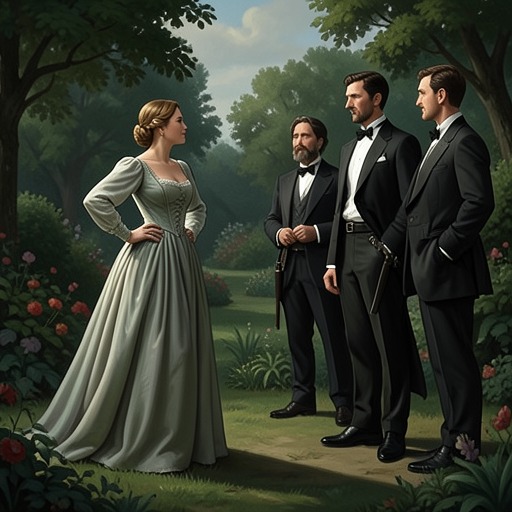
As the fleet prepared to sail, Edward Howard came to take leave of Katherine of Aragon in a new cloak of dark sea-blue. His orders were to blockade the French ships in port or engage them on the open sea. The mission joined the naval command he loved to the larger campaign Katherine had urged Henry VIII to pursue: she believed England’s safety depended on command of the seas, and Howard’s enthusiasm for ships made him especially dear to her among the king’s young companions. His gaiety and open affection also suited the courtly world of Camelot, whose romantic ideals remained close to the minds of Henry’s friends.
The farewell gave that ideal a personal form. Katherine’s voice shook as she blessed him and wished him luck. Howard answered that it was an honor to serve his country, the king, and, in a lowered intimate whisper, her. She called him her knight and said, “You are my knight, and I trust you to bring glory to your name and to mine,” watching pleasure show in his eyes as he bent to kiss her hand. He promised to bring back French ships, as he had brought back Scots privateers. Katherine replied that she needed them, then raised a finger to warn him, “No dying,” adding that she needed him too and would think of him every day and in her prayers. The exchange entwined public service with personal trust: Howard sailed not only as an admiral charged with the fleet, but as the queen’s chosen champion.
The Attack at Brest and Death
On the feast of St. George, while the court waited for news of the fleet, a messenger brought word of the battle off Brest. Edward Howard had pinned the French ships inside the harbor, where they would not venture out. Rather than hold his position and wait for them to act, he chose to attack with a handful of rowing boats, sending his men beneath the guns guarding the French fleet. The assault was a costly failure: the English ships could make no advance, while the French remained protected in port. Katherine understood his impatience as the fatal error of a young commander who mistook courage for invulnerability and was too eager to force a victory.
The account of his final moments made the cost brutally tangible. Howard fought on after slipping and falling, using one arm to parry until a blade cut into his sword arm and left him unable to fight. His opponents pressed in and killed him with a hundred stab wounds. He had set out certain that he would return with a French galleon for the Pool of London; instead, his death turned the promised naval triumph into a report of slaughter.
The French first threw his body into the sea. Once they recognized him as the English admiral and the son of a powerful English family, they attempted to recover it—not to honor him, Katherine believed, but because a living prisoner could have been ransomed. Sailors went out with hooks to drag him back from the water. They gutted the corpse, cut out and salted his heart, and took his clothes as souvenirs to send to the French court. What remained was returned to his father and Katherine. The desecration made Howard’s fate more than a battlefield death: even after he could no longer resist, his body became spoil, stripped of the burial and respect his enemies might have granted a formidable opponent.
Aftermath and Significance
The account of Howard’s death reshaped Katherine’s understanding of the enemy and of the chivalric ideals surrounding the court. She recalled Hernando Pérez del Pulgar’s daring raid on the Alhambra and imagined that the Moors, had they captured a great foe, would have honored him and returned his body with ceremony. By contrast, the French had mutilated Howard and treated his remains as salvage. The reversal unsettled the language of Christian and barbarian: Katherine found herself ashamed to call the Moors barbarians when the French had shown so little charity toward a fallen Christian. Her grief sharpened into a vow that France would regret killing her champion, and that the desecration would never be forgiven.
Howard’s death also made the approaching campaign against France newly real to Henry VIII. Katherine worked harder on preparations for the English army’s departure for Calais, insisting through her efforts that real shot, cannon, swords, and arrows be made well and aimed truly. Henry had imagined war through stories and jousts; Howard’s fate showed him that a brilliant young man could leave in sunshine and return butchered in a cart. He did not lose his courage, but the loss darkened his mood as he prepared to follow the troops. With Thomas Howard stepping into his brother’s place and their father summoning tenants and calling in debts to raise men for vengeance, Edward’s death became both a private bereavement and an impetus to the English war effort.