England, Catherine's realm
The Constant PrincessEngland, Catherine's realm, is presented as a promised home, a dynastic prize, and a political responsibility that Catalina must claim through marriage, endurance, and government. First imagined as the country she is destined to protect, it becomes the setting in which her identity as Princess of Wales and Queen of England is tested against succession fears, financial disputes, bereavement, and the limits imposed on a royal woman’s authority.
A Realm First Known as Destiny
Before Catalina travels there, England is already central to the life arranged for her. Betrothed to Arthur, Prince of Wales, since she was three, she expects to sail there at fifteen, marry him, and become queen. Her future is described as settled almost from birth: leaving her mother and homeland will bring sorrow, but she understands the match as both her duty and her destiny. England is not merely the place where she will live; she imagines it as a country she will care for and make her own.
That expectation is also political. Catalina is the daughter of Isabella of Castile and Ferdinand II of Aragon, and the marriage joins their emerging Spanish dynasty to the House of Tudor. On her arrival, Henry VII of England warns that traveling overland would have exposed her to capture amid hostility with France; as a royal bride, she would have been a valuable hostage. Catalina, however, answers the suggestion that she is only about to become Princess of Wales by insisting that the title has belonged to her since childhood. England is the destination of a plan she has long treated as certain, even when the journey makes its dangers plain.
Marriage, Succession, and Royal Space
The wedding gives Catalina a public place in England, but it also reveals the scale of the political interests invested in her. When she and Arthur take their vows, she understands that she has finally assumed the name and position prepared for her. The crowd’s welcome expresses more than delight in the young couple: it also carries hope that a settled succession will protect the country from civil conflict. The celebration presents the marriage as a union between the Spanish monarchs’ new realm and the Tudor dynasty, and as a public declaration of royal continuity.
The couple’s first English settings include the royal barge’s progress downriver to Baynard's Castle Palace in London, where they take up residence. Their marriage is not isolated from the bargaining that made it possible. At Ludlow Castle, Catalina’s household uses her gold plate, while the dispute over the promised dowry continues between Henry VII of England and Ferdinand II of Aragon. Ferdinand has sent only part of the agreed money and proposes that the value of the household goods make up the difference; Henry demands the full amount. Catalina is caught between two rulers’ competing claims, and objects brought to furnish her household become part of the financial argument surrounding her place in England.
Arthur’s death turns the marriage settlement into a question of her future in the realm. Catalina is told that her widow’s jointure should amount to a third of the revenues of Wales, Cornwall, and Chester, while her parents also demand the return of her dowry. She doubts that Henry VII of England will pay either sum, recalling that he did not provide her allowance even while Arthur lived. The contractual claims establish a material basis for her position as a royal widow, but the narrative makes clear that their value depends on whether the king will honor them.
The Queen's Body and Authority
Catalina’s eventual coronation makes England’s political order visible through ceremony. On 24 June 1509, she is carried from the Tower of London to Westminster Palace in a cloth-of-gold litter borne by four white palfreys. Wearing white satin and a pearl coronet, she is crowned after Henry VIII. The holy oil, scepter, ivory wand, and throne set just below the king’s give formal shape to the authority she has awaited. She understands anointing as confirmation that she has at last taken the place promised to her and that her queenship carries divine appointment.
The novel also binds the queen’s public standing to her capacity to produce an heir. In January 1510, Catalina’s first pregnancy ends with the birth of a stillborn daughter. Her grief is compounded by the meaning she attaches to the loss: she believes she has failed England, her husband, and Spain, and privately feels that she has failed Arthur as well. The episode shows how dynastic expectation makes a private bereavement bear the weight of several countries’ political hopes. Her body is treated not only as her own, but as the place where the continuity of the monarchy is expected to be secured.
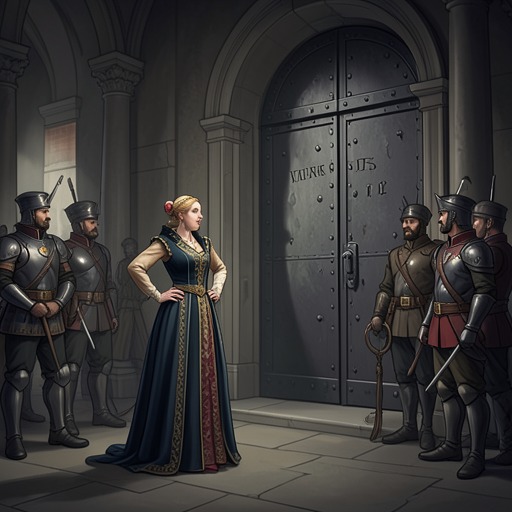
Later, the question of her marriage becomes a legal and political contest. The proposed marriage between Henry VII of England and the widowed Catalina faces the affinity objection: she had been married to Henry’s son, Arthur. The claim that the first marriage was not consummated is therefore consequential, and a papal dispensation is discussed as necessary to overcome the obstacle. Years later, in the court proceedings over her marriage to Henry VIII, Catalina enters despite having prepared no legal defense and having declared that she does not recognize the court. Her appearance turns the dispute over the validity of her marriage into a direct confrontation before the king and the assembled court.
From Queen to Governor
England becomes more than the object of Catalina’s childhood hopes when she receives formal governing authority. As Henry VIII prepares to sail for France, arrangements for the expedition are made with care; four hundred ships wait at the docks. At Dover, in a public ceremony, Henry gives Catalina the Great Seal of State and appoints her regent, governor of the realm, and captain general of the forces charged with home defense. The transfer places the machinery of government in her hands while the king is away.
Catalina presents the appointment as the fulfillment of her ambition: beyond her titles as Princess of Wales and Queen of England, she is now governor and commander, with responsibility for the country itself. Her first stated objective is to defeat the Scots. The appointment does not erase the gendered and dynastic constraints surrounding her, but it gives her a defined public office and an immediate task in the defense of England, Catherine's realm.
A Realm Claimed and Contested
Across Catalina’s life in England, royal identity repeatedly depends on public recognition: the wedding crowd welcomes a promised succession, the coronation consecrates her queenhood, and the regency ceremony entrusts her with the realm’s defense. Yet each recognition is exposed to challenge. Dowry negotiations make her household goods instruments of diplomacy; widowhood brings contractual claims whose payment she doubts; pregnancy carries the burden of succession; and the later marriage case puts her personal history before a court whose authority she rejects.
England is therefore both the country Catalina says she will protect and the political order that requires her to prove her right to belong within it. Her constancy is measured not by an uneventful ascent but by repeated changes of status: prospective bride, wife, widow, queen, regent, and litigant. The country she first imagines as a destined home becomes the arena in which she attempts to turn inherited promises into recognized authority.