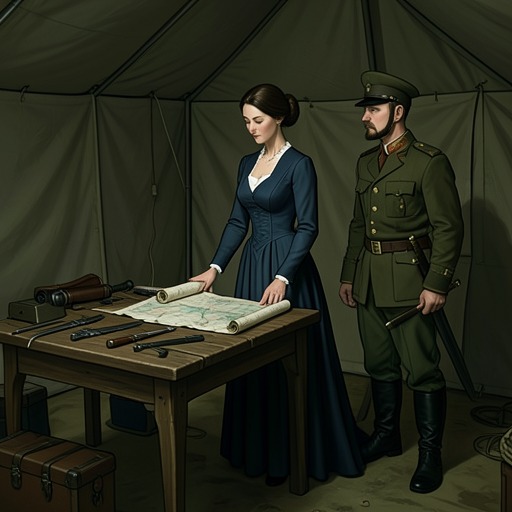
English army
The Constant PrincessThe English army is both a military force and a measure of Katherine of Aragon’s growing political authority. She helps organize its supplies, assess its readiness, and direct its deployment; when she becomes regent, she plans its defense of the kingdom. Its campaigns reveal the gap between the promise of glory and the practical demands of command—and, finally, give Katherine the power to choose restraint after victory.
Formation and political purpose
Katherine’s idea of England’s military role begins with the religious and dynastic convictions she learned in Spain. She sees an alliance between England and Spain as essential to resisting France and defending Christendom against Muslim powers. In that vision, English wealth and ships could extend a Spanish-led struggle beyond Europe. Her understanding of the army is therefore bound up with international alliance and religious duty, rather than limited to the defense of England’s borders.
At the English court, Katherine works with members of the Privy Council to strengthen the kingdom and its defenses. She supports efforts to make the law operate throughout the country, to survey ships that might be assembled into a fighting navy, and to draw up army muster rolls. These measures place military readiness within a broader project of government: an army needs records, supplies, coastal defenses, and a functioning realm behind it. Katherine presents this work as the practical realization of hopes she and Arthur had shared for a peaceful and powerful kingdom.
Alliance, preparation, and failure
Before a campaign against France, Katherine considers both the army’s readiness and the risks to Henry VIII. In a coded letter to her father, Ferdinand II of Aragon, she proposes that Henry should experience campaigning and learn how battles are conducted, but insists that he must not be exposed to real danger. Ferdinand agrees to manage that risk without letting Henry know that he is being protected. The exchange shows the English army serving as a school for its inexperienced king as well as a tool of alliance.
Katherine also weighs the danger from Scotland before supporting the dispatch of English forces abroad. Thomas Howard, Earl of Surrey, and intelligence gathered from merchants and travelers lead her to judge that a major Scottish invasion is unlikely that summer. She treats that assessment as a condition for sending the army against France, not as a reason to disregard the northern border. Her decision links foreign deployment to surveillance at home.
In spring 1512, Katherine oversees the provisioning of an expeditionary fleet joining Ferdinand’s campaign. Her preparations include ships, armories, and equipment for the soldiers; she regards reliable supply as a prerequisite for victory. The force sails with high expectations of defending the Pope, defeating France, and winning territory. Instead, the English army returns in December in disarray. Lord Dorset has received neither clear orders nor the reinforcements he expected from Ferdinand; mutiny, exhaustion, and illness have further weakened the troops, and two thousand men have been lost to sickness. Katherine recognizes that the English had been kept inactive in Fuenterrabia as a diversion, helping to hold French forces in place while Ferdinand invaded Navarre. The campaign thus exposes the difference between England’s declared military partnership and Ferdinand’s use of English troops to serve his own strategy.
The army under Katherine’s regency
When Henry prepares to sail for France, he appoints Katherine regent, governor of the realm, and captain general of the English forces for home defense. The English army now belongs directly to the problem of protecting the kingdom while the king is abroad. Katherine’s immediate priority is Scotland, whose incursions she sees as a threat to the security of the realm and her own authority.
She plans for defeat as well as victory. Forty thousand of her men march behind the royal guard, carrying weapons and provisions. Katherine rides at the head of the column beneath the royal standard and makes her way along the line twice daily to encourage the troops. Meanwhile, her force coordinates with Surrey’s army: Surrey is to engage the Scots first, while Katherine keeps a reserve that can block a further advance if he is defeated. If the defense fails, their plan provides for regrouping, summoning a citizens’ army, fortifying London, and, as a last resort, holding the Tower of London until Henry can return from France.
The plan reflects Katherine’s view that a campaign cannot be reduced to a single battle. When reports place the Scots on high ground at Flodden, she judges that an uphill assault would expose the English to a severe disadvantage. She advises Surrey to seek a route around the Scots, or to draw them off the ridge, while leaving him authority to make his own decision in the field. Her counsel joins tactical attention to terrain with a larger defensive design: preserving the army and the route to the capital matters as much as winning an immediate engagement.
Victory and the choice of peace
After the English victory, Surrey reports that the Scots’ king and many leading figures have died. He credits the result to men Katherine raised, trained, and armed, and tells her that the victory has made England safe. Yet the army’s success creates a new decision rather than ending Katherine’s responsibility. She considers the possibility of pursuing the defeated Scots and destroying their capacity to resist, but concludes that such a policy would perpetuate the conflict and pass it to the next generation.
Katherine therefore orders Surrey to allow the Scottish soldiers to surrender their arms and depart in peace. She also intends to offer peace to the Scottish queen, on the condition that she become a good sister and neighbor. The English army’s role shifts, in this ending, from defending the kingdom to making a victory compatible with reconciliation. Its story traces Katherine’s development from an advocate of expansive religious war to a commander who sees that military success cannot by itself secure lasting safety.