Establishment of Santa Fe
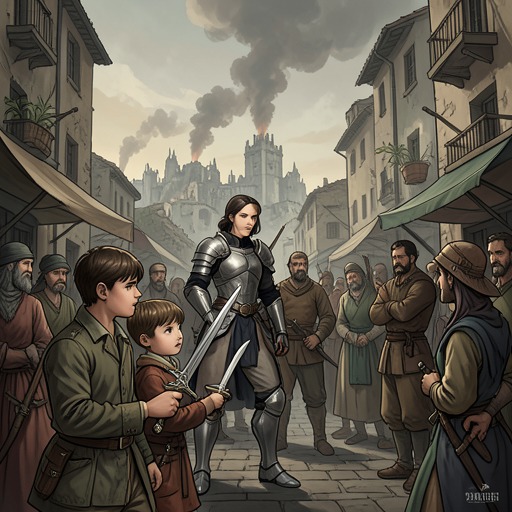
The Constant PrincessThe Establishment of Santa Fe transforms the destruction of a siege camp into an act of political and military resolve. When fire leaves the Spanish army without tents or shelter outside Granada, Isabella of Castile refuses to withdraw. She directs the army to build in stone instead, and a camp becomes a town bearing the name Santa Fe. The episode presents construction itself as a response to defeat: rather than surrendering the season’s campaign, the royal army remakes its position and continues the siege.
Fire and the rejected retreat
The crisis begins with the Spanish camp reduced to smoldering hangings, ruined tents, and heaps of burned forage after a candle is carelessly set. The army had ridden out proudly to besiege the last great kingdom of the Moors in Spain; now its shelter and supplies are destroyed, and retreat appears to the generals the only practical course. They argue that the army has lost the season, not the war, and can return after provisioning itself and setting the siege again. Their case rests on immediate military necessity rather than unwillingness to fight.
Isabella rejects that distinction. She argues that retreat in singed clothes, carrying burned carpets, would give the enemy reason to laugh, and insists that pride matters precisely because the Moors understand it. She also frames forward movement as God’s will, refusing to treat withdrawal as a neutral military choice. The decision is therefore both strategic and religious in the scene: the army must not merely recover from the fire but demonstrate that the disaster has not determined the campaign’s direction. Ferdinand II of Aragon does not oppose her. When the generals look to him, he affirms her judgment, and when the lack of tents is raised, he asks Isabella what she proposes to do.
The decision to build in stone
Isabella’s answer is to build a city of stone rather than another camp. The generals point out the scale of the difficulty: the countryside has been laid waste for miles, there is no cloth or canvas, no watercourses, and no crops in the fields. The army has broken canals and plowed up crops; in the account’s pointed reversal, it is the besiegers who have been left devastated. The plain around them is arid and rocky, but stone is available. Isabella turns that constraint into the basis of her plan, and when its feasibility is challenged, she insists that it will be done.
The narrative makes the change in purpose visible in the army’s labor. Defeated by fire, the soldiers turn to earth and water, working in spring heat by day and cold at night. Cavalry officers, generals, great lords, and royal cousins all toil and sleep on hard ground. Their labor is a striking reversal of the triumphant advance they had expected: rank does not exempt them from building the place that will sustain the campaign. From the high battlements of Granada’s red fort, the Moors observe the Christians’ determination and concede their courage, even as the fortress seems nearly impossible to take.
From camp to town
Construction proceeds in stages. A round chapel, shaped like a mosque, is built first because local builders can make it most quickly. Next comes a small, flat-roofed house set inside an Arabic courtyard for Ferdinand, Isabella, and their family: the Infante, their son and heir, and their daughters Isabel of Aragon, María of Aragon, Juana of Castile, and the baby Catalina. Isabella asks for no more than a roof and walls, having spent years at war and expecting no luxury. Around the royal household, a dozen stone hovels provide reluctant shelter for the country’s greatest lords.
Practical military needs follow. Stables are built for the horses, along with secure stores for gunpowder and explosives. The account emphasizes that Isabella pawned her own jewels to buy these supplies from Venice, connecting the new settlement’s defenses to the resources and sacrifices required to keep the siege going. Only after the stables and secure stores are in place do barracks, kitchens, stores, and halls follow. The order of construction gives the new town a clear function: it must house the royal family and army, protect valuable military supplies, and support the continuing campaign before it can offer the fuller arrangements of a settled community.
A setback made into a foothold
The transformation is deliberately presented as improbable. No one thinks the work can be completed, yet a little town rises in stone where the camp stood, and it is named Santa Fe. Isabella has, in the narrative’s words, triumphed over misfortune again. The siege of Granada does not end with the fire or with the building project; it continues from the new town. Santa Fe thus marks a change in the form of the campaign rather than its conclusion: the army replaces its destroyed encampment with a constructed base and renews the pressure on Granada.
The episode also establishes the political character of Isabella’s command. Her response does not deny the material losses or offer an easy victory; it converts scarcity into a plan, and her husband’s public support allows that plan to direct the army. Stone becomes the answer to the absence of canvas, collective labor the answer to the burned camp, and a city the answer to the proposed retreat. In the novel’s account, Santa Fe is at once a practical military settlement and a visible assertion that the siege will continue despite disaster.