France, the rival kingdom
The Constant PrincessFrance, the rival kingdom, is a persistent political and military presence in the story rather than a place described for its own sake. Its proximity makes travel dangerous, its ties with Scotland threaten England from the north, and its contested borders become the focus of competing plans for alliance and war. France also gives dynastic marriage its larger purpose: rulers imagine that marriages and shared heirs might secure a peace that force alone cannot guarantee.
A Rival at England’s Borders
France first appears as a danger on Catalina of Aragon’s route to England. After her voyage from Cádiz was driven back by storms and forced into Plymouth, an overland journey was considered out of the question: the French king might have taken the royal bride as a hostage. The threat turns France from a distant rival into a risk that could have interrupted her arrival and altered the political value of her marriage before it began. The king’s relief that she had not fallen into enemy hands underscores how her person already carried diplomatic weight.
That danger is not confined to the southern approaches. Edward Stafford, Duke of Buckingham, explains to Catalina that Scotland repeatedly allies with France during wars and crosses England’s northern borders. Scotland may be small, but its position offers France a way to invade from the north. English concern about France therefore depends on the geography and conduct of its neighbors: the threat is not only a direct confrontation, but also the possibility that an ally will open another front. The account connects that strategic anxiety to raids and recurring border conflict, as well as to the king’s stated determination to secure peace.
Maps, Marriage, and the Promise of Peace
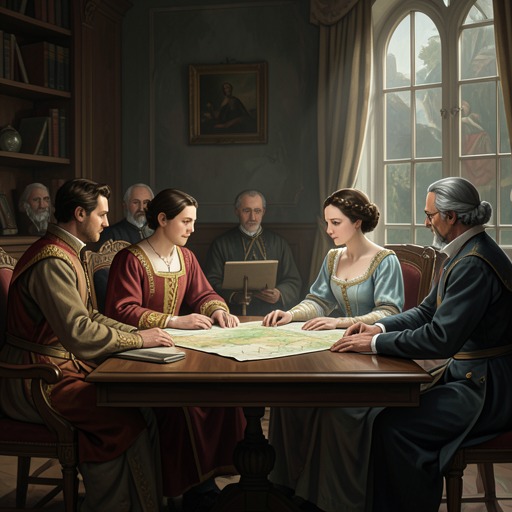
A map becomes the clearest image of France’s place in the political imagination. Henry VII spreads out a collection whose illuminated sea monsters frame coastlines and borders, tracing England, France, the Holy Roman Empire, the papal lands, and the widening territories of Catalina’s homeland. His argument is practical: England and Catalina’s homeland must be friends because France’s power presses upon both, and they cannot trade freely unless France can be kept out of the narrow seas. France thus threatens both land security and the maritime connections on which relations between the kingdoms depend.
The map also turns rival territory into a dynastic calculation. Henry imagines that a son of Catalina’s could inherit England, an alliance with Scotland, and English lands in France, while another branch of the family might unite Spain and the Netherlands. Their descendants would be powerful cousins, bound together across territories that otherwise invite conflict. Catalina welcomes the prospect of a son whose rule might extend across much of Christendom, and imagines that he and Juana’s son could drive the Moors back. The vision is expansive, but France is its immediate political problem: land claimed or held there appears as part of the inheritance through which England might gain security and greatness.
France also figures in the unresolved marriage negotiations surrounding Catalina. After Margaret Beaufort’s death, Catalina fears that the court may consider another bride for Harry, even a French one. Such a match would not merely displace her; she understands it as a possible failure of the alliance her parents need her to maintain between England and Spain, and of their shared opposition to France. Henry VII, meanwhile, sees the proposed marriage to Catalina as a way to secure the remaining dowry, avoid the cost of her jointure and maintenance, and preserve the Spanish alliance while seeking further agreements with Scotland and France. The same country can therefore represent both a rival to be contained and a partner to be courted.
From Containment to a Campaign
Under Harry, the language of containment gives way to an eagerness for war. He declares that France’s king cannot avoid conflict and orders heavy armor intended for the battlefield rather than for jousting. Catalina has reasons to resist this direction: she believes that if an English army leaves for France, Scotland may exploit its absence and invade the north. She also sees unfinished domestic work—tax reform, schools, the king’s council, forts, and a defensive navy—as more urgent than Harry’s desire for a campaign. France is consequently not just a target abroad; preparations against it compete with the work of governing at home.
Catalina’s father advises that any war with France should be launched not from the north coast, where England usually invades, but along the French-Spanish border. He proposes reconquering Aquitaine, which he believes would welcome liberation from France and receive Spanish support. The account presents this as a proposed campaign, not an accomplished conquest. Its imagined ease and glory reveal how royal counsel could turn a disputed border into a plan for coordinated intervention, while also showing Catalina’s position between her father’s strategy and her husband’s martial ambitions.
France and the Queen’s Authority
The military plans eventually make France the destination of Henry’s expedition and the circumstance of Catalina’s rise to governing power. The preparations are extensive: four hundred ships wait at Dover, with the king’s vessel, royal guard, armor, and horses ready for departure. Before sailing, Henry invests Catalina with the Great Seal of State and appoints her regent, governor of the realm, and captain general of the forces assigned to home defense. His campaign abroad gives her authority over the kingdom he leaves behind.
That transfer brings the story’s competing strategic pressures together. Catalina regards the regency as the power she has long wanted, but immediately identifies the Scots as the enemy she intends to defeat. France’s expedition has therefore produced a vacancy in domestic command, while the danger associated with France’s Scottish alliance remains active at the border. The country’s narrative significance lies in this recurring conjunction: it is at once a threatened frontier, a diplomatic counterweight, a possible source of dynastic claims, and the destination whose wars place Catalina in command at home.