Granada, the Nasrid stronghold
The Constant PrincessGranada, the Nasrid stronghold, is at once a military objective, a contested seat of power, and the homeland Catalina continues to imagine after leaving it. The narrative first places it at the center of the Spanish campaign in 1491, then records its surrender the following year. Later, its gardens, water, and surrounding mountains return in Catalina’s memories and dream, giving the lost city a life beyond the account of conquest.
Setting and Defenses
The narrative situates the red fort above the city, on a cliff overlooking a broad plain. The rise of red rock becomes, in the description, the red stone walls of the fortress; its elevation and sheer face make it inaccessible to scaling ladders or a climbing party. The fort is said never to have fallen in two centuries. Its position does not merely make an assault difficult: it limits the possibilities of surprise and makes a straightforward military victory appear unattainable.
Within the walls, the Alhambra Palace is associated with gardens and with al-Yanna, the garden understood as an image of paradise. The account sets this cultivated interior against the rougher castles and fortresses of Castile and Aragon. This contrast presents Granada not simply as a fortified possession, but as a place whose political strength and beauty belong together in the imagination of its defenders. The palace and the fort are distinct elements of the setting, yet both become part of the inheritance transferred when the city surrenders.
The city’s natural surroundings also persist in Catalina’s recollections. She remembers the Sierra Nevada, the olive trees, the red soil turned by farmers, and the seasonal return of water to the canals. These details are not a separate description of the campaign landscape; they are the features through which the absent place becomes intimate and recognizable to her. Granada is therefore rendered both as a strategic stronghold seen by armies and as a lived landscape recalled by someone far away.
The Campaign and Siege
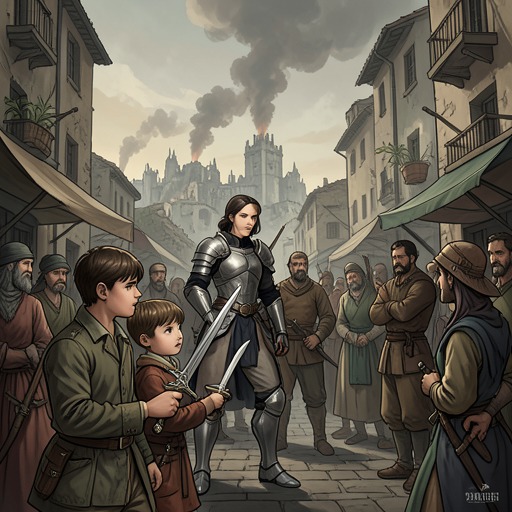
In 1491, a fire in the Spanish army’s camp outside Granada destroys tents, hangings, and forage. The damage is traced to a single carelessly placed candle, and the army has no choice but to regroup and withdraw from its immediate position. This setback occurs outside the city: the camp is devastated, not Granada itself. The distinction matters to the episode’s course, because the army’s defeat by fire does not end the campaign or bring down the fortress.
Isabella of Castile refuses to treat retreat as the conclusion. Instead of advancing directly against the defenses, the army turns to work on the land, laboring in the heat and cold and sleeping on hard ground. The narrative emphasizes that this work is shared across rank: cavalry officers, generals, great lords, and royal cousins are all expected to take part. From the battlements, the Moors recognize the Christians’ courage and determination, even as the account stresses how difficult the undertaking remains. The contrast between the fortress’s apparent invulnerability and the besiegers’ continued labor defines the prolonged struggle around the city.
The turning conditions are political as well as military. By 6 January 1492, the account describes the Moors’ position as steadily weakening. The Queen’s Skirmish has been their last battle, their champion is dead, the city is encircled, and the population is starving in a land its forebears had made fertile. Expected support from Africa has not arrived; the account also notes that the Moorish king’s son is held as a hostage by the Christians. Against these losses, Isabella of Castile and Ferdinand II of Aragon command the campaign, which is presented as a Christian holy war gathering momentum. The narrative thus locates the city’s fall in a combination of encirclement, deprivation, failed support, and the growing power of its opponents, rather than in the breaching of its defenses.
Surrender and Transfer
Within days of the meeting of the champions, Boabdil, identified as the King of Granada, agrees to terms of peace. The ceremony that follows is described as carefully arranged and marked by the grace attributed to the Moors of Spain. Boabdil walks on foot to the city’s iron gates carrying the keys to the Alhambra Palace on a silken pillow, and hands them to Isabella of Castile and Ferdinand II of Aragon. The gesture makes the change of rule legible: authority over the city and its principal palace passes through a formal act of surrender.
The account names the red fort, the city, and the palace as the possessions given to the two monarchs. The formidable defenses that had made direct conquest seem unlikely do not disappear from the story; instead, the transfer comes through an agreement reached after the city has been isolated and its position weakened. This reversal gives the surrender its particular force. A place presented as secure behind an almost unscalable height becomes the object of a negotiated handover, while the keys stand for a change that force alone had not easily secured.
The narrative’s language of victory is also bound to a larger religious and political claim: the campaign is framed as a Christian crusade, and Granada’s surrender as the culmination of that advance. At the same time, the account has already acknowledged the courage and determination of both sides. The city’s fall is therefore not represented as proof that its defenders lacked resolve. It follows from the closing of alternatives around them, while the ceremony preserves the dignity of the defeated ruler even as it confirms the transfer of power.
Memory and Narrative Significance
For Catalina, Granada remains a place of sensory and seasonal memory, though the account focuses on her recollection rather than on a return there. She imagines winter giving way: frost releasing the water in the canals, meltwater coming down from the mountains, and the soil warming as flowers and young trees are planted. The sequence continues through the reopening of the palace windows to warm breezes, the return of summer birds to the hills, the green-gray shimmer of olive leaves, and farmers turning the red earth. The details give her longing a particular landscape and calendar; home is not an abstraction but a place whose renewal she can picture in stages.
This recollection stands against her experience of England, where she dislikes the lingering winter and gray skies. The contrast makes Granada’s returning water, growing plants, and warm mornings a measure of what she has lost. Yet the memory does not lead her to abandon her duties. She describes herself as a sentry keeping watch and remains committed to the promise she made to Arthur. In this way the city’s remembered garden is linked to fidelity: the place she longs for belongs to her past, while her obligation holds her in her present life.
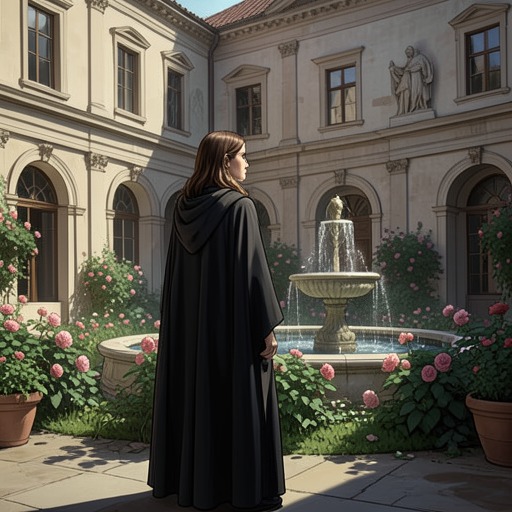
On the night before her betrothal to Prince Harry, Granada appears again in a dream. Catalina walks in the Alhambra garden with Arthur, showing him the sandstone wall, the city below, and the snow-capped mountains on the horizon. In the dream she tells him that she has fulfilled their plans and her mother’s wishes, and that she will become the queen he wanted her to be. Arthur answers that he will watch over her in al-Yanna. The word connects heaven, a cemetery, and a garden in Moorish usage, so the dream brings together the remembered palace landscape, grief for Arthur, and the prospect of death and enduring love. Granada consequently retains an emotional meaning the political surrender cannot erase: it is both the stronghold transferred to new rulers and the imagined garden through which Catalina understands home, promise, and loss.