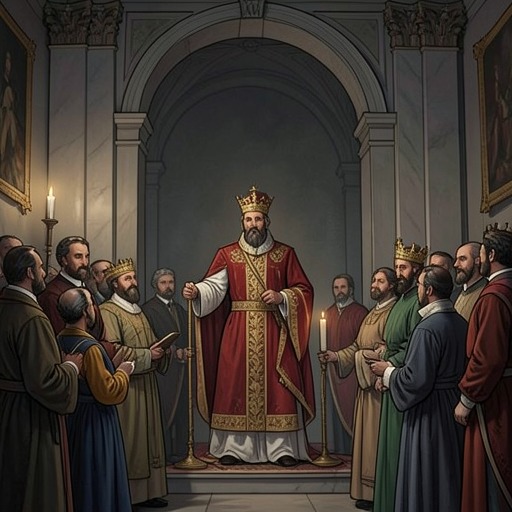
Henry VII Delays Catalina and Harry’s Marriage
The Constant PrincessHenry VII Delays Catalina and Harry’s Marriage traces how a dynastic betrothal remained unfulfilled for six years, keeping Catalina dependent on the English court while her dowry and status as a widow remained in dispute. What began as a negotiation between royal families became, in Catalina’s account, a prolonged condition of uncertainty and deprivation; its eventual resolution came only when she was crowned Queen of England in 1509.
Dowry and the Unsettled Betrothal
The marriage negotiations were entangled with a financial dispute from the beginning. Catalina told Margaret Pole that Henry VII was displeased over the dowry. The agreed sum had not been fully delivered: Catalina’s father had sent her with only part of the money, proposing that the remainder be represented by the plate and treasures in her household. Henry demanded the balance in cash. The dispute made Catalina’s possessions part of the political bargaining, rather than merely the equipment of her household.
After the death of Arthur, Prince of Wales, the question of Catalina’s future became more urgent and more conditional. A letter from her mother instructed her to remain where she was until she had completed a further course and knew whether she was expecting a child. If she was not, she was to have Dr. de Puebla seek her jointure as Dowager Princess of Wales and return to Spain only after receiving the full payment. If she was expecting a child, the instructions instead called for the remaining dowry to be paid in cash, her allowance secured, and her to rest in hope of a male heir. Her possible return, financial support, and prospects for another marriage were thus linked to both her widow’s rights and the unresolved question of an heir.
The ambassador explained that the jointure amounted to a third of the revenues of Wales, Cornwall, and Chester, while Catalina’s parents were also asking for the return of her entire dowry. Catalina doubted that Henry would pay either the sums or the revenues, recalling that he had not even paid her allowance while Arthur was alive. The contract established her claims, but she saw little reason to expect the king to honor them when doing so offered him no advantage.
The Betrothal Without a Settlement
In 1504, when Harry Tudor reached twelve and was declared Prince of Wales, Catalina expected that her betrothal would be formally advanced and that she would be invested as princess alongside him. Neither happened. She sought an explanation from the Spanish ambassador, who came only after a delay and could give no definite answer. He suggested that the English were waiting for the dowry payment, although Catalina understood that she no longer possessed all the plate that could have helped satisfy their demands. Without the missing contribution from her father, she had no means to make the arrangement proceed herself.
The legal obstacle was also acknowledged in discussions of a possible marriage to Henry VII. Dr. de Puebla raised affinity as a possible impediment and said that a dispensation would be needed. The proposed marriage depended on the claim that Catalina’s marriage to Arthur had not been consummated, but even Henry’s representatives recognized that the Pope’s dispensation would have to be sought. De Puebla argued that Catalina would obey her mother and that, without her parents’ consent and an application for the dispensation, the marriage could not take place. The negotiations therefore involved more than the king’s preference: family consent, church authority, and contested accounts of Catalina’s previous marriage all constrained what could be arranged.
Six Years of Waiting
Catalina later described the delay as lasting six years, from the age of seventeen to twenty-three. Harry grew from a child into a young man, passing successive birthdays without the marriage being celebrated or anyone coming to bring her to him. She rarely saw him and could not rely on him to make the betrothal binding. In her telling, the wait was not a pause between formal stages but an extended experience of powerlessness: she believed Henry’s hostility was effective precisely because she had no way to compel the court to act.
The financial consequences accumulated in ordinary necessities. Catalina turned the panels of her gowns, sold jewels, and parted with her gold plate piece by piece to feed herself and her household. She understood that the plate was claimed as the king’s property and that selling it weakened the resources connected to her marriage, but she could not leave her attendants unpaid and hungry. Her allowance stopped, and the royal household did not press her case. The dowry dispute therefore touched daily survival, while each sale further narrowed the means available to sustain her position.
Her surroundings reinforced that marginalization. After moving her household to court on the promise of rooms, Catalina found that she had been given poor accommodation and service and could see Harry only at formal occasions. On one progress, the court departed without telling her household; her party had to follow along unmarked country lanes and, on catching up, took the remaining rooms over the stables. The episode made the distinction between a promised place at court and actual access to royal favor painfully concrete.
Resolution and Significance
Catalina came to interpret the betrothal as a means by which Henry could keep her from marrying elsewhere without granting her the marriage she expected. That was her conclusion about his purpose, formed amid years of delay, dwindling resources, and his failure to provide for her. The arrangement left her bound to a future that the king could withhold, while the dowry dispute gave the parties another reason to defer its completion.
The impasse ended with the accession of Harry Tudor. On 24 June 1509, Catalina was carried from the Tower to Westminster as an English princess, in a cloth-of-gold litter drawn by four white palfreys. After Harry’s coronation, she was anointed and received the symbols of queenship. The ceremony marked the reversal of the years in which she had been kept waiting: the princess who had lacked money, secure accommodation, and influence was at last publicly recognized as Queen of England. The delay is significant not simply because it postponed a dynastic marriage, but because it shows how dowry claims, widowhood, royal authority, and ecclesiastical requirements could combine to determine whether Catalina could act on her promised future.