Hernando Pérez del Pulgar
The Constant PrincessHernando Pérez del Pulgar is a Spanish lord and soldier who leads a small band of companions on a daring raid into the Alhambra Palace during the siege of Granada. To the five-year-old Catalina, his exploit first makes him a storybook champion; his unexplained absence then exposes the danger beneath the glory. His return turns the raid into a celebrated triumph, but it cannot erase the fear his disappearance has awakened in her.
Identity and Introduction
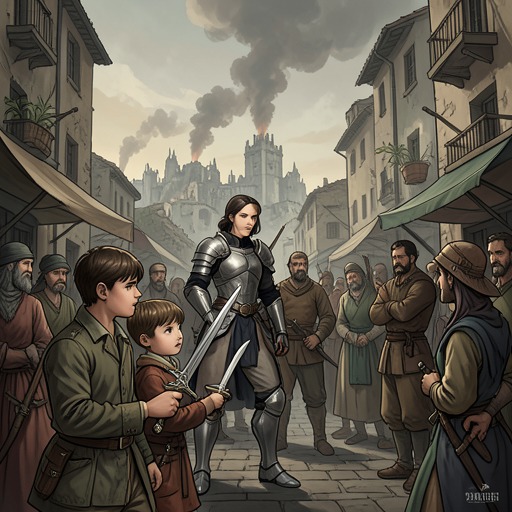
Hernando appears in the Spanish camp while the Christians are building Santa Fe, the stone town established during the siege of Granada. Catalina, still a young child close to her mother, finds him whispering with friends and asks what they are doing. He initially brushes her off as an Infanta, but her insistence wins her the confidence she wants: he agrees to tell her, provided she swears not to inform her mother.
His plan is a deliberately provocative one. He knows of a lightly guarded postern gate into the Alhambra Palace and intends to enter with his companions, say their prayers in the mosque, and leave an Ave Maria fixed to the floor with his dagger. The exploit is framed as a challenge to Granada as much as a feat of arms: a Christian prayer placed inside a Muslim holy place.
The Raid and Its Aftermath
Hernando promises Catalina that he will return and tell her and her mother what happened. She vows to stay awake, but falls asleep in her little cot while her maid, Madilla, keeps watch nearby. In the morning Hernando has not appeared. His horse is gone from its stall, and his companions are absent too. Catalina asks where he is and whether he will come back; Madilla’s silence gives her no reassurance.
When Hernando finally returns, he is dressed in his best suit, his beard combed and his eyes bright. At the queen’s audience for petitioners and friends, he recounts how the group dressed in Arab clothes to pass as townspeople in the dark, slipped through the postern gate, and reached the mosque. They said their prayer there, then fought their way past guards and escaped through the entrance they had forced. No one was lost, and none of them had been scratched. The successful escape made the raid a public humiliation for Granada as well as a personal adventure for its participants.
Catalina’s View of Hernando
The royal family receives the story as a joke and a victory, and Catalina and her sisters look at Hernando as if he were a hero from the romances, a knight from the time of Arthur at Camelot. Catalina claps with delight and commands him to tell the tale again and again. His return validates the image of the bold champion she had formed from his plan; the repeated retellings turn the dangerous night into a courtly legend.
Yet Catalina’s excitement is shadowed by the hours when she thought he might never return. As she reflects in her mother’s chapel, the possibility of Hernando’s death makes her consider that even her parents might die. The exploit therefore leaves two impressions at once: the exhilarating story of a daring victory and the unsettling knowledge that courage and fame cannot make a person safe.
Narrative Role
Hernando’s raid brings the conflict around Granada into Catalina’s childhood in a form she can witness and remember. Its religious provocation is celebrated by the Christian court, while its execution depends on disguise, secrecy, and a narrow escape. Through Hernando, military daring becomes a story told for pleasure; through his absence, the same episode briefly breaks open Catalina’s confidence that those she loves are beyond danger. His significance in the account lies in that contrast between the hero she celebrates and the mortal man she feared she had lost.