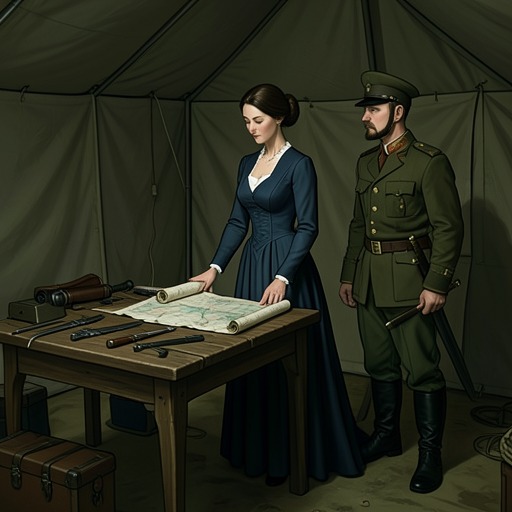
Isabella of Castile
The Constant PrincessIsabella of Castile is a queen, campaign leader, and mother whose influence extends beyond her lifetime. During the campaign for Granada, she refuses to treat retreat as the only sensible response to disaster; in private, she teaches Catalina of Aragon to understand faith and endurance as a princess’s duties. Later, when Catalina is stranded in England amid disputes over marriage and money, Isabella’s guidance remains a source of direction. Her death removes that support, but not the resolve her daughter has learned from her.
Identity and Character
Isabella is presented through her actions and through Catalina’s recollections rather than through a continuous account of her life. She is both a sovereign responsible for the course of a campaign and a mother who deliberately restrains her tenderness because she believes that softness will not prepare a princess to become a warrior for Christ. When she returns to the five-year-old Catalina after a camp disaster, she checks that her daughter is safe but does not simply collapse into an embrace. Her care is real; so is her conviction that royal upbringing requires self-command.
That discipline is part of a larger confidence in divine purpose. Isabella prays when the campaign’s prospects are uncertain and insists that a battle’s immediate result cannot determine whether its cause is right. She asks Catalina to trust that acting in accordance with God’s will matters more than winning on a particular day. The teaching does not promise the child safety or understanding. Instead, Isabella equips her to endure doubt and fear without giving up her sense of duty.
Resolve in the Granada Campaign
When the Christian camp has been devastated and its generals recommend withdrawing for the season, Isabella rejects their assessment that retreat is simply prudent. She argues that abandoning the siege in a visibly weakened state would concede a moral and symbolic advantage to the Moors. More fundamentally, she regards the campaign as God’s work and therefore refuses to accept that moving forward would be wrong merely because the army has lost its shelter and supplies. Ferdinand II of Aragon supports her decision, and the army continues the campaign.
Isabella’s firmness is not represented as an easy certainty for everyone around her. Catalina is frightened when a challenge threatens the Christian champion, and Isabella answers by repeating that the outcome belongs to God. Whether the champion wins or loses, she tells her daughter, their duty is to remain faithful. In this lesson, military action and religious belief are inseparable: Isabella frames the conflict not as an ordinary contest whose meaning depends on victory, but as a struggle in which perseverance itself expresses faith.
The campaign eventually ends with the surrender of Granada. After the Christian champion’s death, the city is encircled, its people are starving, and promised support from Africa has not arrived. Boabdil agrees to terms, then brings the keys of the Alhambra Palace to Isabella and Ferdinand II of Aragon in a formal surrender. The outcome vindicates Isabella’s refusal to abandon the siege, while the novel also places the victory within the advance of a declared holy war. Her resolve has brought the campaign to its decisive conclusion, but the narrative’s account of Granada’s loss keeps the costs of that triumph in view.
A Mother’s Lessons and Political Guidance
Isabella’s influence on Catalina is practical as well as spiritual. As a child, Catalina watches her mother maintain composure amid military disaster. Later, she recalls that example when she is isolated and uncertain in England. The traits she associates with Isabella—determination and courage—become resources Catalina draws upon after she has lost her husband, her mother, her friends, and much of her financial security. The novel thus makes the daughter’s endurance an inheritance: Isabella’s influence persists not through a continuing presence but through habits of thought and action.
That inheritance also includes a dynastic understanding of identity. Isabella writes to Catalina that her destiny is to become Queen of England, but instructs her to be patient and not to offend the king or his mother while events develop. Catalina, who still claims the title of Princess of Wales, wants her upbringing and rank to remain visible even while her future is unsettled. Isabella affirms the goal without offering an immediate solution. Her advice combines ambition with caution: Catalina should hold to the future her mother believes is hers, yet survive the present by waiting.
The family’s marriage negotiations reveal the political pressures beneath that counsel. Catalina is caught between English and Spanish demands over her dowry, her widow’s jointure, and the possibility of returning home or marrying again within the English royal family. Isabella’s plans are slow to reach her daughter, and messages are opened and delayed. The negotiations make distance itself part of Catalina’s predicament: a mother can advise and advocate, but cannot quickly remove her daughter from a court whose king controls her immediate circumstances.
Death and Continuing Influence
Catalina’s dependence on Isabella becomes especially clear when she fears that her mother is ill and writes begging for a reply. Isabella dies on the very day the letter is sent; she never receives it, and Catalina never gets the word of reassurance she sought. Catalina experiences the missed exchange as a final form of silence, intensifying the loneliness that had already marked her life in England. Her mother’s absence is not merely private grief: it also leaves Catalina feeling less secure in her effort to reach the marriage and status she has been promised.
The loss has material and political consequences as well. Catalina had taken comfort in imagining Isabella still at the Alhambra, a distant but steady presence. After her death, the family’s financial position worsens. Ferdinand II of Aragon has spent heavily in the long campaign against the Moors, while the revenues of Castile pass to Juana; Catalina fears that her father can no longer provide the money required for her marriage. What had seemed like a difficult negotiation becomes a more precarious struggle, with Catalina imagining herself as a poor widow rather than one of Christendom’s great royal brides.
Yet Catalina does not interpret these years as defeat. She understands them as a bitter passage into adulthood, sustained by childhood happiness, love for her late husband, and the qualities she recognizes as her mother’s living within her. Years later, at her coronation as Queen of England, Catalina understands the anointing as the fulfillment of the destiny she had pursued. The resemblance to Isabella is explicit in Catalina’s sense of becoming a queen appointed by God. Isabella’s lasting narrative role is therefore not only that of a victorious sovereign or a lost mother: she is the model through which Catalina makes endurance, queenship, and divine purpose part of a single identity.