James IV of Scotland
The Constant PrincessJames IV of Scotland is characterized as a seasoned warrior whose appetite for conflict turns England’s northern border into a test of Katherine of Aragon’s political and military authority. First checked by papal pressure after incursions into English territory, he later leads an invasion backed by a French promise to recognize him as King of England if he wins. His death in the ensuing defeat ends the immediate threat and makes Katherine’s preparations for the defense of England a decisive part of his story.
A warrior on the northern border
James IV enters the narrative through the anxiety his actions create in England. The border is described as long and difficult to defend, and a courtier argues that James fears neither an English army led by its king nor the border lords. The same courtier calls him an old warrior who has been spoiling for a fight for two generations. This is an assessment reported in conversation, not James’s own account, but it establishes the formidable reputation against which Katherine must act. The immediate dispute concerns repeated Scottish incursions and the security of the border. James is portrayed as willing to disturb the peace between Christian rulers over a contested stretch of land and a pirate’s raid. His challenge is therefore both practical and political: the incursions expose the difficulty of defending England’s frontier, while the possibility of a larger war threatens to draw attention away from Henry VIII’s broader alliance.
Papal intervention and a bitter protest
Katherine finds a way to bring the dispute before the Pope. She sends a letter through Richard, framing James’s conduct as a threat to the peace of Christendom and connecting the danger on England’s border to the wider alliance. The Pope responds by writing directly to James and threatening excommunication unless he respects the peace and the agreed borders of another Christian king. James is described as shocked by the intervention and as taking the warning seriously. Under that pressure, James accedes to the Pope’s wishes and apologizes for his incursions. The concession does not settle the political quarrel. He writes bitterly to Henry VIII, objecting that Henry had no right to approach the Pope alone about a dispute between the two kings. His complaint turns the diplomatic success into a fresh source of tension: James yields to the Pope, but resents the means by which England secured that result. The episode presents him as both susceptible to ecclesiastical authority and unwilling to accept what he sees as an affront to his royal standing.
Invasion and the claim to England
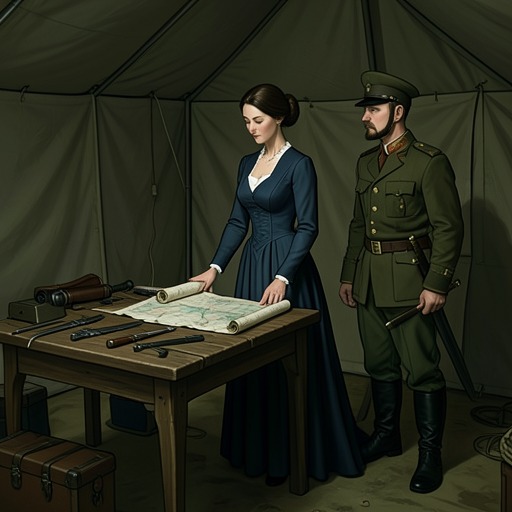
The restraint proves temporary. When Katherine’s forces begin moving north, messengers bring news that James’s army has crossed the border and is advancing through the border country, recruiting men and taking food. The invasion is no longer treated as a raid. Katherine learns that the king of France has promised to recognize James as King of England if he wins the battle. The promise gives the invasion a direct dynastic stake: a Scottish victory would carry a claim to England backed by a foreign monarch. Katherine has already arranged for Henry VIII to appoint her regent, governor of the realm, and captain general of the forces for home defense before he sails for France. James’s advance therefore confronts a government acting under her authority. She raises and equips an army under Thomas Howard, Earl of Surrey, and awaits news from the north. The narrative links James’s offensive to the military responsibility Katherine has taken on; his invasion supplies the immediate crisis in which her authority must prove effective.
Defeat and narrative significance
The news from the battle confirms James’s death and the scale of Scotland’s defeat. A messenger reports that twenty Scottish lords have died with him, along with bishops, earls, and abbots, and says that half of Scotland’s great men have fallen in one day. The torn and bloodstained surcoat taken from James’s body serves as tangible proof of his death. His body is being embalmed, while Katherine orders a full report so that she can write to Henry VIII. The account’s emphasis falls not on James’s private life but on the consequences of his kingship: the invasion, the French promise, the threat to England, and the loss of Scotland’s leading men. A messenger tells Katherine that her army has done what she ordered and that England is safe from Scottish invasion. James’s death thus closes the immediate conflict while affirming the significance of Katherine’s regency. His reputation as a long-experienced warrior makes the scale of the defeat especially consequential, but the narrative presents the victory through the actions and authority of the woman who prepared England’s defense.