James IV's surcoat
The Constant PrincessJames IV's surcoat is the garment taken from the body of James IV of Scotland after the Scottish defeat at Flodden and sent by Katherine of Aragon to Henry VIII. Its importance lies not in any described design or material, but in what it proves and communicates: the death of the opposing king, the success of the English defense, and Katherine’s ability to turn a battlefield result into a message of royal authority and offered peace.
Provenance and Identification
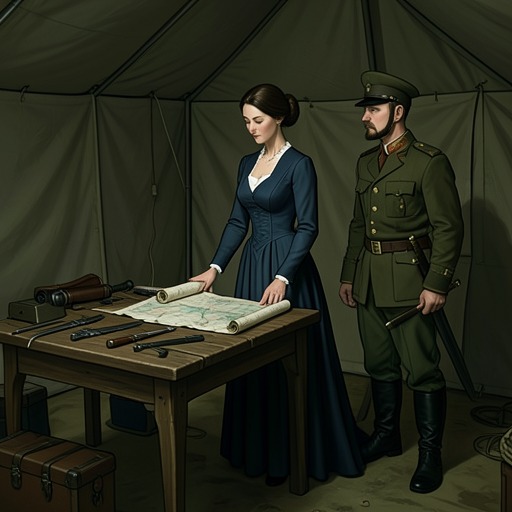
The surcoat enters the narrative with the news that James IV of Scotland has been killed. A messenger reports that the Scottish king lies dead alongside twenty Scottish lords, with bishops, earls, and abbots among the fallen. He presents Katherine with a garment that is torn and slashed from the fighting and marked with blood. It is identified as the coat taken from the dead king’s body; the body itself is being embalmed. Together, garment and body serve as material confirmation of a victory that might otherwise have reached the queen only as a report.
The garment is therefore not simply an item recovered after battle. The messenger explicitly offers it as proof of the king’s death, and Katherine is told that the defeat has left Scotland’s leading men gravely diminished. The report frames the result as a security achievement for England: the English forces she raised, trained, and armed have carried out the task she ordered. The surcoat gives that claim a visible, portable form, linking the battlefield’s outcome to the queen who receives the news.
From Battlefield Proof to Royal Message
Katherine’s response is swift and practical. She asks for a report to be dictated so that she can write to Henry, and instructs a fresh messenger to carry her thanks to Thomas Howard, Earl of Surrey. She also orders that Scottish soldiers be allowed to surrender their arms and go in peace. The surcoat arrives amid these decisions, not as an invitation to prolong the fighting but as evidence that gives her authority to declare the victory and choose what should follow it.
In her letter to Henry, Katherine says she is sending the Scottish king’s coat for his banners. She also makes clear that she considered sending the king himself, but that the Englishmen would not allow it. The garment thus stands in for the defeated ruler without becoming his body: a token that can travel to the absent king and announce the result of the campaign. Its role is at once evidentiary and ceremonial, a captured sign made useful in communication between sovereigns.
The letter’s framing matters as much as the object’s arrival. Katherine emphasizes the victory’s significance to Henry rather than presenting the surcoat as a claim to personal glory. Yet she has received the trophy, directed the response, and ordered the message sent. The contrast makes the coat an instrument of political self-presentation: it carries news of her achievement while allowing her to describe the result as her husband’s triumph.
Authority, Victory, and Restraint
The surcoat belongs to a moment when Katherine’s authority has been formally entrusted to her. At Dover, as Henry prepares to sail for France, he appoints her regent, governor of the realm, and captain general of the forces for home defense. Her stated priority is to defeat the Scots. When the news and the garment arrive, that commission has become a victory she can report and interpret. The coat helps join the battlefield to the governance exercised at home: it arrives as confirmation that her instructions have been carried out.
Its meaning is shaped by what Katherine does after receiving it. She orders that defeated soldiers be permitted to surrender, and offers peace to the Scottish queen on the condition that she become a good sister and neighbor. Katherine hopes the victory can lead to lasting peace rather than serve as an excuse for further savagery. The surcoat is therefore a trophy, but not a mandate for vengeance. It marks the force that has won while accompanying a policy aimed at ending the immediate conflict.
The narrative also places the garment beside Katherine’s private hopes. After the victory, she considers telling Henry that she believes she is pregnant, and uses her promised visit to Walsingham as a way to convey the news in a letter that others may read. In her later reflection at the shrine, she remembers sending the king’s coat and stresses that she made sure to call the victory Henry’s, though she understands it as a victory for him and for the kingdom. The object travels within a message that combines public military news with personal meaning, even as the garment itself remains proof of the battle’s outcome.
Narrative Significance
The surcoat forms a material counterpoint to the insignia of Katherine’s earlier coronation. In 1509, her authority was expressed through the holy oil, the scepter, and the ivory wand; in 1513, the Scottish king’s coat gives physical witness to her command of the realm’s defense. These objects are not equivalent: one belongs to a sacred ceremony of queenship, the other is a captured garment from a battlefield. Their juxtaposition nevertheless traces how her public role has changed from an anointed queen to a regent whose orders have helped secure the country.
At Walsingham, Katherine’s recollection turns the trophy away from simple triumph. She considers whether a future may come when England needs the courage and skills of the Scots, and wonders whether her offer of peace can allow them to forgive the battle. The surcoat remains the proof of a decisive defeat, but its meaning is no longer confined to victory. In the narrative, it carries both the cost of the conflict and Katherine’s effort to make the end of fighting more durable than the triumph itself.