Katherine and Henry’s marriage
The Constant PrincessKatherine and Henry’s marriage joined personal attachment to dynastic necessity, and its unresolved legal foundations eventually became a public struggle over Katherine’s status as Queen of England. At first the proposed match was tied to dowry payments, a papal dispensation, and the claim that her marriage to Arthur, Prince of Wales, had not been consummated. In the early years of Henry’s reign, Katherine came to love her husband and quietly shaped how he governed. But affection did not erase the marriage’s political and legal vulnerabilities: Henry’s infidelity tested their bond, and years later Katherine entered court prepared to defend the marriage by standing by the account on which it had been founded.
A marriage shaped by money and dynastic claims
Katherine’s position after Arthur’s death depended on agreements that neither court treated as a merely private matter. Her mother’s instructions made her next steps conditional: if Katherine was not pregnant, she was to seek her jointure as Dowager Princess of Wales and return to Spain only after receiving the money; if she was with child, the dowry was to be paid in cash, her allowance secured, and she was to hope for a son. The instructions made marriage, possible pregnancy, and financial support parts of the same negotiation.
The sums at stake gave Katherine little confidence that the English king would honor his obligations. Her jointure was described as a third of the revenues of Wales, Cornwall, and Chester, while her parents also sought the return of her dowry. She doubted Henry would pay either the promised support or the dowry, recalling that he had not even paid her allowance while Arthur was alive. The contract might give her a claim, but it could not ensure that the king would meet it.
When Henry proposed to marry her himself, the proposal altered the terms of her precarious position. He offered to absorb her goods into his household and provide an allowance, rather than settle the dispute over the dowry first. The ambassador raised affinity as a possible obstacle because Katherine had been married to Henry’s brother; Henry answered that he would seek a dispensation and asked whether the earlier marriage had been consummated. The ambassador confirmed the claim that it had not. Yet the match still depended on the agreement of Katherine’s parents: without their application for a papal dispensation, the marriage could not proceed. The account of Katherine’s first marriage therefore functioned not just as a statement about the past but as a condition for her future with Henry.
Affection and influence in the early marriage
Katherine’s later account of her feelings distinguishes the reasons she married Henry from the affection that grew afterward. She describes marrying for Arthur, for her mother, for God, for their cause, and for herself, then coming within a short time to love Henry. She portrays him as a cheerful, generous, and affectionate young king, accustomed to admiration and inclined to hand difficult business to someone else. Her growing attachment did not make her politically passive: she learned to make herself the person to whom he entrusted the burdens of rule.
That influence worked through access and preparation rather than open command. Members of the Privy Council came to Katherine to learn what Henry would think; courtiers and petitioners sought her help before approaching him. She understood that he responded poorly to being openly directed, and that Margaret Beaufort’s diminishing influence offered a warning about advising him too plainly or making decisions without him. Katherine’s role in the marriage thus became a form of political mediation: she aimed to preserve Henry’s trust while helping steer decisions and maintain the alliance with Spain.
Her hopes for their children also joined private affection to dynastic purpose. During a pregnancy, Katherine imagined naming a son Arthur Henry, honoring both her dead first husband and her living one; if the child were a daughter, she planned to call her Mary, as Henry wished. She saw Henry’s affection for her and desire for a son as making him more attentive, and hoped that fatherhood would help him mature. The imagined child represented an heir for England and Spain, but also a way to honor Arthur without denying her present bond with Henry.
Infidelity, confrontation, and reconciliation
The marriage was strained when Katherine learned that Henry had been unfaithful while she was confined with their child. She confronted him in private and understood from his reaction that he was about to lie. His account of a masked festivity did not convince her. She had expected to expose his deception and respond with righteous anger, but instead felt sadness and defeat: if he could not remain faithful during her confinement, she wondered how he could keep his lifelong vows. Her distress arose not only from the affair but from the gap between the permanence she expected of marriage and Henry’s momentary desire.
Henry eventually acknowledged that his doubts about whether they were married had contributed to his conduct. Katherine urged him to remain faithful and reminded him that she was his wife. He asked forgiveness, and she insisted that they never speak of the episode again or allow anyone to dishonor either her or Henry’s mother. Their reconciliation preserved the marriage, but it also depended on secrecy and on Katherine’s decision to contain the damage rather than let the breach become a public dispute.
A later pregnancy briefly seemed to confirm a more secure partnership. At the Christmas feast at Richmond Palace, the child’s movement was plainly felt, and the court took joy in the prospect of an heir. Katherine thought Henry had become more thoughtful and hoped he would grow into a good father and husband. Yet her optimism remained qualified: she allowed that a king might take lovers, while hoping he would remain constant in his heart and avoid promises that threatened his marriage. The episode shows both her continuing hope in Henry and her awareness that affection alone could not guarantee fidelity.
The marriage defended in court
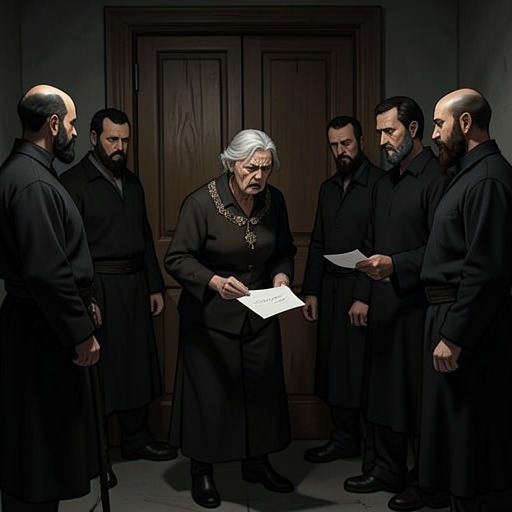
Years later, Katherine’s account of the marriage became the central stake in the court proceedings. She understood that her rival sought not simply Henry’s affection but her throne, and feared that the secret on which the marriage rested would be used against her. Although she had made clear that she did not recognize the court and had prepared no defense, she answered when summoned and walked into the hall. Her entrance converted a legal proceeding into a direct confrontation with Henry and the question of whether their marriage could stand.
Katherine entered relying on Henry’s reluctance to contradict the story that had enabled their marriage. She believed his vanity would prevent him from publicly saying that she had been Arthur’s wife and lover before becoming Henry’s wife, and she judged that he would not have the courage to challenge her again. Her position therefore rested on an unstable conjunction: the claim that her first marriage had not been consummated had helped secure Henry’s dispensation, while her later defense invoked the possibility that the truth was otherwise. In her view, the lie had preserved her queenship and the marriage for years; now she staked her case on whether Henry would openly expose it. The relationship that began as a negotiated dynastic solution had become a contest over memory, authority, and Katherine’s right to remain Queen of England.