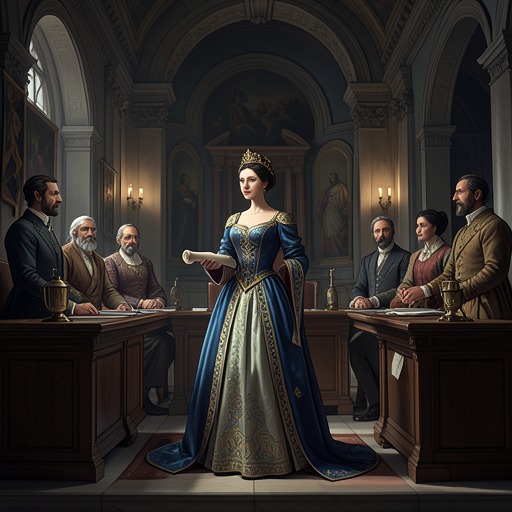
London, the royal capital
The Constant PrincessLondon, the royal capital, first appears as the ceremonial center of Catalina of Aragon’s new life in England and gradually becomes the home she chooses to claim. Its river carries her wedding procession into the city; its palaces host her brief triumph and subsequent solitude; its crowded streets offer a daily contrast with the world she left behind. For Catalina, London is at once a foreign environment and the ground on which she intends to fulfill her destiny as Queen of England.
Arrival and Royal Ceremony
On the morning of her wedding, 14 November 1501, Catalina rose early after a nearly sleepless night. The contrast between her upbringing at the Alhambra Palace and English customs was already visible in the bath prepared for her: her ladies reported that the English were astonished she would bathe before the wedding, while Catalina had grown up among the palace’s celebrated bathhouses. The city’s wedding setting thus begins not only with public ceremony but with a private encounter with unfamiliar habits. She regarded such differences as privations to endure, part of her passage from al-Yanna, the garden or paradise, into an ordinary world.
In the winter of 1501, Catalina and Arthur travelled downriver aboard the royal barge, stiffly side by side and without exchanging a word. A fleet of brightly painted barges accompanied them to Baynard's Castle Palace, their London residence for the coming weeks. The rectangular palace stood above the river, with gardens reaching down to the water. The mayor, city councilors, and court followed the royal barge as musicians played, turning the heirs’ arrival into a public procession through the capital. The river linked spectacle to settlement: the newly married couple entered the city not as private travellers but as the dynastic future of England.
Palaces, Court, and Political City
Baynard's Castle Palace placed Catalina within London’s royal and civic life, but the residence was temporary. After days of wedding festivities, the court moved to Richmond Palace, and the celebrations continued there for a further week. Catalina experienced the succession of jousts, feasts, and introductions as a sustained celebration centered on her. The king then told her that her Spanish companions must return home. The departure made clear that the welcome afforded by the capital’s ceremony did not mean she could keep the household and familiar company that had accompanied her across the sea.
The city also disclosed the political work performed by royal households. During her stay, Catalina noticed Scottish envoys attending court to negotiate the marriage of her sister-in-law, Margaret Tudor. Arthur’s marriage had secured a vital connection with Spain; the proposed Scottish marriage was intended to make a former enemy into a friend. Catalina understood that the king’s children were being used to shape alliances, and that Princess Mary Tudor would likewise be married for political ends. Her familiarity with her own future role, fixed since childhood, helped her bear separation from her family. In London, dynastic policy was not an abstraction: it was conducted through the marriages and public appearances of the royal family.
A Foreign City and a Chosen Home
After the Spanish party sailed away, Catalina watched the barges recede from a pier beside the river. Henry VII found her there, alone and looking downstream. Rather than demand an explanation, he recognized her homesickness and offered to show her his library, where she could borrow books. The scene gives the river a different function from the wedding procession: it becomes the line of sight along which Catalina watches her former life depart. Her loneliness is sharpened by the knowledge that her companions’ departure was expected, not an accident or a temporary interruption.
Later, at Durham House, London’s streets supplied a measure of how far her surroundings differed from home. Looking through the gate at the city, Catalina recalled the absent features of her former environment: richly dressed men, veiled women, spice and flower sellers, physicians and astronomers practicing openly, prayer at the mosque, and the sound of fountains. In their place she saw a busy, prosperous city, animated by commerce and the bells of hundreds of churches. The comparison registers homesickness, but it also marks a decision. Catalina turned from the imagined warmer city and declared, “This is my home now.” She would not be sent away to remarry as though her years in England and her preparation to rule counted for nothing.
From Exile to Political Belonging
London remains the setting in which Catalina’s private resolve connects to public support. In a later recollection of walking beside the cold river, she remembers boatmen bundled against the weather and a passerby calling, “God bless you, Princess!” The greeting suggests that the people who had crowded to see her at Plymouth continued to recognize and love her. Catalina regarded that affection as politically valuable: a newly enthroned prince, she reasoned, would be susceptible to the appeal of popular approval. Her claim to remain in England therefore rested not only on marriage negotiations and dynastic strategy but also on a bond with the people of the country.
Her dream of flying north over the Sierra Nevada carries this transformation into an imagined landscape. The dream first makes her long for Ludlow Castle and Arthur’s embrace, then shifts to Windsor Castle and the broad, busy River Thames. She recognizes that she is far from Spain, yet also that England can become home. In the dream’s final turn, she imagines herself no longer as Catalina, the Infanta of Spain, but as Katherine of Aragon, Queen of England, in the identity Arthur had given her. London’s river and streets do not erase the loss of her birthplace; they become the setting in which she recasts displacement as belonging and inheritance as a future she will defend.