Ludlow Castle, Wales
The Constant PrincessLudlow Castle, Wales, is the setting in which Catalina of Aragon and Arthur, Prince of Wales, made a home together, tried to govern as a pair, and saw their brief married life end. A fortified residence and the seat of Arthur’s Welsh household, it is also a measure of distance: Catalina finds it smaller and less splendid than the Spanish palaces she knows, yet its rooms and battlements become the landscape of her love for Arthur—and, after his death, of the future she can no longer inhabit.
A Welsh residence and a first impression
In the middle of December, Arthur was ordered by Henry VII of England to prepare to leave for his castle at Ludlow. At the decisive urging of Margaret Beaufort, Catalina was sent with him: she and Arthur were married and needed to live together and produce an heir. Their journey ended in January 1502, when they passed through the castle’s great gate in the low red light of the winter sun.
The arrival was both a public welcome and Catalina’s introduction to a very different kind of royal home. Men-at-arms announced the prince as they rode into town. Shopkeepers’ wives waved from their stools, and glovers’ girls, apprentices, goldsmiths’ boys and spinsters leaned from upper windows to call to Catalina. Church bells rang from the town’s religious houses, college, chapels and hospital. At the castle, the mayor, church elders and leaders of the wealthy trade guilds assembled to greet the couple. Arthur listened to a long address in Welsh and then English while Catalina, waiting through the formalities, teased him in Latin about eating and going to bed.
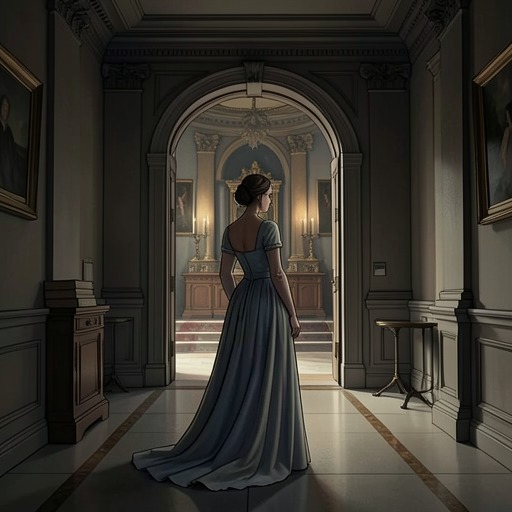
Her first assessment of the castle was less enthusiastic than the townspeople’s welcome. The residence was neat and sturdy, built around an inner bailey enclosed by a high curtain wall of warm, rosy-colored stone. Wells in both the outer and inner baileys and the successive defensible spaces made it seem capable of resisting a siege for years. But Catalina compared its compact scale with the defended city of her childhood home, with its gardens, terraces, views and crowded center. At Ludlow, she observed, a sentry could circle the battlements in minutes. The castle was secure, but to her it seemed almost a toy beside the immense royal spaces she remembered.
Architecture and the shape of the household
The castle’s round chapel altered Catalina’s first impression. Its squat, circular form recalled to her the traditional shape of a mosque, designed so that worshippers would not be ranked by wealth or position. She found it lovely. Arthur had regarded it simply as a round tower of local stone; seeing it through her response, he noticed how it glowed in the afternoon light and seemed peaceful. The chapel’s shape thus became more than a feature of the castle: for Catalina it connected an unfamiliar Welsh residence to a religious architecture she recognized.
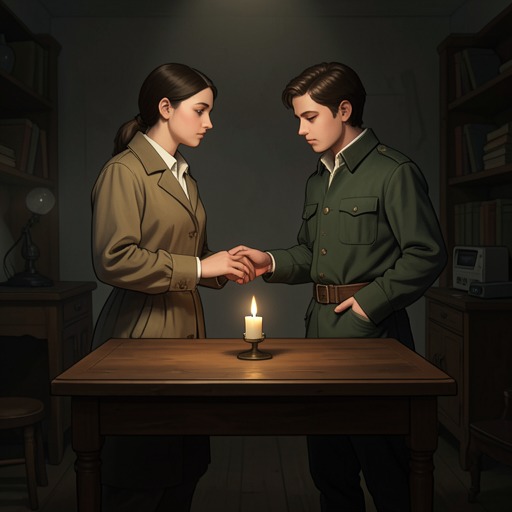
Arthur described the arrangement of the principal buildings as they approached the great hall. The Welsh council chambers lay to one side, with his rooms above them; guest chambers and the rooms of the castle warden and his wife, Sir Richard Pole and Margaret Pole, lay to the other. Catalina’s rooms were on the top floor, opposite Arthur’s. This arrangement made the household’s formal divisions literal: the married couple had separate apartments across the hall, while a private door from each set of rooms gave access to the encircling battlements.
Public ceremony and private movement followed different routes. In obedience to Margaret Beaufort’s instructions, Arthur was to visit Catalina in a procession through the great hall four times a month. On other nights, he could reach her by the battlements, where the couple could move between rooms without others knowing which one they occupied. The fortified circuit that first impressed Catalina as a defensive measure therefore also provided a discreet path between husband and wife. The castle’s architecture accommodated both the visible obligations of a royal marriage and the couple’s private life.
Married life and shared government
The formal schedule did not define every night of their life together. Their servants woke them at dawn, and Arthur was ceremonially escorted from Catalina’s bed; at Mass, the couple sat on opposite sides of the round chapel with their separate households and could not speak. The public routine of the residence kept them apart even as the private route along the battlements allowed them to seek one another. For Catalina, the chapel could also sharpen homesickness: its resemblance to a mosque and the incense at Mass brought her mother to mind, while religious duty and desire for Arthur became difficult to reconcile.
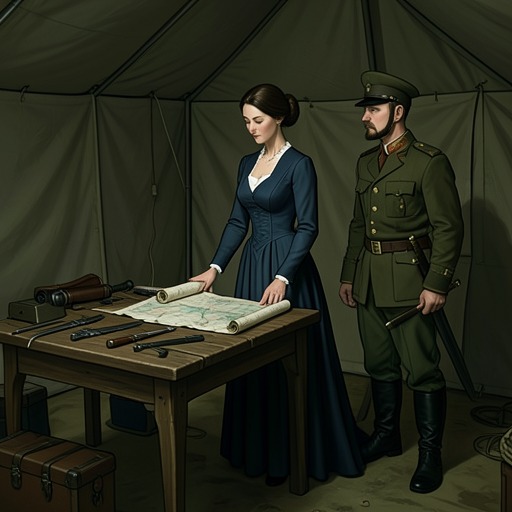
As the days grew warmer, the castle’s routine changed again. Catalina and Arthur set up an office in her rooms, moved a large table to the window for afternoon light, and pinned maps of Wales on the linenfold paneling. Their work gave their marriage a political dimension: the prince and princess were not only sharing a residence but planning together around the principality. Margaret Pole remarked that they looked as if they were planning a campaign. Doña Elvira, by contrast, resented that the princess seemed to be working when she ought to be resting. The map-covered room embodied the couple’s hopes for a joint future, while exposing the tension between their ambitions and the expectations placed on Catalina.
Loss and the castle remembered
Arthur died at Ludlow on 2 April 1502. At vespers, his confessor administered extreme unction; Catalina knelt at the threshold while the priest anointed her husband and remained on her knees until she was told that Arthur was dead. At sixteen, she became a widow. Margaret Pole and Doña Elvira carried and half-dragged her to her bedchamber. There, the castle’s familiar architecture turned painfully into an inventory of absence: Catalina knew she would never again hear Arthur’s quiet step on the battlements or his tap at her door, and would never again open it to step into his arms.
In the years afterward, Ludlow remained a point of reference in Catalina’s life, even when she was no longer living there. Margaret Pole’s presence at the castle was still part of the court’s calculations: when the king asked whether Catalina wished to accompany Arthur to Ludlow, she nervously asked whether Margaret Pole was still there. During her widowhood, Margaret Pole later recalled that she and her husband had been at Ludlow, where the Welsh business had fallen on him because neither the king nor the prince came to Wales. The castle thus persisted as a working center of Welsh administration as well as the scene of Catalina’s loss.
Ludlow also returned in Catalina’s imagination as the home of a love and future interrupted. In a dream, she flew north over the hills toward what she first took to be Ludlow, anticipating the night when Arthur would take her in his arms. The vision shifted: the gray walls were those of Windsor, and the river was the Thames. She understood that England would be her home, but the dream’s first destination was still Ludlow, where married happiness had taken shape. A patched cloak María de Salinas placed around her shoulders years later was the same one Catalina had worn on the winter journey from London to Ludlow. Through such recollections, the castle remains at once a real seat of government, a carefully organized royal household, and the lost home against which Catalina measures her life in England.