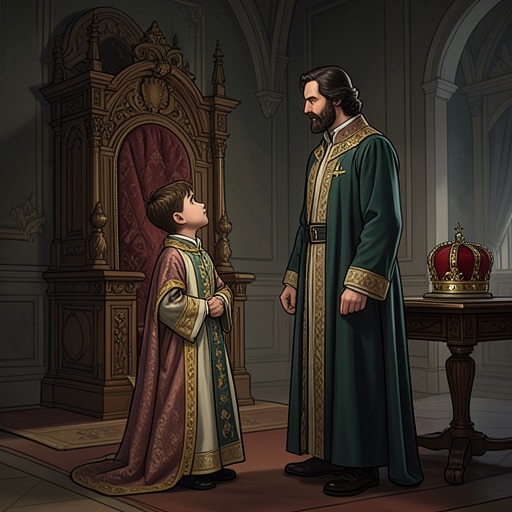
Marriage of Henry VIII and Catherine of Aragon
The Constant PrincessThe Marriage of Henry VIII and Catherine of Aragon, celebrated at Greenwich Palace on 11 June 1509, transformed Katherine of Aragon from a dependent widow into Queen of England. She entered it believing she was carrying out Arthur’s command, while the marriage’s dynastic purpose, unresolved finances, and disputed canonical basis gave it consequences far beyond the ceremony itself.
Background and Stakes
The marriage followed years in which Katherine remained in England as Arthur’s widow and waited for her betrothal to his younger brother, Henry, to become a wedding. The alliance had been designed to bind England and Spain, but money repeatedly obstructed it. Henry VII was angered by the dispute over the dowry: Isabella of Castile and Ferdinand II of Aragon had sent only part of the promised money, treating Katherine’s household plate and treasures as compensation for the balance. At Ludlow Castle, the gold plate was put to daily use, and each careless scrape threatened to reduce its value as a substitute for cash.
Katherine’s financial dependence had become personal and immediate. She recalled turning the panels of her gowns and selling jewels and pieces of her plate to buy food and meet her household’s needs; she could not pay her servants’ wages while asking them to endure hunger. The marriage would end her years of waiting, but the obligations surrounding her dowry and her status as Arthur’s widow had made that wait a struggle for survival as well as a diplomatic impasse.
The proposed union also raised a question of affinity: Henry was the brother of Katherine’s deceased husband. When the objection was raised, Katherine’s ambassador, Dr. de Puebla, acknowledged it, and she said she would seek a papal dispensation. He confirmed that the marriage to Arthur had not been consummated, but also warned that a dispensation would still be needed and that her parents might refuse to seek it. The match therefore depended not only on the couple’s decision but on ecclesiastical permission and the cooperation of the Spanish monarchs.
The Greenwich Ceremony
Katherine dreaded repeating marriage vows she had already spoken to Arthur. She nevertheless tried to keep the memory of him out of her mind and understood her new marriage as the act Arthur had commanded. The contrast with her first wedding was stark: rather than the grand ceremony at St Paul’s Cathedral, the couple married within Greenwich Palace, in the church of the Friars Observant, before only three witnesses and a small handful of others.
There was no lavish feast, music, dancing, or public bedding, the ritual Katherine had feared. Henry and Katherine dined quietly before the court and withdrew together; the court drank their health and let them go. The restraint of the occasion suited a bride who was anxious about the vows and a king described as shy, while its small scale marked how far this wedding stood from the spectacular public celebration of her marriage to Arthur.
Lady Margaret Beaufort was present, cold-faced, but her authority over Katherine had changed. Katherine showed her courtesy and curtseyed as she departed; she believed that whatever Lady Margaret thought, the wedding could no longer be prevented. Afterward, Katherine’s ladies undressed her in silence. Their fortunes, like hers, depended on the deception surrounding Arthur’s marriage: the account presents them as having reason to deny Arthur’s existence if asked.
Marriage, Law, and Political Vulnerability
The wedding did not settle the questions that had accumulated around Katherine’s earlier marriage. Its legal vulnerability would later become central when the marriage tribunal summoned her as Queen of England. Rather than remain absent, she entered the hall and faced Henry. Her defense rested on the claim that she had been Arthur’s wife and lover before she became Henry’s wife, and on her belief that Henry would not publicly contradict the truth he had long known. In that later confrontation, the intimate history the wedding had sought to set aside became a matter of law and royal authority.
The event thus joined private grief to public strategy. Katherine feared the vows because they recalled Arthur, yet proceeded because she believed she was honoring his wish. The canonical question of affinity and the disputed account of consummation made the marriage more than a new household or personal bond: they left its legitimacy exposed to future challenge.
Consequences and Significance
The marriage ended Katherine’s prolonged limbo and established her as queen, but it did not make her political position effortless or secure. The narrative links her years of waiting and deprivation to the authority she later exercised: as queen, she consulted the Privy Council, worked toward a more unified kingdom, and helped plan its legal reach, coastal defenses, army musters, and naval strength. Her command of government is presented not as a sudden discovery at the wedding, but as an ability formed by her royal education and sharpened during years in which others could neglect her.
The small ceremony therefore carries a double meaning. It marks Katherine’s arrival at the position for which she had been raised, while preserving the wound and legal uncertainty attached to the marriage that preceded it. The vows made at Greenwich brought her to the throne; the disputed history of those vows later became the ground on which she had to defend her queenship.