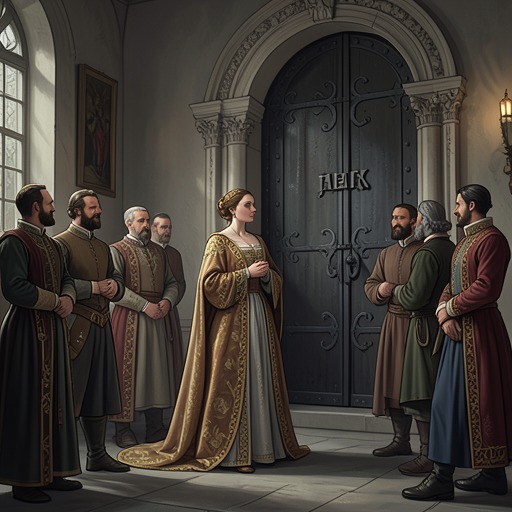
Mary I of England
The Constant PrincessMary I of England is presented through Katherine of Aragon’s hopes, grief, and resolve: first as a daughter imagined before birth, and later as the living heir whose inheritance her mother refuses to surrender. Her significance lies in the way her name links private loss to the Tudor succession and Katherine’s claim to remain Queen of England.
A Daughter Imagined
At Katherine of Aragon’s coronation, her place beside Henry VIII marks the fulfilment of a long-pursued royal destiny. The text does not yet introduce Mary as a living child, but the later accounts make clear that Katherine’s hopes for a daughter are bound up with her marriage and with her promise to Arthur, Prince of Wales.
In January 1510, Katherine loses a stillborn daughter. The loss is sharpened by her memory that Arthur had wanted a first-born girl named Mary. The child who dies is therefore associated with the name, but the later narrative distinguishes that bereavement from the daughter Katherine subsequently calls Mary.
Named in Memory of Arthur
After Katherine becomes regent while Henry VIII sails for France, she reflects that she has gained the authority and country she wanted, yet still longs for Arthur. She believes she has conceived a child who will live, and says that a boy would be named Arthur and a girl Mary. The naming keeps Arthur’s memory within the future family she is trying to secure.
Later, Katherine identifies Mary as her beloved daughter and says that Arthur named her. Mary’s name thus carries both maternal affection and the weight of Katherine’s enduring promise to Arthur. The narrative connects that promise to Katherine’s claim that her marriage to Arthur was never consummated, a claim she says she will maintain for life.
Heir and Motive for Resistance
When Katherine faces the court, she understands the danger as a threat to Mary’s inheritance. She refuses to accept that her daughter can be put aside in favor of a rival child associated with Anne Boleyn. Mary is not shown directing this confrontation; her inheritance is the stake that makes Katherine return to court and face Henry VIII in person.
Mary’s role is therefore chiefly relational and dynastic in the supplied scenes. Her mother’s earlier coronation and later regency give the succession question political force, while the repeated association with Arthur’s name makes Mary a living link between Katherine’s past marriage and the future she intends to defend. The novel presents her through that tension: cherished daughter, named heir, and the reason Katherine insists that her place as Queen of England cannot be taken from her.