Our enemies should be those who inflict cruelty for power
The Constant PrincessThe expression Our enemies should be those who inflict cruelty for power marks a change in Katherine of Aragon’s understanding of religious conflict: faith alone does not make a people enemies, and victory does not justify cruelty. First articulated by Yusuf, a Muslim physician, it challenges the crusading convictions Catalina had inherited from Isabella of Castile and Ferdinand II of Aragon. Later, as queen and military leader, Katherine makes its moral distinction practical, choosing restraint toward a defeated Scotland rather than another cycle of war.
The inherited logic of the crusade
As a girl, Catalina had understood the alliance between Spain and England as part of God’s work. England’s wealth and ships, she believed, would help Spain oppose France and carry a Christian campaign against Muslim powers in Africa, the Ottoman Empire, and beyond. The imagined struggle seemed to have no natural end: she feared that even if one enemy were defeated, others would return. At Granada, she had watched Muslim families leave under Christian rule as the flag of St. James replaced the crescent above the red fort. The scene joined military victory to the expulsion and grief of the defeated, even while bells rang for Mass.
This early outlook treats religious identity as a decisive boundary and continuing war as a sacred duty. Its scale keeps widening: from Spain’s immediate conflicts to a crusade reaching across the world. The later expression does not erase that formation; its force comes from the fact that Katherine has to reconsider convictions that once seemed inseparable from loyalty to her parents and faith.
Yusuf’s challenge
In a conversation with Yusuf, Katherine initially calls herself a child of the true religion and him an infidel, but the declaration carries less conviction than before. Yusuf answers by turning attention from religious difference to shared displacement and moral conduct. He argues that the true enemy is the person who inflicts cruelty for power, not someone who worships differently yet believes in a forgiving God and tries to live well. His words make a distinction between faith and the violence committed in its name.
Katherine cannot answer immediately. She feels the conflict between her mother’s teaching and the goodness she sees in Yusuf, and finally admits, “I don’t know.” She says she must take the question to God and pray for guidance rather than pretend to certainty. Yusuf calls that humility the beginning of wisdom. The exchange makes uncertainty an ethical turning point: Katherine does not simply exchange one doctrine for another, but recognizes that inherited certainty may itself need examination.
The encounter also occurs amid practical medical advice. Yusuf offers to write down foods she must avoid and send medicine to strengthen her humors; he warns her not to be cupped, leeched, or persuaded to take poisons or potions, and reassures her that a baby will come. His care gives Katherine a concrete experience of goodness across the religious boundary she had just named. The moral argument is therefore embodied in a relationship of trust, not presented only as an abstract dispute about doctrine.
From doctrine to judgment
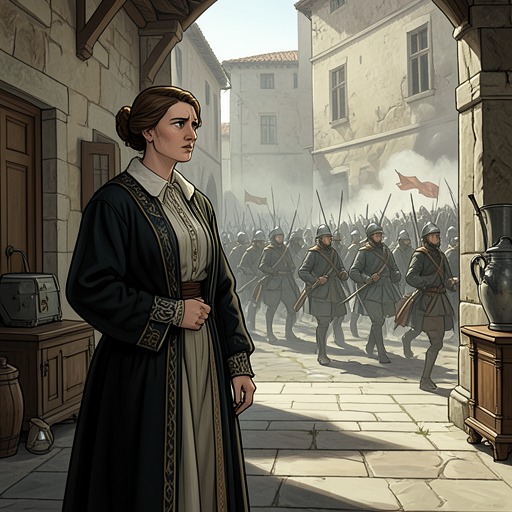
Later, after a great victory over the Scots, Katherine feels the pull of the military reasoning she had absorbed from her parents. Thinking as a commander, she recognizes that the defeated country lies open to conquest and that its soldiers could be destroyed as a force for a generation. She also acknowledges that Isabella of Castile and Ferdinand II of Aragon would have pressed the advantage. Then she judges their approach wrong: permanent warfare wounds victor and defeated alike, and devastation leaves conditions in which hatred and renewed conflict can grow.
Katherine’s conclusion is stated in a repeated, compressed maxim: “War does not answer war, war does not finish war. The only ending is peace.” The phrase recasts the earlier fear of enemies returning. Rather than treating recurrence as proof that the crusade must continue, she sees how one generation’s violence can prepare the next generation’s retaliation. Her account of the conflicts between Christians and Muslims makes the point explicit: Isabella of Castile and Ferdinand II of Aragon had driven the Moors overseas, but victory had not ended the struggle.
A principle enacted
Katherine turns this judgment into an order. She sends a messenger to Thomas Howard, Earl of Surrey, thanking him for the victory but directing him to let the Scottish soldiers surrender their arms and go in peace. She also promises to write to the Scots queen, offering peace if she will be a good sister and neighbor. The distinction between victory and vengeance becomes a matter of policy: the English have won, Katherine says, and should be gracious so that the result can become a lasting peace rather than an excuse for further savagery.
Her treatment of the defeated does not deny that the battle has been won. Instead, it refuses to make victory a license for destruction. She tells the soldier that they can return home knowing they may live at peace, then sits at her table with her writing box, quill, paper, and sealing wax to write to her husband. The movement from a maxim about cruelty to orders, surrender terms, and a written promise gives the expression its decisive significance: it becomes a principle of rule, tested at the moment when retaliation is both possible and celebrated.