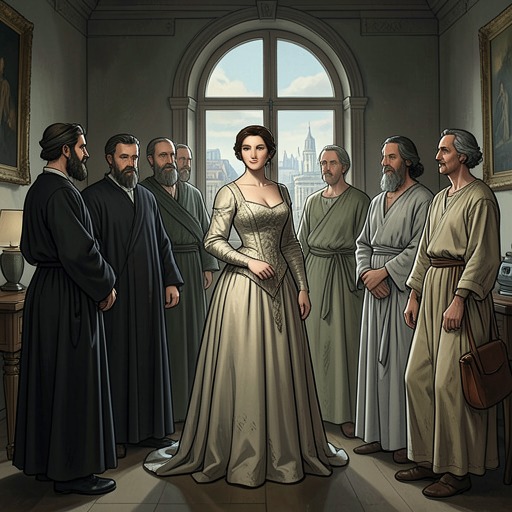
People of the Book
The Constant PrincessPeople of the Book is the designation through which the novel imagines Christians, Muslims, and Jews as capable of living together with mutual respect. Its significance rests on a sharp contrast: the phrase gives voice to an ideal of shared belonging, while the rulers who invoke that ideal abandon it in pursuit of religious uniformity. Katherine of Aragon’s changing judgment of Muslims makes the contrast an intimate moral reckoning as well as a political one.
A promise of shared belonging
In the account of Granada’s conquest, the victors promise Boabdil that Muslims will be as safe under Christian rule as Christians had been under his. The proposed convivencia rests on the claim that Moor, Christian, and Jew can all live quietly and with self-respect as People of the Book. The designation gathers distinct communities under a common religious inheritance and lends the political truce a moral language: it is presented not merely as a pause in conflict, but as the basis for a society in which each group can live securely.
That promise sits uneasily beside the victor’s assertion of power. Palace servants must profess the Church’s beliefs, the mosque’s call to prayer is silenced, and those who dissent are told to leave for Africa, convert, or face the Inquisition. The novel thus places the language of shared belonging beside the coercive conditions imposed on those meant to share it. The phrase expresses an aspiration; it does not describe an equality that the conquering authorities are willing to protect.
The repudiation of convivencia
The promised truce lasts only three months before the rulers expel the Jews and threaten the Muslims. Conversion becomes compulsory, while suspicion can expose a convert to examination by the Inquisition. Religious conformity is explicitly treated as the means of making one nation and one people from the varied communities of al-Andalus. In this turn, the political meaning of People of the Book is overturned: a designation that had supported coexistence is displaced by a demand that difference disappear.
The change reaches into public justice as well as private belief. A chapel replaces the Arabic inscription in the council chamber that had invited people to seek justice; the narrator observes that no one comes for justice anymore. The lost inscription makes the betrayal visible in the altered use of a shared civic space. Religious consolidation is presented not only as a change in worship, but as a reordering of who can seek redress and what kind of rule the palace represents.
Katherine’s changed judgment
Katherine’s recollection of a Moorish physician complicates the inherited division between Christian and heretic. She remembers his compassion toward her and concludes that a person capable of such kindness cannot simply be dismissed as a barbarian or savage. She allows that he may be mistaken in faith while insisting that he should be permitted his own conclusions and reasons. The encounter does not erase religious difference; it changes what that difference can justify.
This reassessment widens into a criticism of the policies associated with Katherine’s parents. She connects her secret search for medical care to the expulsion of Muslims and Jews, whose learning and skills, she believes, Spain has driven away by naming their knowledge sinful. She comes to reject a crusade against Muslims and opposition or cruelty based on skin color or belief. Her developing position gives the phrase an ethical force: People of the Book becomes a way to recognize the humanity of people whose convictions differ from her own, rather than a label that can excuse their subjection.
The novel’s framing of the ideal
In the afterword, the author identifies Catalina of Aragon’s Spanish background and a research visit to Granada as important to the novel’s conception. The author describes the remembered convivencia of al-Andalus as a society in which Jews, Muslims, and Christians lived side by side in respect and peace as People of the Book, and presents that past as a way to think about questions that remain pressing in the present. The phrase therefore links the story’s political reversals to its larger concern with religious coexistence: it names both a promise made and betrayed within the narrative and an ideal the novel asks its readers to consider.