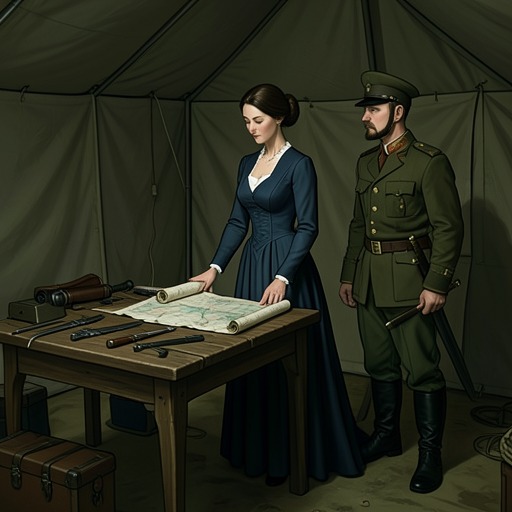
Privy Council for Succession and Marriage
The Constant PrincessThe Privy Council for Succession and Marriage is presented as a council of royal ministers whose political work extends from dynastic negotiation to the practical business of governing. Its appearances connect marriage, alliance, and royal finances with Catalina of Aragon’s later participation in the administration and defense of England, showing how the council’s counsel operates within a changing balance of power at court.
Council and dynastic negotiation
The council’s clearest early appearance comes when Gutierre Gómez de Fuensalida is summoned to meet the new king’s ministers. He enters expecting to discuss Catalina’s status and the unpaid dowry, but the councilors tell him that the dowry and her household plate no longer matter: the king intends to marry her. Their abrupt announcement reframes the negotiation. What had been a dispute over money and the obligations owed to a widowed princess becomes a prospective royal marriage.
The councilor explaining the decision makes its diplomatic purpose explicit. England’s security, he says, depends on an alliance linking England, Spain, and the emperor against the power and ambitions of France. The proposed marriage is therefore not treated as a private arrangement alone: it is expected to secure the support of the King of Aragon for a broader political cause. Fuensalida is left to carry the news of this change in Catalina’s fortunes, while the council’s curt dismissal of the dowry signals that the ministers now consider alliance more important than the earlier financial dispute.
Counsel in the work of government
Later, Catalina describes consulting members of the Privy Council as she works to consolidate England into a peaceful and powerful kingdom. The council’s role in this account is advisory and collaborative: she seeks its members’ counsel and shares with them the political hopes she and Arthur had held. Together, they begin considering how law might operate across the country, and how its coasts and military resources might be organized.
The work she describes is concrete. The group considers coastal defenses, surveys ships that could be called into service as a fighting navy, and draws up army muster rolls. Catalina presents these preparations as part of bringing the kingdom under effective administration, not merely as court ceremony. Her claim to authority rests both on royal position and on her ability to take up the business of rule with the council’s advisers.
A changing court and royal authority
The council’s place in the narrative shifts alongside Catalina’s. In the earlier marriage negotiations, the ministers speak for a new king and communicate a policy to a foreign ambassador. Later, Catalina depicts herself as an active participant in consultation and government, even while Harry neglects the realm’s business. The contrast gives the council two related functions: it helps express the strategic priorities of the crown, and it provides a setting for the practical deliberation through which Catalina exercises political influence.
The council is not shown with a detailed constitution or a fixed roster in these scenes. Instead, its significance emerges through decisions and work: the ministers’ sudden reprioritizing of dowry negotiations in favor of an alliance, and the later consultations over law, ships, and military readiness. The book thus makes the council a link between the personal stakes of royal marriage and the larger questions of national government.
Limits of the council’s role
When Henry VIII prepares to sail for France, he formally appoints Catalina regent, governor of the realm, and captain general of the forces responsible for home defense. The appointment takes place in a public ceremony at Dover, with the Great Seal of State, rather than being described as a decision made by the Privy Council for Succession and Marriage. The distinction matters: the council is associated with counsel and administrative preparation, while the king’s act confers Catalina’s authority.
As Catalina prepares to confront the Scottish invasion, she rides past the five hundred troops assembled before the palace, drawing on lessons learned from her parents about making each soldier feel seen. This episode does not establish that the council directs her military command. Instead, it places her regency and the kingdom’s readiness beside the earlier work of consultation: the council helps make government and defense thinkable as shared business, while the authority to act in this crisis belongs to the appointed regent. Across these scenes, the organization’s narrative significance lies in the way dynastic diplomacy opens onto statecraft, without erasing the difference between advice, royal appointment, and command.