Public bedding and bridal-sheet custom
The Constant PrincessThe Public bedding and bridal-sheet custom is the expectation that a royal couple be put to bed in a public ritual and that the sheets be shown the next morning. At Catalina and Henry VIII’s wedding, neither practice takes place. Yet the anticipated proof remains powerful: Catalina arranges for a mark on the sheets to be treated as evidence of a consummated marriage, making a custom that was omitted part of the deception on which her royal position rests.
The custom and the wedding
Catalina dreads having to repeat her marriage vows after the ceremony to Arthur, Prince of Wales, but the wedding to Henry VIII is deliberately unlike the grand celebration at St Paul’s Cathedral. It takes place in the church of the Friars Observant within Greenwich Palace, with only three witnesses and a small gathering. There is no public bedding, which Catalina had feared, and no morning display of the sheets. The couple dine before the court and withdraw together; the court drinks their health and lets them go.
The quiet ceremony does not make the expected signs irrelevant. Catalina anticipates that people will ask what happened on the wedding night even though no formal inspection is planned. The private sheets thus acquire a public meaning without being publicly displayed: the court’s assumptions about bridal evidence can be used even in the absence of the ritual itself.
A mark prepared as evidence
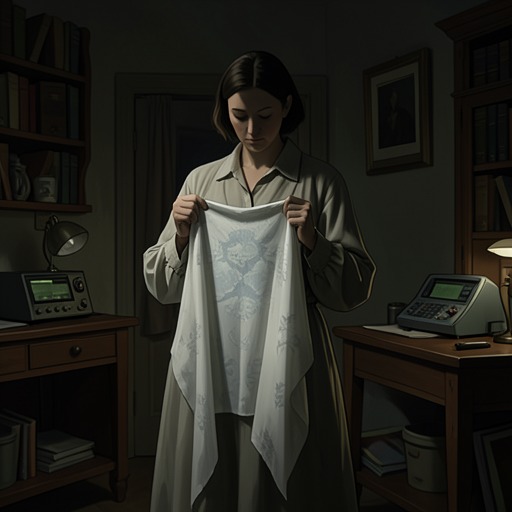
Before morning, while Henry VIII is asleep, Catalina makes a small cut on the sole of her foot and places enough blood on the sheet to create a convincing mark. She expects that her ladies can attest to having seen it and that her complaint of pain will reinforce their account. The mark is not the result of the marriage being consummated; it is deliberately arranged to stand in for evidence that others might expect.
Catalina then performs the outward signs of a bride who has lost her virginity. She says she is tired and rests, smiles with lowered eyes, walks stiffly, and declines to ride out hunting for a week. These gestures give her attendants and the court a coherent story to repeat. In her account, the deception works partly because people are already disposed to believe it: no one wants to credit an alternative.
Marriage, affinity, and political stakes
The wedding is entangled with the question of whether Henry VIII may marry his deceased brother’s widow. Dr. de Puebla raises affinity as a possible objection when Henry announces that he intends to marry Catalina; Henry says he will seek a papal dispensation and asks whether the earlier marriage was consummated. Dr. de Puebla confirms the claim that it was not. He later warns that the Pope must grant a dispensation and that Catalina’s parents must consent to seek one. The assertion of non-consummation is therefore more than a private account of the first marriage: it bears on the legal and diplomatic conditions of the next.
The bridal-sheet deception helps make that assertion publicly sustainable, but the story also exposes its contradiction. Catalina has made others believe that her marriage to Henry VIII was consummated, while her later case against him depends on the claim that her marriage to Arthur, Prince of Wales, was consummated. She enters court knowing that this history could support the dissolution of her marriage to Henry, and stakes her defense on his unwillingness to acknowledge that she had been Arthur’s wife and lover before she became his.
The custom’s later significance
Years after the wedding, Catalina walks into the court convened over her marriage despite the expectation that proceedings would continue without her. Her confidence rests in part on Henry VIII’s reluctance to confront the truth she believes he fears: that she loved Arthur, and that the marriage to Arthur was real in the very respect she had concealed from Henry. The wedding-night performance therefore has a lasting cost. It protects her position by sustaining the account of her virginity when she married Henry, but it also leaves her exposed to the legal argument that the earlier marriage was consummated.
The custom’s force in the narrative lies less in a public spectacle than in its conversion into usable proof. The sheets are not shown before the court, and the couple are not publicly put to bed; nevertheless, a planted mark and practiced behavior create witnesses to a story. A private marriage night becomes part of a dynastic and legal contest, where appearances can secure a queen’s place even as the hidden truth threatens to undo it.