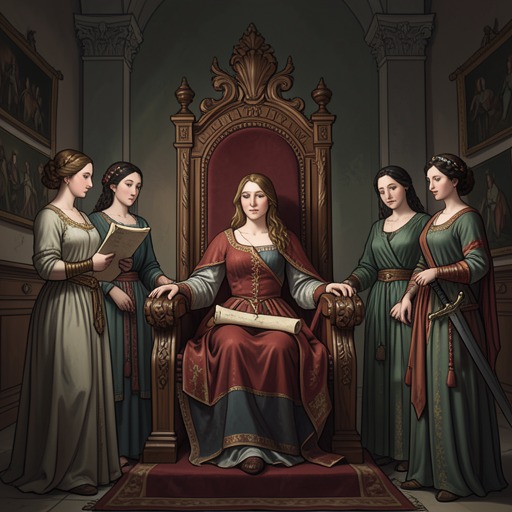
Queen with the heart of a man
The Constant PrincessQueen with the heart of a man is a martial accolade in a song about Isabella of Castile, but its significance reaches beyond the battlefield. Catalina of Aragon remembers the phrase as a child of a queen whose judgment could determine whether an army advanced or withdrew. In turn, she understands her mother’s authority as a model of sovereign rule: not an imitation of a man, but the rightful command of a queen born to govern. The phrase thus links military reputation, female political judgment, and the destiny Catalina claims for herself.
The phrase in the song
Catalina introduces the title while speaking with Arthur, Prince of Wales, about a song the Moors made concerning her father’s advance. She translates and sings it to him. Its riders carry fearful news to the king at the Alhambra; the song names Ferdinand leading Spain’s army and Isabella accompanying him. The refrain-like description of Isabella as Queen with the heart of a man catches Arthur’s attention. He asks whether people really called her that, and Catalina explains that her presence in the field strengthened her troops and frightened their opponents. In the battles fought while she was there, she says, the army was never defeated.
The song makes a queen’s presence part of military power: Isabella does not merely appear beside an army but changes how it is understood by both its own soldiers and its enemies. Arthur responds with admiration for the fame the song confers. Catalina’s response is more intimate. She misses her mother, remembers her as fearless, and describes her as a living legend. The title therefore carries both public renown and the daughter’s longing for the person behind it.
Isabella’s authority and Catalina’s interpretation
Catalina’s account gives the epithet a political meaning. When Isabella’s husband and his advisers believed the army should retreat to Toledo and return the following year, Isabella opposed withdrawal. Catalina presents this as part of a recurring pattern: when a major decision concerned whether the army should continue or whether an undertaking could succeed, her mother seemed to know what ought to be done. Her father, she says, recognized that judgment, and events commonly proceeded in accordance with it.
The account nevertheless registers the conventions against which such authority is measured. Arthur is fascinated by the possibility of a wife who is not simply a subject. Catalina acknowledges that Isabella would never openly contradict or disrespect her husband, and that Isabella herself would say a wife should obey. Yet Catalina insists that deference does not erase political influence: her mother can disagree without public defiance, and her judgment is often decisive. The phrase’s comparison to a man marks the culture’s standard for courage and command, while Catalina’s explanation locates Isabella’s authority in her own competence and queenship.
Catalina then distinguishes Isabella from a queen whose rank comes only through marriage. Isabella was born a princess and became queen in her own right; Catalina describes her as born for the office and protected by God through danger. To Catalina, that birthright answers the question of why Isabella should command her kingdom. The epithet is therefore not merely praise for bravery. It forms part of a larger understanding of a woman’s authority as legitimate when it is grounded in sovereign status, judgment, and divine purpose.
From inheritance to queenship
The memory becomes a pattern for Catalina’s own political identity. On 24 June 1509, she is carried from the Tower to Westminster in a cloth-of-gold litter, visible to the crowd, wearing white satin and a pearl coronet. After Henry VIII is crowned, Catalina is anointed and receives the sceptre and ivory wand. She understands the ceremony as the fulfilment of the destiny she had long claimed: she is now an anointed queen, appointed to rule and under God’s protection. The public celebration recognizes both the young king and the Spanish princess who has endured years of uncertainty before becoming Queen of England.
That moment does not make Catalina’s life a simple repetition of Isabella’s military story. The evidence shows her claiming royal authority through coronation, counsel, and government rather than recounting battlefield command. When Henry VIII prepares to sail for France, he formally appoints her regent, governor of the realm, and captain general of the forces assigned to home defense. At Dover, in a public ceremony, she receives the Great Seal of State. The appointment converts the language of divinely appointed queenship into a specific responsibility for governing and defending England. She welcomes the authority and identifies the defeat of the Scots as the first task she intends to undertake.
Authority, loss, and endurance
The phrase’s association with strength should not be mistaken for an absence of vulnerability. After Arthur, Prince of Wales, dies, Catalina withdraws for a month, keeping silent and struggling not to surrender to grief. On the anniversary of his death she spends the day alone in the chapel at Durham House, attending a memorial Mass and fearing that she is beginning to lose the memory of his face. These episodes place the public image of steadfastness beside private mourning; endurance is not presented as invulnerability but as the effort to continue while grief remains.
Later, while queen, Catalina suffers the loss of two children. In January 1510 she recognizes that her first child cannot be saved, and the child is stillborn. In February 1511, news of another baby’s death reaches her at a moment she had believed to be one of exceptional happiness. She says that this loss is worse even than Arthur’s death and that she cannot bear it. Lady Margaret answers that, in time, she will learn to bear what cannot be changed. The contrast matters: the story does not use the maternal body as proof that Catalina is always strong, but shows the human cost carried alongside dynastic expectation and public duty.
The phrase ultimately frames a transformation rather than a claim that Catalina becomes identical to her mother. Isabella’s example gives her a language for female authority; Catalina’s anointing and appointment as regent give that authority distinct forms in England. Her strength consists not in being untouched by grief, but in continuing to inhabit the office and responsibilities she regards as her God-given destiny. What begins as a song’s name for a queen’s martial reputation becomes, in Catalina’s understanding, an inheritance of judgment, legitimacy, and command.