Royal confinement for childbirth
The Constant PrincessRoyal confinement for childbirth is a court protocol directing the queen to withdraw from public life before giving birth. Set out in the Royal Book, it shapes the rooms, company, and expected seclusion of Katherine’s childbirths. Its practice joins a private experience to the public stakes of royal succession: the queen is removed from ordinary court business, yet her confinement is watched and organized around the anticipated arrival of a child.
Authority and preparation
The Royal Book, written by Margaret Beaufort, provided the ceremonial model for preparing the queen’s rooms. Before Katherine entered confinement at Greenwich Palace, the rooms were arranged with tapestries depicting pleasing and encouraging scenes; rugs covered the floors, and fresh herbs were strewn about. This was not simply a change of accommodation. The preparations established a prescribed setting in which the queen’s retreat and the expected birth could take place according to court custom.
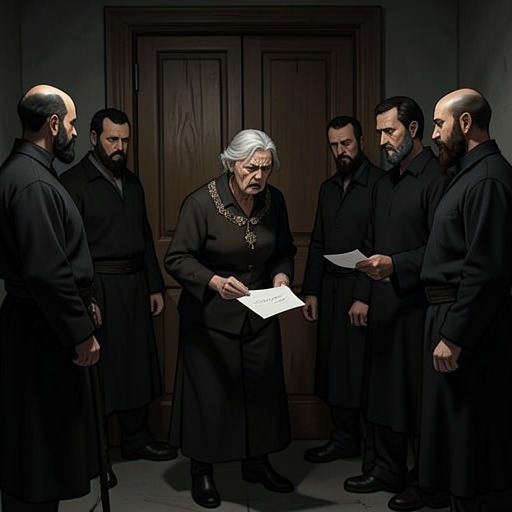
The rule also shaped who could be present. As Katherine entered the prepared rooms, she left behind friends and male members of her household, including the Duke of Buckingham, Edward Howard, her confessor, and the Spanish ambassador. She expected not to see them again until the child was born. Her women accompanied her instead, making the confinement a formally enclosed but female-populated space. The rule did not place Katherine alone: it separated her from ordinary public and court life while surrounding her with attendants.
The first confinement
For Katherine, the first entry into confinement carried the force of anticipated destiny. She understood childbirth as the work she had been raised to perform for the kingdom and entered the closed rooms with confidence. Her female attendants made the prescribed environment a lived community. Elizabeth Boleyn placed a pomander beside the bed; Elizabeth and Anne, sisters of the Duke of Buckingham, adjusted a tapestry; María de Salinas stood by the bed; and Margaret Pole prepared the cradle. Katherine, normally formal in matters of appointment, impulsively asked Margaret Pole to take charge of the royal nurseries, revealing how much she wanted the counsel of an experienced older woman at this moment.
Henry VIII observed the boundary as Katherine’s confinement began. He asked the women to serve her well and told Margaret Pole to send for him immediately if there was news, by day or night. After bidding Katherine farewell, he left her with her ladies. She welcomed the withdrawal as a peaceful refuge: it allowed her to set aside, for a time, the public performance of confidence and fertility and to wait in the familiar company of women. Her hope that the child would be strong was bound up with the memory of an earlier loss. The rule offered a defined period of waiting, but it could not guarantee the outcome she prayed for.
Prescribed seclusion and its limits
The later confinement makes clear that the Royal Book’s authority was not absolute in practice. Katherine delayed entering the rooms as long as she dared, then withdrew on the evening of the Christmas feast. She welcomed the quieter routine, resting through the winter days and praying for a safe delivery. Yet she also arranged for Henry to visit privately on most days, despite the book’s instruction that the queen should be in absolute isolation before the birth. Katherine rejected Margaret Beaufort’s rule as a command that should not govern her from beyond the grave, and explained her choice by her distrust of leaving Henry alone at court.
That decision shows the distinction between ritual prescription and the queen’s practical control over her household. Katherine did not abandon confinement: she entered it, remained in her rooms, and relied on her women. Instead, she interpreted the rule selectively, maintaining her withdrawal from the wider court while making room for the king’s visits. On New Year’s Eve, Henry dined with her before joining the feast and gave her rubies. The encounter places the king within the otherwise secluded space and underlines that Katherine could adapt the inherited protocol to her own political and personal circumstances.
Custom under pressure
The instructions in the Royal Book describe an orderly birth: the cradle was to be ready, and two beds prepared, one for delivery and one for rest. The actual arrangements proved less composed. When Katherine’s labor began on New Year’s Eve, the ladies hurried about in confusion. The midwives had gone to celebrate and had to be summoned from the hall; one was too unsteady to remain, and María de Salinas sent her out of the room. The physician could not be found, so pages searched the palace for him. Margaret Pole and María de Salinas remained calm beside Katherine as the carefully ordered ritual met the uncertainty of events.
The episode gives the rule both its practical value and its limits. It organizes the queen’s surroundings, defines the attendants’ role, and provides a model for managing a birth; it cannot ensure that the people required will be ready when labor begins. The birth followed after several hours, and the infant’s cry brought the waiting to an end. Across Katherine’s pregnancies, confinement therefore recurs as a formal threshold between public queenship and childbirth: a space shaped by inherited ceremony, sustained by women’s care, and adjusted by a queen who could claim authority within its boundaries.