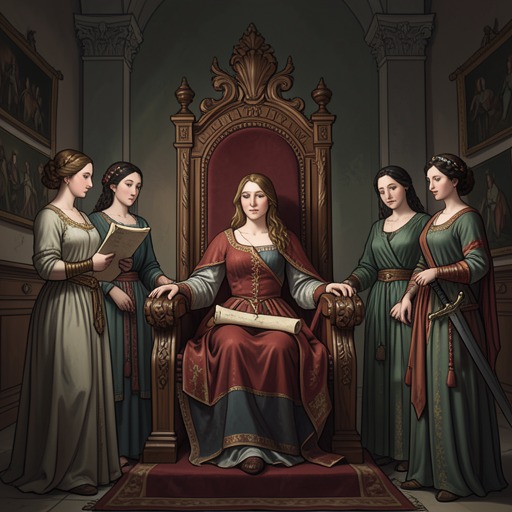
Royal women’s duty of obedience and limited autonomy
The Constant PrincessRoyal women’s duty of obedience and limited autonomy is a recurring condition of dynastic life in the novel, not simply a personal virtue or failing. Women’s positions depend on marriage, kinship, and recognition by rulers, while political survival can leave them with little room to refuse. Yet obedience does not erase judgment: Margaret Pole describes it as a choice made with a mind of one’s own, and Catalina of Aragon eventually exercises authority over government and military preparations. Their stories frame agency not as freedom from constraint, but as the capacity to understand, navigate, and sometimes act decisively within it.
Dynastic Dependence and the Limits of Choice
Margaret Pole explains the limits of a princess’s power through the competing claims of husband, parents, king, and God. A royal woman may be held responsible for choices that are not hers to make, she tells Catalina, even though challenging the decisions of those who rule her may be impossible. In this account, obedience is partly a condition imposed by political rank: a princess’s birth gives her status, but it does not guarantee control over her future.
The discussion of Margaret’s own past makes the danger concrete. She had been a princess of York, but her father was dead and her mother was politically vulnerable, confined in sanctuary under the king’s power. Her brother was held in the Tower of London because he had been born a prince. Margaret says that refusing the marriage arranged for her could have put her in the same danger. She changed her name and accepted a lower status rather than risk her life. Her royal blood was subsequently obscured by a lowly marriage, leaving her a wife on the Tudor Borders instead of a claimant to the crown.
Catalina recognizes a parallel in the story of another York princess, whose prospects, as described in conversation, depended on gaining the king’s favor and marrying him if she hoped to be queen. The comparison leads Catalina to acknowledge that her own path to the English crown had also been determined by dynastic necessity. Her marriage to the man who became Henry VIII made that destiny personally acceptable to her, but did not make the larger rule disappear: a princess might have to marry to secure the position for which she had been raised.
Obedience as Judgment, Not Passivity
Margaret’s counsel complicates the idea that obedience means thoughtlessness. She allows that a woman must think for herself; obedience, in her account, involves recognizing that one might know better and nevertheless choosing to bow. Mere agreement requires no such judgment. The distinction gives constrained women an inward space in which they can assess the decisions governing them, even when their ability to reject those decisions is narrow.
The exchange also gives Catalina a way to speak about her own unease and self-blame. Margaret rejects the notion that Catalina is responsible for another person’s death and urges her not to take upon herself the wrongdoing of others. Their conversation becomes an early bond between women whose royal identities have been diminished by events and marriage. Catalina’s laughter with Margaret marks a rare ease between them, while Margaret’s insistence that she remains herself, whatever title she is given, separates personal identity from public rank.
That distinction does not make resignation easy. After Catalina’s position changes, Margaret tells her that a woman without a husband or son has no position beyond what she was born to. Catalina fears that returning to Spain and marrying again could cost her the identity of Princess of Wales and the possibility of becoming Queen of England. Margaret’s own life offers a painful example: the princess has become a wife of reduced standing. She urges Catalina to live without regret, but Catalina answers inwardly with a different kind of resolve: she will claim what she understands to be hers and fulfill her duty, however difficult the task. The tension between accepting fate and acting upon it remains unresolved, rather than being reduced to simple obedience.
Marriage, Widowhood, and Material Leverage
The limits on women’s choices are enforced not only through titles and marriage plans but also through money. The dispute over Catalina’s dowry places her between Henry VII and her father, Ferdinand II of Aragon. The agreed dowry was substantial, but only half had been sent in cash; the remainder was treated as potentially represented by the household plate and treasure Catalina brought to England. Henry VII demanded the full sum, while the arrangements at Ludlow Castle meant that Catalina’s gold plates were used at meals and their value could be diminished through ordinary wear. Her household goods thus became part of a financial contest between rulers, while her own position was tied to the settlement.
Widowhood makes the contractual terms still more consequential. Catalina’s mother directs her to remain where she is until she knows whether she is pregnant. If she is not, she is to have Dr. de Puebla seek her jointure as Dowager Princess of Wales and travel to Spain only after receiving the full amount. If she is pregnant, the instructions instead call for immediate payment of the remaining dowry, an allowance, and hopes for a son. Catalina is also told to report her condition and remain under Doña Elvira’s chaperonage. The alternatives make her body and possible pregnancy central to the political and financial decisions being made around her, while leaving her responsible for communicating information on which those decisions depend.
The sums at stake are explicit: Henry VII is said to owe her a third of the revenues of Wales, Cornwall, and Chester as her jointure, and her parents additionally demand the return of her dowry. Catalina doubts that he will pay. She recalls that her allowance had not been paid even while his son lived, and sees little reason he would now surrender revenues or return the money. The contract gives her a claim, but the narrative distinguishes having a right on paper from being able to secure its fulfillment. Her dependence is therefore both dynastic and economic.
From Constrained Princess to Governing Queen
Catalina’s later authority does not erase these earlier constraints; it shows how much her position can change when dynastic status and political opportunity align. As queen, she consults influential figures and the English Privy Council, drawing on the statecraft she learned from her parents in Spain. She helps pursue a stronger, more peaceful kingdom, work on extending the law across the country, and plans for coastal defenses, ships, and army musters. The narrative presents this administrative competence as learned knowledge put into practice, not merely as the effect of her marriage.
Her handling of Margaret Beaufort’s funeral offers a public demonstration of that capacity. With no clear orders forthcoming, Catalina summons the Duke of Buckingham and asks for Margaret Pole. She consults the Royal Book and finds handwritten funeral instructions tucked inside it. Rather than follow Margaret Beaufort’s expansive plans unchanged, Catalina reduces much of the proposed scale and gives orders for a restrained ceremony. Her command makes visible a form of authority exercised through judgment, ceremonial knowledge, and an understanding of the court and its audience. Before her coronation, the Spanish princess who had once been neglected establishes herself as a leading figure in the new court.
At the coronation on 24 June 1509, Catalina is carried from the Tower of London to Westminster in a gold-cloth litter, wearing white satin and a pearl-set coronet. Henry VIII is crowned first; Catalina then receives the anointing, scepter, and ivory wand. The ritual confirms a status she has waited years to attain, and the narrative links her anointed queenship to a divinely appointed duty to rule. Her authority is still defined through the monarchy and her marriage, but she is no longer merely the princess whose future others arrange.
That distinction becomes formal when Henry VIII prepares to sail for France. At Dover, he gives Catalina the Great Seal of State and invests her as regent, governor of the realm, and captain general of the forces responsible for home defense. She is entrusted with rule while the king is away. Before the campaign against Scotland, she rides along the ranks of five hundred troops, following the example of her parents in making each soldier feel seen, then addresses the assembled army as its queen. The narrative thereby places her authority in administrative appointment and public military leadership, as well as in ceremonial status.
The Meaning and Limits of Agency
The contrast between Margaret Pole and Catalina clarifies the rule’s central tension. Margaret’s survival depended on yielding a crownward future and accepting a marriage that protected her from a greater threat; she retains an inward sense of identity but does not recover her former rank. Catalina, by contrast, moves from an exposed widow negotiating a jointure to a crowned queen and regent with responsibility for the realm. Neither trajectory suggests that royal women can simply choose their own lives. Instead, the novel shows how their available actions depend on shifting circumstances, the recognition of others, and the resources attached to title and office.
Catalina’s rise also complicates the idea that women’s authority is only an extension of a husband’s. Her marriage brings her to queenship, and Henry VIII formally appoints her regent, but her preparation, advice-seeking, ceremonial decisions, and command of the army give substance to those positions. The same narrative that describes a princess’s constrained marriage and a widow’s precarious financial claims also depicts a woman governing in her own right during the king’s absence. Obedience remains part of the political order she inhabits; it does not define the full measure of what she can do.