Scotland, England's northern neighbor
The Constant PrincessScotland, England’s northern neighbor, occupies the story as both a prospective ally and a persistent source of danger. Its importance lies not in a detailed portrait of the country itself, but in the pressure it exerts on English policy: dynastic marriage is intended to secure peace, while repeated border incursions make that peace uncertain. When an English army prepares to leave for France, the northern threat becomes immediate, and Katherine takes command of the kingdom’s home defense.
Setting and strategic position
In the winter of 1501, Scottish envoys are frequently present at the English court, negotiating the marriage of Margaret Tudor, then twelve years old. The proposed match belongs to Henry VII of England’s larger effort to turn hostile neighbors into allies through his children. Catalina understands the calculations behind these arrangements: her marriage has linked England to Spain, while Margaret’s is expected to make Scotland a friend rather than an enemy. Mary Tudor may also be matched in time to a kingdom regarded either as England’s greatest enemy or as a valued ally. These plans make royal kinship an instrument of foreign policy, with the hope that family ties can contain conflict between kingdoms.
Scotland’s strategic importance is sharpened by its relationship with France. In a private explanation to Catalina, Edward Stafford, Duke of Buckingham, describes the Scottish alliance with France as the source of a continuing danger: whenever England goes to war with France, Scotland may join the conflict and cross the northern border. Even a smaller kingdom can serve as an entry point for a powerful rival. The court’s concern is therefore not simply that Scotland is hostile, but that its alliances can widen a conflict and expose England from the north.
Border conflict and the pursuit of peace
Buckingham characterizes the frontier as a recurring zone of limited warfare rather than settled peace. Invasions occur roughly every three years, with land lost and sometimes recovered; each summer, Scottish raiders harry the border counties and take resources that they cannot grow or make themselves. Farmers in the north are described as living under persistent insecurity. The repeated, sometimes small-scale nature of these incursions does not make them trivial: the accumulated threat to land and livelihood explains why Henry VII of England is determined to secure peace with Scotland.
The language used at court turns this pattern into a familiar political image. Scotland is likened to a continuing plague, while the Moors in Catalina’s childhood had been described in comparable terms by her father. The comparison reveals how the characters make sense of neighboring powers through inherited accounts of danger. It also contrasts the strategic reasoning of the English court with Catalina’s initially limited view of Scotland as a small kingdom. Buckingham’s explanation teaches her that size alone does not determine the danger a state can pose when it can draw a larger enemy into a war.
Marriage as diplomacy and leverage
The proposed marriage of Margaret Tudor is not presented as proof that hostility has ended; it is an attempt to change the relationship between the kingdoms. Buckingham expects the Scots to treat Margaret kindly in their own rough manner, while distinguishing her reception from the welcome given to Catalina. The exchange keeps the human and diplomatic dimensions of royal marriage in view: a young princess is sent to another court in the hope that her presence will help bind a neighboring power to England.
Scotland also appears within the wider bargaining over Catalina’s marriage and dowry. Henry VII of England considers marrying Catalina himself in part because the arrangement could reinforce Spain’s alliance while helping him secure new alliances with Scotland and France. He imagines that marriages linking the royal families could make the great powers of Christendom safer and more closely connected through shared heirs. The plan demonstrates how the same marriage negotiation could carry several political aims at once: financial advantage, dynastic succession, and the containment of rival states. Scotland is one part of that wider design, not a separate question from England’s financial and diplomatic interests.
The northern threat during war with France
The expectation that marriage will moderate Scottish policy remains vulnerable to the demands of English war. When Henry VIII plans to lead an army to France, Catalina recognizes that Scotland may exploit England’s reduced defenses and invade the north, even with an English bride on the Scottish throne. Her objection is connected to a broader program she associates with Arthur: reforming taxation, establishing schools and a king’s council, strengthening forts, and building a defensive navy. These unfinished domestic and defensive tasks, she argues, should take precedence over Henry VIII’s desire for war.
Henry VIII nevertheless intends to appoint his grandmother, Margaret Beaufort, as regent while he is away. Catalina questions whether Margaret Beaufort, already old, should bear that burden. The exchange brings the Scottish threat into the question of who will govern England during the French campaign: leaving the country requires someone able to manage both its affairs and its defense. Scotland is thus a test of the practical consequences of royal strategy. The proposed alliance has not removed the danger that makes a regent necessary.
Invasion, regency, and narrative significance
At Dover, as Henry VIII prepares to sail for France, he formally invests Katherine with the Great Seal of State and names her regent, governor of the realm, and captain general of the forces assigned to home defense. The appointment turns the northern danger from a matter of diplomatic prediction into a responsibility placed directly in her hands. Katherine regards defeating the Scots as the first use she must make of her authority.
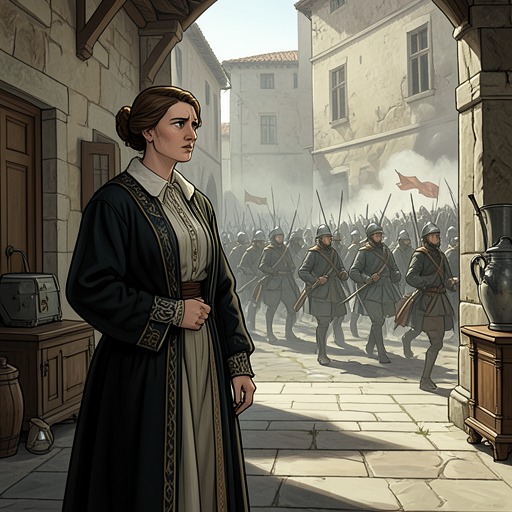
She prepares the women of her household for different roles: some are to accompany her, while those who remain are to continue making banners, preparing bandages, and maintaining order. Before the troops, she rides slowly past all five hundred men, following the example she learned from her parents of making each soldier feel seen as an individual and part of the army. She removes her helmet so that the men can see her face and presents herself not as a veiled Spanish princess but as an English queen leading the defense of her country. In her address, she frames the invasion under James IV of Scotland as a breach of treaty and an affront to his English wife, as well as an attack condemned by the Pope. The soldiers answer with approval, and she makes visible that she is not afraid.
Scotland’s narrative role consequently shifts from the object of alliance-making to the opponent against whom Katherine exercises political and military authority. The marriage plan and the preparations for invasion coexist rather than cancel each other out: a princess may sit on Scotland’s throne while the English court still fears a northern attack. That tension exposes the limits of dynastic diplomacy and gives Katherine’s regency its immediate purpose. Scotland is the recurring test of whether royal policy can keep England secure—and of whether Katherine can turn formal appointment into active command.