Scottish invasion of England (1513)
The Constant PrincessThe Scottish invasion of England in 1513 turns Katherine of Aragon’s regency into a test of whether she can defend the kingdom as well as govern it. With Henry VIII away on campaign in France, Katherine must meet a northern invasion with much of England’s best command overseas. She organizes the defense, keeps a reserve force between the enemy and the south, and advises Thomas Howard, Earl of Surrey, against attacking uphill. The victory that follows confirms her authority in the story not as a ceremonial substitute for the king, but as a ruler who can plan for defeat and still bring England through war.
Causes and Stakes
The invasion unfolds as Henry VIII prepares to sail for France. Katherine and Thomas Wolsey have arranged the embarkation carefully: four hundred ships wait at Dover, equipped for the campaign, while the king is formally appointed regent before the fleet departs. Henry gives Katherine the Great Seal of State and makes her governor of the realm and captain general of the forces assigned to home defense. She accepts the office publicly and understands its military consequence: the defense against the Scots will be her responsibility.
The English campaign in France leaves the kingdom exposed. Katherine’s first defensive army marches north under Surrey, gathering additional men along the way, while messages bring news that James IV of Scotland has crossed the border. The invaders advance through the border country, recruiting soldiers and taking food. The danger is not merely a border raid. Katherine learns that the French king has promised to recognize James as king of England if he wins the battle. The prospect makes the invasion a direct threat to the English crown as well as to its territory.
The reports put the scale of the threat at sixty thousand Scots, perhaps more. Katherine insists on an honest estimate rather than a softened one: if she is to lead an army, she needs to know the strength she may face. The flower of English command and many of the best soldiers remain overseas, and northern castles have already been captured. In her assessment, the invasion is coordinated with the wider war: France expects the Scots to strike England while English forces make a diversion in northern France. The stakes encompass the capital, the succession, and the security of the realm.
Organizing the Defense
Katherine’s response draws on a governing competence already established at court. She has consulted political advisers and the English Privy Council, worked to extend the reach of law across the country, surveyed ships for a fighting navy, and prepared army muster rolls. Her earlier organization of the French expedition had likewise centered on reliable provisioning: she had learned from her parents’ campaigns that armies depended on supplies as much as on courage. The invasion gives that practical knowledge an immediate domestic purpose.
Before the first army marches, Katherine rides past five hundred troops assembled before the palace. She makes each soldier visible to her by looking along the lines, then removes her helmet so the men can see her face. The gesture marks her public change from a veiled Spanish princess to an English queen appearing before her army. Her address frames the campaign as defense of home and realm, and she presents the Scottish advance as a breach of treaty and an assault on the order of the kingdom. The troops respond with a roar of approval and march north under Surrey.
Katherine’s command does not depend on pretending that defeat is impossible. She has planned where to fall back, where to regroup, and where to fight again if the first position fails. She rides with a force of forty thousand, the royal standard above her, and makes a point of being recognized by the men on the march, riding the length of the line twice each day to encourage those at the rear. Her routine of prayer—Mass at dawn, Communion at noon, prayers at midnight—runs alongside the practical labor of command. Religious conviction and military preparation are presented together, not as alternatives.
Strategy and the Approach to Battle
Katherine and Surrey coordinate separate forces rather than risking everything in one engagement. Their first aim is to have Surrey meet the Scots and impede their rapid advance. If his force is defeated, Katherine’s army remains available to stop the invaders from sweeping south. If both forces are driven back, they have a further plan: defend London with a citizens’ army and earthworks, and, if necessary, hold the Tower until Henry can bring support from France. Surrey would prefer to unite the armies before attacking, but Katherine insists that he follow the planned first engagement. Keeping a reserve, she argues, protects the road to the capital if the first battle is lost.
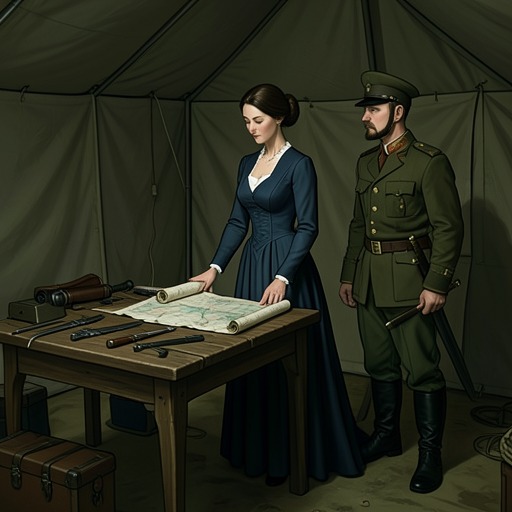
When Surrey reports that the Scots are encamped on high ground at Flodden, Katherine studies his map. An English attack uphill, she judges, would expose the men to Scottish archers firing down the slope and to a charge by the Highlanders. She advises Surrey to send spies around the position and seek a route to attack from the north. His force might feint, pinning some Scots in place while the rest of his men move as if heading north; ideally, the Scots would pursue and leave the high ground. The route is uncertain because a stream crosses boggy terrain, but Katherine sees no sound plan in a direct uphill assault. She offers her advice while leaving the final decision to Surrey, the commander in the field.
This exchange reveals the discipline behind her confidence. Katherine wants to join the battle and feels the exhilaration of a commander released into action, but refuses to risk the reserve for the sake of taking part in a single decisive encounter. Her goal is a defensive campaign that can survive setbacks and destroy the Scottish threat for a generation, perhaps longer. She treats uncertainty as the reason to prepare multiple positions, not as a reason to gamble everything on one battle.
Victory and Significance
News of the outcome reaches Katherine as a report from Surrey’s force: the King of Scotland is dead, along with twenty Scottish lords, bishops, earls, and abbots. The messenger says the English soldiers, raised, trained, and armed under her direction, have carried out what she ordered and made England safe. The defeat is described as one from which Scotland’s leadership will not readily recover. The invasion’s immediate threat has been met, and the promised recognition of James as king of England has come to nothing.
Katherine’s hand goes to her belly beneath the breastplate as she hears the news. The gesture connects the safety of the realm with the future she hopes to secure for her child; her victory is not only military but dynastic. The ending gathers together the powers the story has been building: the regent appointed at Dover, the administrator who organizes ships and soldiers, and the commander who plans for retreat as carefully as for battle. By making the invasion a test of judgment rather than a single display of bravery, the narrative presents Katherine’s rule as active, informed, and answerable to the survival of England.