Spain’s suppression of Moorish scholarship and medicine
The Constant PrincessSpain’s suppression of Moorish scholarship and medicine is portrayed as a religious campaign whose costs reach into the royal household. By driving learned people from Spain and marking their knowledge as heretical, Isabella of Castile’s policy leaves Katherine of Aragon caught between obedience to her mother and Church and the urgent need for medical understanding. The resulting conflict changes Katherine’s view of her family, of Moorish people, and of what faith requires.
Policy and the Dispersal of Knowledge
Katherine initially defends the exclusion of Moorish learning in terms she has inherited: she understands it as knowledge unlawfully obtained and opposed to revealed Christian truth. María de Salinas challenges that account by telling her that the Inquisition arrested most of the learned men and that the rest fled. Jews, María says, went to Portugal, Italy, and Turkey, while the Moors went to Africa and the East. The dispersal is thus not merely a debate over scholarship; it is a consequence of religious coercion that removes people, practices, and expertise from the places where they might be used. Katherine’s first response is to defer to Isabella and the Catholic Church. If the authorities call such learning sinful, she reasons, obedience seems to demand embracing ignorance. Yet the question does not remain abstract. She wonders whether God could require the denial of knowledge and whether that denial might cost England its son and heir. The policy that once appeared to her as a defense of religious orthodoxy begins to look like a danger to the people who must live with its effects. The narrative emphasizes a contradiction in Isabella’s legacy. Katherine remembers her mother as a woman who valued learning and fought for justice, yet comes to see that she banished Jewish skills and Moorish scholarship along with the people associated with them. Her recognition does not erase her love for her mother, but it separates filial reverence from judgment: a parent who has been a model can still have been wrong.
The Medical Knowledge Gap
The conflict becomes concrete during Katherine’s pregnancy. Henry VIII sends his physician, who questions her but cannot examine her because the queen’s body is treated as sacred and touchable only by the king. He discourages fruit and vegetables, dismisses her account of Moorish methods for calculating a birth date with an abacus, and proposes frequent bleeding. His authority rests on his position and English learning, while Katherine’s recollection of medical practice in Spain makes the limits of that learning visible to her. The consultation also exposes the unequal conditions under which a queen’s health is discussed. The physician speaks English, and Katherine must strain to understand him; he is embarrassed and keeps his eyes lowered. Although he is presented as the most skilled doctor in London, his recommendations do not reassure her. María’s remark that learned men have been driven from Spain turns the poor consultation into evidence of a larger loss: the expertise Katherine remembers is no longer readily available to her, while the knowledge she needs is condemned as suspect. The crisis of pregnancy intensifies the stakes. After a loss, Katherine is told that another child may still be expected, but later signs make her doubt that account. She recognizes that the explanation came from her husband’s physician rather than from the midwives, and she wants an honest medical assessment. Her need is both personal and dynastic: she hopes to conceive a son for England, yet official medical authority has not given her confidence about her condition.
Secret Consultation and Changed Judgment
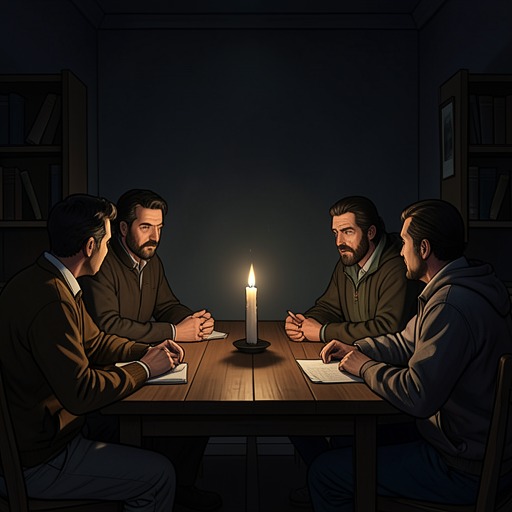
At first Katherine refuses to see a Moorish doctor, reasoning that he is an enemy of both her and her mother and that his learning comes from forbidden sources. María persists, arguing that he may be the only doctor in England with knowledge of women. Katherine eventually agrees to a private meeting at Richmond Palace, reached through a hidden stairway from the cellars and a servants’ passage. The secrecy makes the cost of her earlier convictions tangible: the medical knowledge she seeks must enter the queen’s rooms by a concealed route. Katherine regards the physician as a religious outsider, but also recognizes that his people have studied Greek medical writings, investigated the body, and tested ideas without allowing superstition to settle every question. The physician cannot examine her under the restrictions governing the queen’s body, so he distinguishes what he can infer from what would require an examination. He also explains that her earlier pregnancy indicates that she and her husband are fertile, and gives practical advice about exercise, rest, timing, and diet. His role is not simply to supply a diagnosis; he offers a different basis for reasoning about bodies, one that Katherine has been taught to distrust. The encounter alters the way Katherine interprets the expulsions. She recalls the physician’s compassion and can no longer comfortably equate Moorish identity with barbarism or spiritual worthlessness. She concludes that people of another faith are fallible and hopeful, and faithful to their own creed, rather than enemies whose knowledge can be dismissed without consideration. Her revised view does not mean that she abandons Christianity; she continues to hold her faith firmly while questioning the claim that religious authority has a monopoly on useful knowledge.
Consequences for Katherine’s Beliefs
Katherine’s reassessment extends beyond medicine. She connects the physician’s absence to Isabella’s treatment of scholars, to the loss of Jewish skills and Moorish learning, and to her own earlier dependence on her mother’s judgment. In her view, a woman who admired learning nevertheless helped expel learned people, and a woman who sought justice acted unjustly toward them. The contradiction makes inherited authority answerable to consequences rather than immune from criticism. She therefore rejects a crusade against the Moors and opposes persecution and cruelty based on skin color or belief. Her conclusion is specific to the experiences that have unsettled her: medical uncertainty has shown her what exclusion can cost, and the physician’s conduct has challenged the stereotype by which she had judged him. She still loves Isabella of Castile, but no longer treats her mother as infallible or imagines that her mother’s beliefs and God’s must be identical. The suppression of Moorish learning thus marks a decisive stage in Katherine’s growing independence: she begins to judge religious policy for herself, especially where it governs women’s health and the future of the Tudor succession.