Swifts
The Constant PrincessSwifts are the birds in Catalina’s defining image of the Court of Myrtles: a ceaseless, wind-fast river circling above its water and stucco. More than a detail of remembered architecture, they become a recurring image of the Spain she misses, then surface again in Arthur’s fevered vision, joining her account of home to the crisis unfolding around him.
The birds in Catalina’s description
While describing the courtyard, Catalina pauses to find a name for the birds and offers the Latin word “Apodes?” Her companion supplies “Swifts?”; she nods and explains their movement through the enclosed space. They stream above the courtyard in a circuit, “screaming as they go,” with the speed and force of a cavalry charge. The image is not of a flock resting in the garden but of continuous motion: the birds circle as long as sunlight reaches the water, turning the calm architectural space into a place animated by sound and speed.
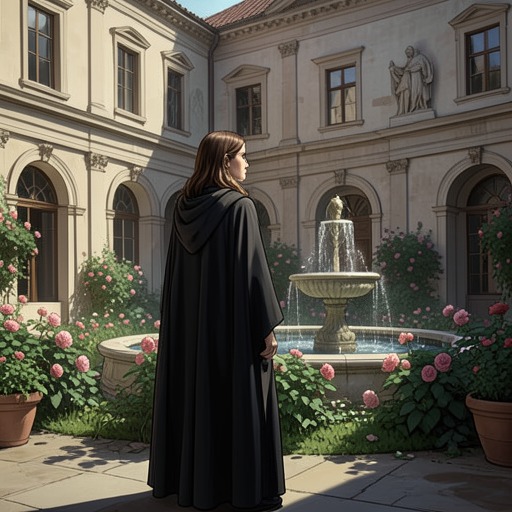
The courtyard is itself described through reflection and enclosure. A gateway, its arch, and the building around it appear mirrored in rippling water; the stucco screens are delicate and airy against the straight, solid hedge. Against these ordered features, the swifts make a moving counterpoint. Their circling gives the courtyard a rhythm that Catalina can recall as a whole scene, rather than as a collection of separate ornaments.
Disappearance and memory
Catalina’s account makes the birds’ nightfall as striking as their flight. She gestures as if casting a spell and says they vanish without being seen settling or nesting; at dawn, they are there again, flowing around the courtyard. This disappearance belongs to the image she describes, not to an explanation of the birds’ habits. In her telling, their absence is as mysterious and memorable as their return.
When she admits that the scene is hard to describe but that she sees it continually, her companion recognizes what the recollection means: she misses it, and the feeling will remain even if she is happy in her new life. Catalina accepts that homesickness as something to be expected, but insists that she does not forget who she is or what she was born to be. The swifts thus belong to a memory with personal weight. Their remembered circuit carries the courtyard, and the self she associates with it, into her life far from home.
The dream over Spain
In a dream set in March 1502, Catalina imagines herself as a swift flying over New Castile, south from Toledo and Córdoba toward Granada. The journey passes above a broad, tawny landscape and ends at the Alhambra of Granada. She skims the watchtower where the crescent-moon flag once flew, then descends into the Court of Myrtles and circles in its warm air, looking down at the reflected water until she finds Isabella of Castile walking in the evening and thinking of her daughter in distant England.
The dream transforms the courtyard birds into Catalina’s own imagined form. Flight gives her a route from England back to Spain and, within that imagined return, to her mother. The recalled garden is no longer merely a place she describes to another person: it becomes the destination of a dream organized around separation and the wish to see Isabella. The swift’s circling also repeats the movement Catalina had already emphasized, making the remembered birds the means by which the dream revisits the courtyard.
Arthur’s fevered vision
Later, while Arthur is gravely ill, reports about his worsening condition mingle with Catalina’s fear for him. He has a high fever and wanders in his mind, at times believing himself in the nursery with his siblings, at times at his wedding, and at times in a fantastic palace. In that palace he speaks of a myrtle courtyard, water reflecting a golden building, and swifts circling throughout the sunny day.
The resemblance to Catalina’s earlier description is concrete: the myrtles, the reflective water, and the birds’ unbroken circuit recur together. The account does not explain how Arthur’s vision came to reproduce these features, so the echo remains an echo rather than proof of its cause. Its placement is consequential nonetheless. As Catalina announces that she will see Arthur, Margaret Beaufort warns that the illness may be the Sweat and refuses to let her go close enough to risk infection. The remembered garden therefore enters the narrative at a moment when the couple are separated by illness and danger.
Narrative significance
Across Catalina’s description, her dream, and Arthur’s fevered speech, the swifts connect three distinct states: a vividly recalled home, an imagined return to it, and an image arising in another person’s delirium. Their repeated flight makes the courtyard unusually persistent in the narrative, while their disappearance at night lends the recollection a fragile edge. The birds do not resolve Catalina’s distance from Spain or the uncertainty of Arthur’s illness; instead, their recurrence makes remembered experience visible across that distance, carrying the same courtyard image from intimate conversation into dream and crisis.