The Nonconsummation Claim
The Constant PrincessThe Nonconsummation Claim is Catalina’s assertion that her marriage to Arthur, Prince of Wales, was never consummated. It begins as a calculated route out of widowhood and toward marriage with Arthur’s brother, Henry VIII, but its consequences outlast that plan: the claim shapes a royal marriage, binds Catalina to a sustained deception, and returns as the central issue in a court challenging her marriage to the king.
Origin and Purpose
After Arthur’s death, Catalina tells Doña Elvira to inform her parents that her marriage had not been consummated and that she remains a virgin. When Doña Elvira objects that the court witnessed the couple’s bedding, Catalina distinguishes public ceremony from what happened in private: witnesses could see that the prince visited her bedroom as ordered, she argues, but no one else could testify to what occurred behind its door. She insists that Arthur was unable to be her husband and that their attempts had no effect.
The claim is not presented as an isolated explanation of the past. Catalina identifies it as her way to remain in England and pursue a future with Arthur’s younger brother, Harry. If the marriage had not been consummated, she reasons, there would be no impediment to marrying him. She instructs Doña Elvira to tell a new Spanish emissary that it is God’s will and her own desire to resume her position as Princess of Wales, and that negotiations should concern her next wedding rather than her widow’s jointure. The declaration thus converts an intimate and disputed fact into a dynastic proposal.
From Private Assertion to Political Evidence
The claim acquires force through repetition and through the cooperation of people positioned to confirm it. When Dr. de Puebla is confronted with the prospect of Catalina marrying Henry VII, he recognizes a possible affinity impediment and raises the need for a papal dispensation. Catalina says she will seek one and asks whether he accepts her account of the first marriage; he confirms that he does. Later, when Henry VII proposes marriage, he likewise treats the reported nonconsummation as removing the principal objection, while still proposing to request a dispensation.
Dr. de Puebla also describes the limits of the Spanish court’s role. Although he confirms that Catalina is said to be a virgin, he warns that her parents must consent to applying for a dispensation. Without their application, he argues, the Pope cannot grant one and the marriage cannot proceed. The private claim therefore does not by itself settle the matter: it must be supported by diplomatic testimony, authorized through ecclesiastical procedure, and accepted by the relevant dynastic parties.
When Catalina later speaks with Henry VIII, she repeats the assertion as the premise of their contemplated marriage. The narrative makes clear that the original lie was devised to bring her to the altar with Harry, not his father. Faced with Henry VII’s proposal, she is shocked, yet says she cannot retract it. What had been a means of controlling her future has become a constraint: the same statement that opens one path to marriage now commits her to an unwanted one.
Marriage, Repetition, and Performance
Years later, Catalina tells Henry VIII that Arthur was not strong enough to be her husband. She recounts their short marriage in a way that supports the claim: they married in November, travelled toward Ludlow in December, were apart during the journey, and Arthur was ill after Christmas before dying in April. She also tells Henry that Arthur tried once or twice, but that the attempts did not constitute consummation. Her account is deliberate and consistent, and she understands herself to be fulfilling the promise she made to Arthur by sustaining the lie.
Catalina adds a further assertion of her virginity, saying that her women and her mother knew she had not been touched. Henry accepts the account, relieved that it resolves his fear of sin and gives him a clear understanding of the marriage he is entering. The exchange reveals an asymmetry: Catalina recognizes that she is maintaining a falsehood, while Henry is willing to believe the version that allows him to proceed. The claim does more than establish a legal position; it gives each of them a story about their marriage that serves a different need.
After the wedding, Catalina secretly creates a small bloodstain on the sheet so that her attendants can report evidence consistent with the expected bridal account. She rests the next morning, behaves as though newly married, walks stiffly, and declines to hunt for a week. These actions extend the claim beyond words into a public performance, preparing others to repeat what she has asserted. The lasting soreness from the concealed cut also becomes, in her account, a reminder of the promise and the deception she expects to carry for the rest of her life.
The Claim at Court
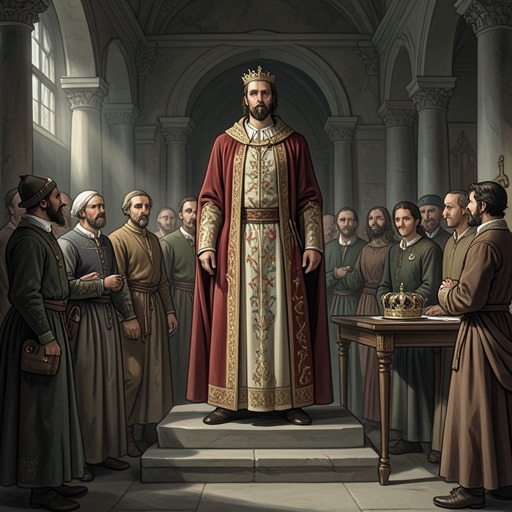
The claim returns when Henry’s marriage to Catalina is challenged. In the later court scene, Catalina enters despite having made clear that she does not recognize the proceedings and has prepared no legal defense. Her presence makes the dispute not merely a question discussed in her absence but a confrontation in which she stands before the king and the court. The issue now threatens the marriage that the earlier claim helped make possible.
Catalina stakes her position on Henry’s reluctance to challenge her account publicly. She believes that his vanity will prevent him from acknowledging that she had been Arthur’s wife and lover before she became Henry’s bride, and that he will not tell the truth even when faced with her directly. In her reasoning, admitting that history would expose his marriage to her as dissolvable. She enters the courtroom relying on what she sees as his weakness and on the force of the claim she has kept intact.
The concept’s significance lies in this reversal. A declaration first devised to secure Catalina’s dynastic future becomes the foundation of a marriage and, eventually, the disputed fact on which that marriage can be attacked. Its persistence depends on more than the original assertion: it requires diplomatic confirmation, a route through church procedure, Henry’s willingness to believe, Catalina’s carefully maintained performance, and her eventual readiness to confront the court. The claim shows how a woman with limited control over royal marriage can use testimony and royal convention to shape her options, while also becoming bound to the account that gives those options meaning.