The Tudor succession crisis
The Constant PrincessThe Tudor succession crisis is the dynastic and political danger created by the lack of a surviving heir to Henry VIII and Katherine of Aragon. In the novel, succession is not an abstract question of inheritance: it shapes the terms of Katherine’s widowhood, gives her pregnancies consequences for two kingdoms, and makes each child’s survival a matter of national hope. Her rise to queenship and regency briefly makes that future seem secure; the death of her infant son then turns the prospect of an heir into a personal and spiritual catastrophe.
The widow’s claim and the dynastic bargain
Before Katherine becomes queen, the succession question is entangled with the financial terms of her marriage to Arthur, Prince of Wales. The dispute over her dowry places her between the competing interests of Henry VIII’s father and her own parents. Her household plate is treated not simply as domestic property but as a possible substitute for cash: at Ludlow Castle, Katherine’s household uses the gold plates, while the dispute over the unpaid portion of the dowry remains unresolved. The expenses and obligations attached to her marriage therefore continue to shape her position after Arthur’s death.
As his widow, Katherine has a claim to a jointure amounting to a third of the revenues of Wales, Cornwall, and Chester, payable until she remarries. Her parents also seek the return of her dowry. Katherine doubts that Henry VII will honor either obligation, recalling that even her allowance had not been paid while Arthur was alive. The contract gives her a formal claim, but she sees little reason to expect that the king will meet it when he has no advantage to gain. The prospect of a child changes the calculation: her mother’s instructions distinguish sharply between a pregnancy and its absence, linking the possibility of an heir to cash payment of the dowry, her allowance, and her future in England. If she is not pregnant, the plan is to secure her jointure before she sails for Spain.
This financial pressure makes the succession crisis inseparable from Katherine’s uncertain personal future. Her widowhood could end in departure and a new marriage arranged by her parents; a pregnancy could instead strengthen her claim to remain and place a potential heir at the center of negotiations. The expected child is therefore imagined both as a family member and as the means by which Katherine’s position in England might be transformed.
Queenship and the hope of an heir
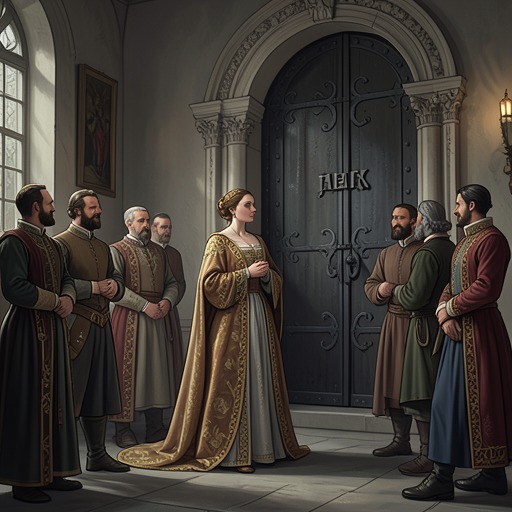
Katherine’s coronation in 1509 gives the succession question a new setting. Carried from the Tower to Westminster in a cloth-of-gold litter, she is anointed after Henry VIII and receives the scepter and ivory wand. The ceremony presents her as a divinely appointed queen, while her position beside the king makes the future of their marriage and dynasty newly public. The novel connects the anointed royal body to the political continuity that a child is expected to provide.
The hope of a son becomes explicit in Katherine’s conversation with Henry VIII. She proposes that their son should be prepared for kingship from an early age, a response shaped by her own experience of how a prince’s education can be managed. At the first Christmas of the reign, her visible pregnancy is celebrated by the court. Henry makes sure she has a chair and is not tired; songs, dances, and masques are arranged in her honor. The court’s happiness reflects more than pleasure in Katherine’s condition: it treats her pregnancy as evidence that England and Spain may at last have an heir.
Katherine’s expectations nevertheless exceed the immediate demand for a male successor. She imagines herself teaching a child Christian conduct, court life, and the work of ruling, drawing on the courage she learned from her mother and the skills associated with her father. Her ambitions make pregnancy part of a prospective political education: she hopes to shape a ruler who can protect England from its enemies. Yet she also remembers Arthur’s wish for a daughter called Mary. The dynastic future she imagines can include a girl, even as the court’s hopes concentrate on the security a living heir would bring.
Loss and renewed expectation
In January 1510, Katherine wakes in pain and finds that she is bleeding. Her dream of a fleet on the River Thames gives way to the knowledge that the child cannot be saved. After a long day, she gives birth to a dead girl. Katherine’s grief is intensified by the memory that Arthur had wanted a daughter first and that the child was to be named Mary. She cannot bring herself to face Henry VIII or write to her father, and interprets the loss through the failures she believes she has brought upon England, her husband, Spain, and Arthur’s memory.
The loss does not immediately end the prospect of an heir. When Henry fears that the death may signify divine displeasure, Katherine reassures him that the fact they have had a baby means they may have another. Later, as she becomes pregnant again, the court’s hope returns with renewed force. In winter 1510, the child’s movement is perceptible to Henry and to Katherine during council meetings; the older councillors take joy in the prospect of an heir for England and Spain. Katherine hopes for a boy but says that a child for England and for Arthur matters more to her than the child’s sex.
She also begins to imagine how she and Henry might raise a prince together. Henry’s care during the pregnancy encourages her to hope that he is becoming a more attentive husband and might be a good father. She plans to guide their son’s education, Christian upbringing, and training as a ruler, teaching him constancy and determination. These plans show how thoroughly the possibility of an heir has gathered personal hopes, dynastic continuity, and the defense of the realm into a single future.
The prince’s death and the crisis renewed
The renewed confidence is broken when news reaches Katherine that the baby has died. The announcement comes after a period in which she has felt the child’s strength and understood its movement as reassurance that an heir is alive. She shuts herself away, unable to bear light or the ordinary sounds of court life. The infant’s death is more devastating to her than Arthur’s death or the long years of widowhood: she cannot reconcile the loss of an innocent child with her belief that God has called her to protect England.
The death also collapses the purpose she had attached to queenship. Katherine had understood her divinely appointed work as bringing security and prosperity to England by guiding the king, securing the succession, and protecting the borders. Now she says that she has lost both her desire to rule and her confidence in God. The succession crisis thus reaches beyond the question of who will inherit. It exposes the fragility of the political mission Katherine has built around motherhood and royal authority, and the gap between her conviction that she can secure the kingdom’s future and the uncertainty of what her own body can sustain.
Succession and the exercise of power
The novel places Katherine’s losses beside evidence of her capacity to govern. Before the pregnancies and deaths, she has already consulted trusted figures and worked with the English Privy Council on extending the law across the country, assessing coastal defenses, surveying ships for a fighting navy, and creating army muster rolls. When Henry VIII later departs for France, he formally invests her with the Great Seal of State and appoints her regent, governor of the realm, and captain general of the forces for home defense. The appointment gives her authority to act for the kingdom, but it does not remove the dynasty’s dependence on producing an heir.
Katherine’s command of ceremony and military preparation reinforces that contrast. When the king’s grandmother dies, Katherine organizes the funeral using the Royal Book and establishes herself as a decisive figure at court. As regent, she draws on the lessons she learned from her parents and rides past the assembled troops, making each soldier feel seen before addressing the army as England’s queen. These episodes show a ruler able to administer the present and defend the realm, while the death of her son leaves its hereditary future unresolved. In this tension, the succession crisis is both a state problem and an intimate wound: Katherine can take the reins of government, but neither ceremony, preparation, nor authority can guarantee the survival of the child on whom the dynasty’s hope has rested.