The princess as a warrior for Christ
The Constant PrincessThe princess as a warrior for Christ is a political and religious ideal that shapes Catalina from childhood: she is raised to treat courage, dynastic duty, and the defense of Christian realms as a single calling. First embodied by Isabella of Castile’s command during a crisis in the Spanish camp, the ideal guides Catalina’s understanding of her marriage to Arthur, Prince of Wales, and her future as Queen of England. It also becomes the belief she must revise. When she later commands English forces, she rejects the endless warfare her parents taught her to expect and chooses to turn victory into a prospect of peace.
A Childhood Lesson in Rule
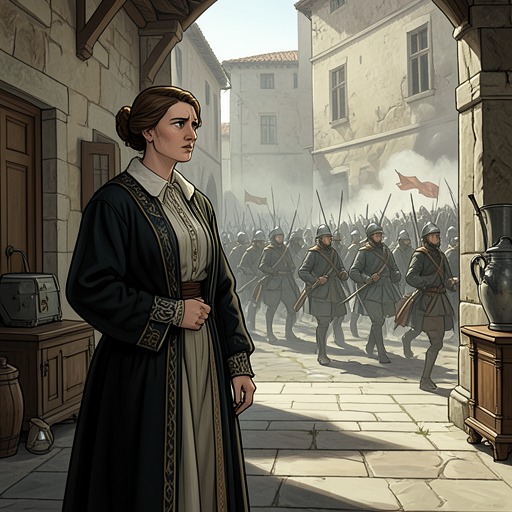
At five, Catalina experiences a fire in the Spanish camp while her parents are campaigning near Granada. Her mother rides out rather than remain with her daughter, explaining that the soldiers must see her or they may desert. Catalina is left with her nurse and told to behave as a princess. Watching her mother restore order, she learns that royal composure is not merely private self-control: a ruler’s visible resolve can steady others and help a frightened camp recover its discipline. When Isabella returns, Catalina is dry-eyed and steady, and her mother approves of her conduct.
That lesson becomes part of Catalina’s account of who she is. She remembers herself as a child who refused to cry out, born into a life of campaigns and raised by a woman who ruled in armor. She understands her future through the paired titles Princess of Spain and Princess of Wales, and imagines herself as destined to fight for her name, faith, and throne. Her parents, Isabella of Castile and Ferdinand II of Aragon, are presented to her as defenders of Christendom; their religious authority reinforces her conviction that the political orders made for her are also divinely sanctioned.
Marriage as a Mission
Catalina has been betrothed to Arthur since she was three. She expects to leave Spain for England at fifteen, become his wife, and eventually become queen. In her childhood conception, England is not only a new home but a realm she must care for. The marriage is therefore both a personal displacement and a political assignment: her place in Arthur’s household is meant to bind England to Spain.
Her mother gives that assignment a military meaning. She tells Catalina that conflict with the Moors will recur wherever it is fought, and that Catalina must make England ready and keep it safe, just as her sisters are expected to serve the lands of their husbands. Catalina internalizes this instruction as a duty to preserve the alliance and help extend the defense of Christendom. She believes that England’s wealth and ships could support Spain’s struggle against its enemies. In this worldview, a princess need not lead troops herself to be a warrior: marriage, loyalty, and the protection of a husband’s realm are also instruments of war.
The ideal reaches into Catalina’s understanding of dynastic marriage and motherhood. She regards producing an heir and securing the alliance as responsibilities owed to England and Spain, rather than simply as private matters. When she loses a child in her first pregnancy with Henry VIII, her grief is joined to a sense that she has failed her husband, her two kingdoms, and the promise she associates with Arthur. The episode exposes the cost of making a royal woman’s body carry dynastic and religious expectations: personal loss is interpreted through the political task she has been taught to fulfill.
Anointed Authority
Catalina’s coronation gives her childhood expectation a public and sacred form. On 24 June 1509, she travels from the Tower to Westminster in a cloth-of-gold litter, wearing white satin and a pearl coronet. After Henry VIII is crowned, she receives the holy oil, takes the scepter and ivory wand, and understands the anointing as confirmation that she has at last become the queen she was born to be. Her position is not simply a title beside the king’s: the ceremony presents her as an anointed ruler under divine protection, and the crowd welcomes her as well as Henry.
The ceremony also makes visible the tension at the heart of the warrior-princess ideal. Catalina’s authority is expressed through her own crowned and anointed body, yet her earlier instruction has defined her service through marriage and the defense of her husband’s country. When Henry leaves to campaign in France, he formally appoints her regent, governor of the realm, and captain general of the forces charged with home defense. The transfer of power turns the lesson of her childhood into an office: Catalina is entrusted with government and military command in her own right, not merely expected to influence England through her marriage.
From Perpetual War to Peace
Catalina’s exercise of authority brings the greatest change in her understanding of her mother’s teaching. After an English victory over the Scots, she considers the opportunity to devastate the defeated country and prevent its recovery for a generation. She then recognizes the logic as a trap: destruction would leave grievances to be inherited, and the next generation would face the same conflict. Looking back on her parents’ campaigns against the Moors, she concludes that their victories won battles but did not end the larger cycle of violence.
Instead of ordering an advance, Catalina directs that the Scottish soldiers be allowed to surrender their arms and go in peace. She intends to write to the Scottish queen, offering peace if she will act as a good sister and neighbor. Her response does not erase her upbringing or her earlier belief in a Christian struggle that might last until the end of the world. It changes what she takes that inheritance to require. The warrior’s courage remains, but it is redirected from punishment toward restraint and political settlement. In this reversal, the princess as a warrior for Christ ceases to mean readiness for unending war and becomes the capacity to refuse its recurrence.