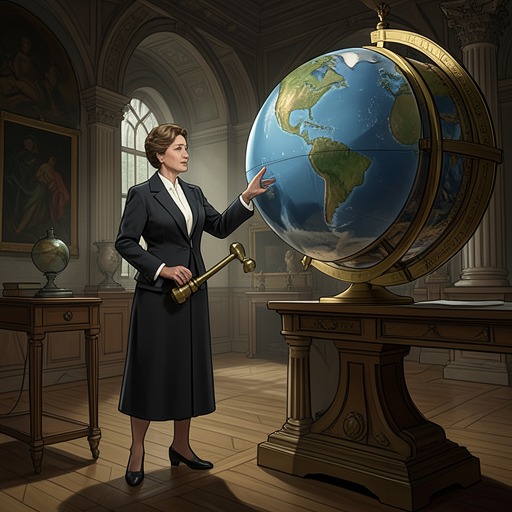
The rule of law and nation-building
The Constant PrincessThe rule of law and nation-building is the ideal Catalina and Arthur, Prince of Wales, imagine for a kingdom held together by common institutions rather than the private power of lords. Their program joins practical government—representation, accountable taxation, education, defenses, and accessible courts—to a moral question: can a country share one law without demanding one faith and language? Catalina’s answer changes as she confronts the consequences of her parents’ policies and later exercises authority herself.
Origins in Granada and the Moorish Example
Catalina’s political vocabulary begins in the world her parents have conquered. In Granada, she sees that Christian victors have benefited from Moorish learning, medicine, architecture, gardens, and water systems. The former Muslim rulers, she reflects, had taught their conquerors how to govern. Yet the Christian settlement contradicts the promise of coexistence made to Boabdil. The call to prayer is silenced, Jews are expelled, and Muslims are pressed to convert or face the Inquisition. The attempt to make one nation through one faith exposes a tension at the heart of state-building: unity may be imposed by force, but coercion destroys the trust that makes peaceful rule possible.
That contrast becomes a practical model for Catalina. She admires the Moorish example not because it changes people’s religions or languages, but because it establishes peace and law across a diverse population. At Ludlow Castle, she tells Arthur, Prince of Wales, that every man should know the law to be greater than his lord. In her account, the lesson of al-Andalus is that a ruler can make a country prosperous by restraining local power instead of remaking every subject’s beliefs. The ideal is not a rejection of royal authority; it is authority made answerable to a rule that reaches beyond the ruler’s favorites.
Welsh Disorder and Arthur’s Governmental Design
The need for such a rule is visible in the Welsh borderlands where the young couple live. After the evening entertainments at court, Arthur’s time is claimed by men seeking land, favor, and influence. Catalina does not yet fully understand the English spoken around her, and Welsh is still more unfamiliar. Beyond the court, the law barely operates: landowners act like warlords, petty lords dominate valleys and coasts, and in the high hills some people remain detached from the changed political order and obey no law. Arthur sees that royal intentions alone cannot govern a country fragmented into local powers.
His proposed answer is an institution for hearing and acting on knowledge from across the kingdom. Inspired by the legendary first Arthur, he imagines a council with a knight for each county, chosen by the county rather than selected for the prince’s personal liking. Each representative would report what was happening locally, including the risk of a failed crop, so that food could be sent before hunger took hold. County representation, in this conception, is not merely ceremony: it would make local conditions visible to the center and connect information to public responsibility. Arthur also wants council members to oversee defenses, especially in the north and along the coasts.
The couple extend that administrative vision to the crown’s revenue and servants. Arthur proposes that tax collectors be paid wages rather than allowed to collect for themselves, because private profit encourages bribery and lets officials’ families grow too powerful. Catalina points to Moorish schools and universities as a way to educate trustworthy clerks, including boys from poor families. She also proposes that parish churches teach reading and writing, with further study supported through colleges at the universities. The underlying principle is that government needs trained servants who owe their livelihood to the crown and their work to public administration, not to private enrichment.
Justice, Knowledge, and the Shape of a Country
For Catalina, building a country involves both institutions and knowledge of the people and land they govern. She insists that a queen must understand her country, including what farmers grow. Her own early misunderstanding of English field ditches—she thinks they carry water in, then learns they drain it away—makes learning the practical details of another country part of her education. She expects to ride out and learn, not to remain ignorant of the conditions on which ordinary life depends.
That attention to practical rule belongs to a wider plan. Arthur and Catalina imagine roads, markets, churches, schools, coastal forts, ships, and courts of justice. The courts are meant to ensure that no one is cruelly treated by another and that everyone can bring a case to be heard. Catalina’s ideal therefore joins public order to protection from arbitrary power: a legal system should not merely secure the crown or quiet the border, but give people a means of seeking redress.
Their conversations also distinguish common law from cultural sameness. Catalina considers her parents’ approach of one church, one language, and one law, then asks whether a country might instead have one law alongside many faiths and languages. She and Arthur read philosophy and politics, debate whether people can be trusted with freedom, and consider whether a king should govern as a good tyrant or restrain his own power. Arthur names their projected country Camelot. It remains a shared plan for a future reign, not a set of reforms the narrative shows them completing; its importance lies in the breadth of the government they mean to build and the principles they use to judge it.
From Dynastic Aspiration to Political Responsibility
Catalina’s early confidence in her parents’ example gives way to a more critical understanding. After remembering the compassion of a Moorish physician, she can no longer treat the Moors as merely barbarous enemies. She recognizes that they, like Christians, are fallible people who hold to their faith for reasons of their own. She also reconsiders her mother’s judgment: the persecution of Jews and Moors has driven away learning and skill, while policies Catalina once regarded as righteous have inflicted injustice. Her faith remains, but religious conviction no longer requires her to support a crusade or the persecution of people for their beliefs.
When Henry VIII appoints her regent as he prepares to sail for France, Catalina receives authority as governor of the realm and captain general of the forces for home defense. The appointment makes her imagined duty to rule immediate. In the Scottish campaign, she considers the advantage of pursuing a defeated enemy and leaving the country unable to resist for a generation. Instead, she reasons that devastation would produce hardship and renewed hatred: the enemy’s children would eventually fight her own. She orders the Scottish soldiers to surrender their arms and go in peace, and she offers peace to the Scottish queen if she will be a good neighbor. Victory, in her judgment, should be converted into lasting peace rather than used as permission for further violence.
This decision completes the concept’s movement from institutional design to political ethics. The youthful program asks how law can overcome local disorder; the later choice asks what lawful, responsible power should do after it has prevailed. For Catalina, neither administrative unity nor military success is enough if it perpetuates cruelty and conflict. Nation-building becomes a test of whether authority can secure justice, accommodate difference, and prevent one generation’s victory from becoming the next generation’s war.