Thomas Wolsey
The Constant PrincessThomas Wolsey is Katherine of Aragon’s right-hand man, royal almoner, and faithful assistant in the preparations for war. He turns the queen’s military plans into the practical work of musters, provisions, armor, training, and reports. His role also reveals a limit to their partnership: although he recognizes that Scotland may attack while Henry VIII is campaigning in France, Katherine keeps her larger intention from him. In a later hall scene, she sees him among the cardinals aligned with the king and remembers him as a betraying former ally.
Identity and Position
Wolsey appears first as an officer of the royal household entrusted with consequential work. Katherine calls him her right-hand man while describing his task of writing to towns across England to learn how many men they could muster for the king’s service. The work links the queen’s strategic purpose to local resources: before an army can march, its numbers must be known and its supply organized.
His responsibilities extend beyond correspondence. During the preparations for war, Wolsey and Katherine work together daily on muster rolls, provisions, the forging of armor, and the training of volunteers. He is therefore not simply a messenger carrying orders from the queen; he is a close administrative collaborator in assembling the force that Henry will take to France. The narrative later presents him as a cardinal, giving his red cardinal’s robe a stark visual contrast with his earlier identity as Katherine’s dependable assistant.
Preparing for War on Two Fronts
The French campaign is built around an alliance that depends on coordinated action. Under the treaty with Ferdinand, Spanish forces are to invade Guienne as English troops take Normandy, while Maximilian I, Holy Roman Emperor, is expected to join the northern army. Katherine’s account makes clear that the plan’s success rests on all three partners keeping faith and attacking together. Wolsey’s muster work serves that larger military design, but Katherine’s preparations also anticipate a danger the alliance does not resolve: the Scots may exploit England’s attention to France.
Wolsey notices that Katherine has two muster rolls, as though she were preparing two armies, and asks whether she expects to fight both the Scots and the French. She confirms her expectation. He then warns that Scotland will strike as soon as English troops leave for France and that the borders will need reinforcement. Katherine says she hopes to do more than reinforce them, but does not explain what she intends. His questions show that he grasps the strategic vulnerability; her silence marks the point at which her plans exceed what she is willing to share with him.
Wolsey also insists on the political constraint imposed by Henry’s priorities: the king will not be distracted from his war with France. Katherine agrees that Henry must be sent with a great force to Calais and must not be diverted. Wolsey continues to warn that men must be kept back to defend against the Scots. Their exchange exposes the dilemma behind the preparations: the queen needs to make the French expedition strong enough to hold the king’s attention, while also preserving the manpower needed to meet the northern threat. Wolsey identifies the danger openly, but he does not learn the full purpose of Katherine’s response.
Reports from the Campaign
Once Henry’s army is in France, Wolsey becomes a source of information for the queen. Katherine has messengers posted along the route, and Wolsey has strict instructions to report the campaign’s progress to her. She wants an accurate assessment, not merely the optimistic account she expects from Henry. His reports therefore give her an independent view of events as well as a means of following a campaign in which she has invested substantial administrative work.
The news from Calais is initially celebratory: the English army has arrived, there are feasts, parades, and musters, and Henry is praised for his armor and troops. Wolsey’s account also records that Maximilian has failed to muster the promised army. Instead, the emperor pleads poverty while professing support and offers his personal service to the young king. The contrast between the original promise of a force and the arrival of its ruler in person makes the alliance’s uncertainty concrete. Wolsey’s reporting supplies the facts; Katherine interprets them as evidence of the double-dealing that has shadowed the campaign and worries that Henry may pay dearly for the emperor’s service. At the same time, Maximilian’s presence means that an experienced ally will accompany Henry into battle, a reassurance Katherine draws from Wolsey’s news.
From Trusted Assistant to Accused Betrayer
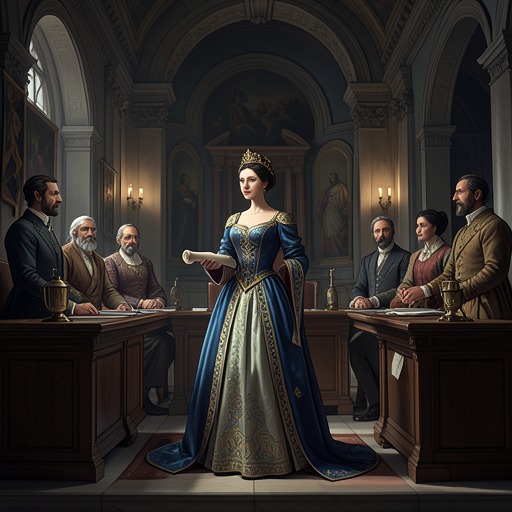
In the later hall scene, Wolsey is no longer presented through the practical work of war. Katherine enters and sees him below the king, seated with Campeggio as one of two cardinals. He wears a red cardinal’s robe, has a red face, and fails to meet her eye. Katherine interprets his posture and place in the hall as signs of betrayal; in her furious judgment, he has joined the king and the other cardinal in an effort to distress and break her. The scene records her accusation and perception, rather than independently establishing what Wolsey has done.
That reversal gives his earlier service a lasting significance. The man who once helped Katherine prepare for war and supplied her with reports now stands within a courtly arrangement she experiences as hostile. Her account does not explain the intervening change in their relationship, but it makes the rupture unmistakable: a trusted administrator has become, in her eyes, a betrayer. Wolsey’s narrative role rests on that contrast between competence and allegiance. His work supports Katherine’s command of military preparations, while his appearance beside the king’s cardinals embodies the political isolation she now confronts.