Titles and status of widowed royal women
The Constant PrincessThe status of a widowed royal woman in The Constant Princess depends less on her birth than on the husband and child through whom she holds a place in the dynasty. After Arthur, Prince of Wales, dies, Catalina of Aragon is told that she is no longer Princess of Wales but a dowager princess, and that her English future turns on whether she bears his child. The rule reduces a princess raised to expect a crown to her remaining title at birth; Catalina’s response is to preserve her claim inwardly and seek a way to recover the future she believes was promised to her.
Birth, marriage, and the title of Princess of Wales
Catalina’s sense of rank precedes her arrival in England. As a child, she understands herself as the daughter of Isabella of Castile and Ferdinand II of Aragon, and as a princess whose marriage to Arthur has been arranged since she was three. The match is not simply personal: she is expected to become his wife and, in time, queen. Her titles and prospects are bound together from the beginning, so the loss of her husband threatens more than a private future. It puts her political identity in question.
That identity is also a duty she has learned to perform. When she arrives in an unfamiliar country, far from her mother and unable to speak the language, she believes she must appear confident and protect the companions and servants who depend on her. She understands herself as serving both Spanish and English interests through her role as a dynastic bride. The title Princess of Wales therefore represents not only precedence, but the future she has been trained to inhabit and the political bargain she is expected to fulfill.
Widowhood and conditional status
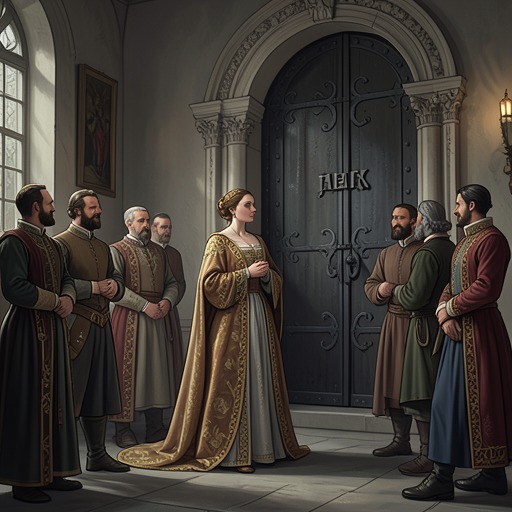
After Arthur’s death, the distinction between Princess of Wales and dowager princess is made explicit. Catalina insists that she has been Princess of Wales all her life; Lady Margaret Beaufort answers that she is now a widow and will be called Dowager Princess. Catalina recoils from the title and says she will not answer to it. Lady Margaret explains that it is the English designation for a widow, but the exchange makes clear that a change of marital status is also a change in rank.
The court’s uncertainty about whether Catalina may be pregnant makes that change conditional. If she bears a son, Lady Margaret tells her, the child will become Prince of Wales and then King of England, while Catalina will be known as the King’s Mother. If there is no child, Henry VII’s younger son becomes Prince of Wales; on Henry VII’s death, that prince will become king. Catalina asks what position would remain for her, and Lady Margaret indicates that she would have little beyond her identity as an Infanta. The future queen, in that outcome, would be the new prince’s wife. A possible child would thus determine not only succession, but whether Catalina could retain a central place in the English royal family.
Her mother’s instructions translate this uncertainty into practical terms. Catalina is to remain in the house provided for her until her next menstrual course makes clear whether she is pregnant. If she is not, she is to have Dr. de Puebla claim her jointure as Dowager Princess of Wales and sail to Spain only after receiving the full sum. If she is pregnant, the dowry money is to be paid at once, she is to secure an allowance as dowager princess, and she is to rest in hope of a boy. She is also instructed to report her condition and remain under Doña Elvira’s chaperonage. Mourning, residence, money, and the possibility of a child all become parts of the same status negotiation.
Birth title, marriage, and constrained choice
Lady Margaret sets Catalina’s predicament within a broader rule: a woman takes her position from her husband, and without a husband or son she has only the rank into which she was born. She also describes her own life as an example. Her royal blood had been diminished through a low-status marriage so that she could pose no threat to the Tudor throne. Her brother, Edward Plantagenet, Duke of Warwick, was imprisoned in the Tower of London for being born a prince; Lady Margaret says that refusing marriage would have placed her in danger as well. Marriage offered her a chance to change her name and avoid sharing his fate, but it also cost her the possibility of becoming queen.
The comparison clarifies why Catalina cannot treat widowhood as a simple return to her former life. If she went back to Spain and married an archduke, she says, she would become Archduchess Catalina rather than Princess of Wales, and would never be Queen of England. Lady Margaret acknowledges the likeness between their situations. Both women face a narrowing of political possibility through marriage, but Catalina refuses to accept that her original title and English future have ended. Lady Margaret counsels acceptance of what has passed; Catalina insists that she will find a way to fulfill her destiny.
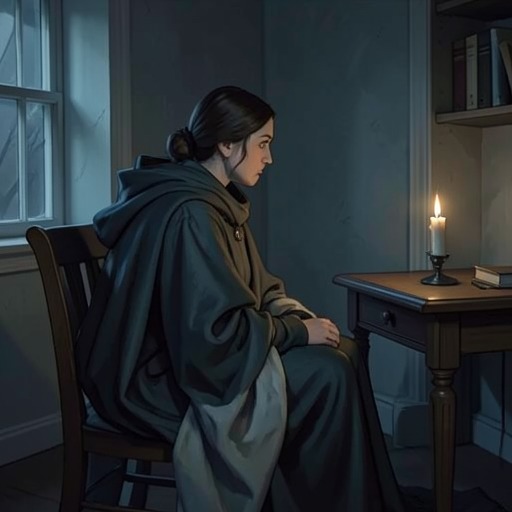
Catalina privately holds to the identity the court is withdrawing from her. She resolves to remain Princess of Wales in her heart until she sees her son married and her daughter-in-law crowned, and connects that resolve to Arthur’s belief that even a princess by birth may have to claim her title. She knows she is not pregnant, but does not tell those who repeatedly ask. Instead, she considers how to preserve her position and keep the promise she associates with Arthur. Her silence is political: while others wait for information that could decide her rank, she withholds it and prepares to act.
From dowager to queen and regent
The story later shows that widowhood’s loss of standing is not the final measure of Catalina’s political capacity. After marrying Henry VIII, she works with the Privy Council on law, coastal defenses, ships, and army musters, while the king neglects the business of the realm. Her education at the court of Isabella of Castile and Ferdinand II of Aragon has prepared her for government; in England, she takes responsibility for practical affairs and gains influence among courtiers who recognize that she attends to the kingdom’s needs.
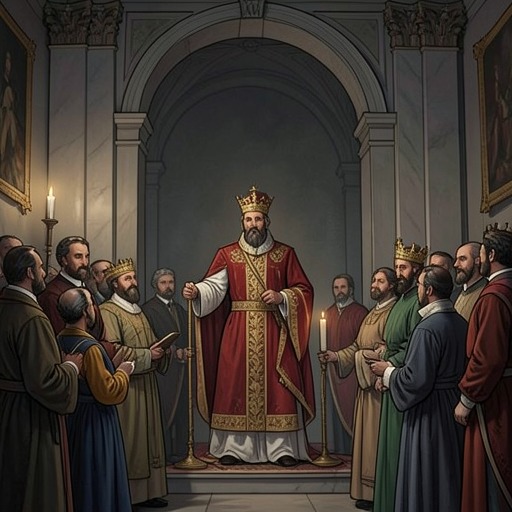
When Margaret Beaufort dies, the court lacks someone who can organize the royal funeral. Catalina consults the Royal Book, finds Margaret’s handwritten funeral instructions, reduces their scale, and gives the necessary orders. The ceremony establishes her authority before her coronation: courtiers who had overlooked her during years of poverty come to regard her with respect. On 24 June 1509, she is crowned Queen Katherine of England after Henry VIII. The ceremony gives public form to a status she had once feared would be lost: she is again a ruling queen, not a dependent widow whose place rests on an uncertain pregnancy.
Her authority later becomes formal as well as ceremonial. Before Henry VIII sails for France, he invests her with the Great Seal of State and appoints her regent, governor of the realm, and captain general of the forces for home defense. She reviews five hundred troops, making sure each man can see that she has inspected the ranks, and addresses them as their English queen. The appointment is a sharp contrast with the conditional position described by Lady Margaret: Catalina’s authority now comes through an office granted by the king and is exercised in the realm’s defense.
The title as a claim
The rule is most severe when Catalina has lost Arthur but has not yet secured another place through marriage, motherhood, or office. It treats female royal standing as relational: a husband or son can elevate a woman, while their absence can leave her dependent on birth alone. The distinction between Princess of Wales, dowager princess, Infanta, archduchess, queen, and regent marks changes in political circumstance, not merely changes in forms of address.
Yet Catalina does not regard the title as only something granted by others. Her inward refusal to surrender the Princess of Wales identity anticipates her later insistence on her standing as Queen of England. When summoned to the marriage tribunal, she enters despite having made clear that she does not recognize the court. She bases her position on her claim that her marriage to Arthur was real and that she is entitled to remain Henry’s queen. The novel thereby places a woman’s testimony and self-assertion against a court deciding the validity of her status. Widowhood exposes how precarious a royal woman’s position can be; Catalina’s later conduct shows her turning that precarious inheritance into an active claim.